Total Pageviews

Showing posts with label occurrences. Show all posts

Thursday, June 7, 2012

Gold Occurrences in Benin


Map of Benin


Mineral resource development is controlled by the Office BĂ©ninoise des Mines (OBEMINES). Benin has been revising its mining laws in order to attract foreign investment.

Benin has gold, iron ore and phosphate potential and has awarded several exploration licenses for gold exploration in the country to foreign investors. There are deposits of brick and china clay, feldspar, the Loumbu Loumbo low grade iron ore deposits and the Mekrou phosphate deposits. The development of the Loumbu Loumbu and Mekrou deposits hinges on the proposed development of a hydro electric power scheme that is to be constructed on the Mekrou River. Gold mineralization has been identified in the Atacora and Alibori regions, where hard rock and alluvial deposits are known to exist. At Alibori, a 350 km2 prospective area includes alluvial and vein hosted gold occurrences.

Major sources of alluvial gold and diamonds can be found in the Birimian rocks that are found in Ghana, the Ivory Coast, Mali and Burkina Faso   These rocks derive their name from the Birim River thay are one of the main tributaries of the Pra River of Ghana.  The same rocks also contain the country’s most important diamond deposits.  Diamonds are produced in Ghana and Mali that are the second and third largest producers in Africa.

The gold and diamond bearing rocks are called the Birimian Terranes that are composed of a mix 0f meta-volcanics, meta-sedimentary and rocks that are plutonic in nature.  Almost half of the rocks found in the southern part of the West African Craton are alkaline granites.  These rocks formed in a period of about 50 million years between 2,200 and 2,100 Ga years ago.

It is believed the Birimian Rocks that stretch across the countries that are to the north of the Gulf of Guinea formed when a series of island arcs were driven together forming a series of parallel belts that trend to the northeast in a belt that is about 40 to 50 kilometers wide.  Many of the volcanic rocks have been metamorphosed into greenschist facies.

Although most of the gold mined in the country is recovered by artisanal miners from the Birimian Terrane it has recently discovered more gold is found in the overlaying conglomerate of the Tarkewian formation.  The gold does not have its origin in the Birimian Terrane. 

There are several varying theories about the origin of the Birimian Terrane.  One theory holds the rocks were formed by the collision of the Archean Cupixi-Carajas craton of the Southern Guiana Shield.  Another theory that is more widely accepted is the terrane has it origins in a mid-oceanic series of volcanic island arcs that formed a crust that was then thrust faulted onto the West African Craton that was later compressed into a series of folds.

During the recent civil war in Benin foreign investment literally dried up, but with the onset of peace it is beginning to flow once again.

Wednesday, May 16, 2012

Gold Occurrences in the Argentine


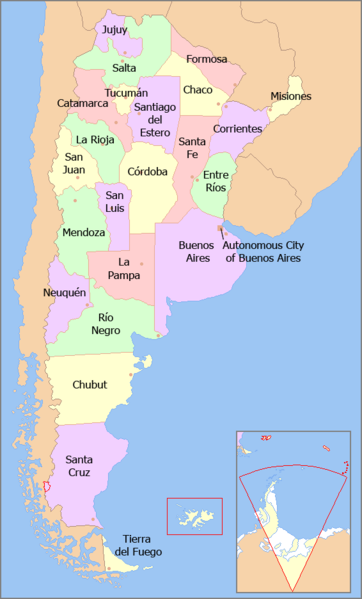
Map of Argentina.  The provinces in the far west of the country are most apt to contain gold
By Bliff


Although an ocean separates them Argentina has a neighbor the country of South Africa that although they were split apart with the opening of the Atlantic Ocean during the Cretaceous millions of years ago they share much in common.  Forty percent of all the gold that has ever been mined comes from the Witwatersrand in South Africa that leaves the question are like gold deposits to be found in the rocks of Argentina.  The very name of the country is derived from the Latin word for silver “argent” hence Argentina.

Argentina overhauled its protectionist mining laws in 1993 causing gold production to rise in a parabolic curve from a mere 36,000 ounces to over 1 million ounces.  This change in the laws has made Argentina the third largest producer of gold in South America.  This number was only exceeded by Peru and Brazil, respectively.  Only Argentina has seen as dramatic a rise in recent years.

Only in Argentina has the level of gold production raised in recent years with the production of gold having peaked in the other countries.  These points out the fact that unlike the others Argentina’s gold fields are from being mature is respect to their development cycles.  Argentina’s wealth of buried gold is yet to see any meaningful development translating into a booming domestic gold industry with a pronounced growth curve.

In area Argentina is the second largest country in South America that is 1,580 kilometers from east to west and 3,460 kilometers from north to south.  To its west it borders Chile along the crest of the Andes.  The country has well over thirty volcanoes that also follow the Andes which have supplied the heat engines necessary to forming deposits of gold dissolved in their hydrothermal waters.

The presence of placer gold in the rivers and streams draining the eastern slopes of the Andes Mountains are known to contain large amounts of placer gold.  Some of the deposits that have been found are supposed to exceed 1 million ounces of gold.  Some of this gold is pristine crystals giving weight that gold nuggets are caused by gold fixing bacteria.  Much of this crystalline gold is as high in content as >98% pure gold, some of the purest in the world.

Lode gold is often associated with arsenopyrite and copper sulfides the normal byproducts of hard-rock gold.  Another element often associated with the gold from Argentina is mercury that may explain why the placer gold has such a high percentage of gold because the mercury left over from past mining operations has dissolved the residual silver.  There are lode deposits the length of Argentina in the spine of the Andes Mountains.

Friday, May 4, 2012

Gold Occurrences in Brazil


Coat of Arms of Brazil


Within its borders Brazil is the fifth largest country in the world; it touches upon all the countries in South America except Ecuador.  The country also has an astonishing variety of mineral deposits including iron, gold, gemstones, diamonds and oil.  There are literally hundreds of active mining companies found in Brazil.  Brazil also enjoys a rising economy and has a stable government with the future for mining being extremely bright.

The Amazonian shield covers much of the eastern portion of the South American continent and provides many of its gold mines.  Prospecting in the area is similar to prospecting in Canada’s Abitibi Gold Province in Ontario with a repeat of its greenstone belts with alternating gneiss’s.  There are also many deposits of turbidite hosted paleo-gold deposits similar to those found in the Witwatersrand in South Africa.  To the north of the Amazonian shield is the Guyana shield, to the south are the Rio Apa and Platian cratons and in the west is the Sao Francisco craton.  All of these areas are gold bearing.

Brazil covers 8.5 million square kilometers with 7,500 kilometers of coastline making it the largest country in South America, a size that dwarfs all its neighbors.  Its size is on continental size contains a vast resource base making it a prime target for attracting foreign investors and miners as well as Brazilian mining companies.  The country also has a long history of gold mining dating back into the 16th century.

It is estimated that less then 30% of the country has been adequately mapped so there is plenty of room for prospecting in both placer and lode gold deposits. Placer deposits can be found throughout Brazil except in the depths of the Amazon Basin, and there are plenty of gold deposits found in the Precambrian Shield areas that dot the country.

One of the biggest problems facing the Brazilian mining industry are the number of artisanal mining operations that keep popping up; there was a gold rush in the 1990s that centered on the Guyana shield that reportedly attracted over 90,000 miners to the area.  These miners for the most part disregarded good environmental practices resulting in large areas that were contaminated with mercury and other contaminants.

It has been found that artisanal mining is today the largest source of mercury release into the environment not only in Brazil but other countries too.  One of the sites mentioned that is the largest is in the Tapajos River Basin in the Amazon region of Brazil.  The Global Mercury Project (GMP) under the auspices of the United Nations is aiming to reduce this mercury contamination.

Brazil as a whole is mining friendly and enjoys a now stable government and a rapidly expanding economy that welcomes miners from around the world.  There are still vast amounts of the country that have not been explored, so one never knows what might be found just around the next bend of the river.

Friday, March 23, 2012

Gold Occurrences in Chile


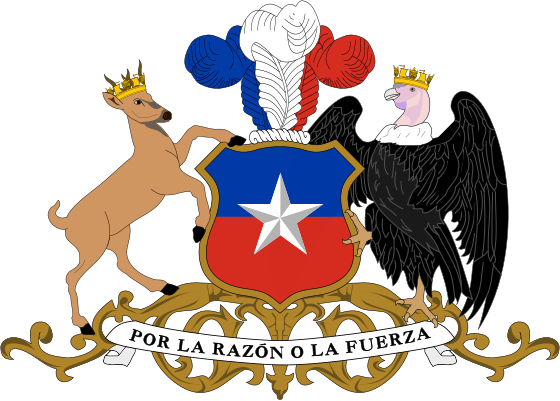
Coat of Arms of Chile
by B!mbo

Whenever anyone thinks of Chile they immediately think of copper since it is the largest producer of copper in the world, but many of the copper deposits have gold and silver as trace metals.  A recent statement by the Chilean Copper Commission (Cochilco) says their country’s production of gold could triple by 2015 making the country one of the top producers in the world.  Currently Chile’s gold production is pegged at 39.2 tonnes, however new developments and expansions of existing mines could cause output to swell to 103 tonnes by 2015.  This figure may be an underestimation as there are other gold mining projects waiting in the background.  Most of the gold produced in Chile comes from the production of copper as a byproduct.

There are several mining companies involved with this surge in gold production with the most notable being Barrick with its Pascua Lama project.  This does not include several other gold mining projects that are waiting in the wings.  Recent discoveries of gold/copper mineralization have been found in the high Andes that have become viable because of the high rise in gold and copper prices.  The biggest hurdle facing miners is the lack of or shortage of capital for developing these gold finds that sometimes can cost billions of dollars to get them into production.

Most of these projects in the high Andes are found above the 4,000 meter line making them difficult to mine as operations are hard on both personnel and equipment.  Some of these projects are centered on banded quartz projects carrying in places high anomalies of gold.  Other projects are to be found in gold bearing porphyry that has a lower gold content, but because of the vast volumes of rock present high tonnage, low grade projects.  At present the main target of the explorers is at La Falda that is a near-surface porphyry having associated epithermal gold-silver. 

Chile is not as famous for gold production then either Mexico or Peru exploration of the country by the Spaniards was financed with the placer gold that was discovered there.  In 1810 an the eve of its independence Chile was producing as much gold as Mexico and Peru combined.  In the 16th century from the founding of Santiago in 1541 gold from placer deposits mainly in the southern part of the country produced up to 2 tonnes of gold annually. This mining came to an abrupt end when the Spaniards were evicted by the local Indians.

A second cycle of gold production started at about 1740 that were mainly based on vein mining.  The gold was recovered using trapiches and mercury to recover the gold.  This production peaked with the production of 3 tonnes in 1810.  There were several areas that were producing gold with the most prominent being located at Andacollo and other areas.  Gold production in all areas declined during the War of Independence that was finally reached in 1823.


Thursday, March 22, 2012

Gold Occurrences in Peru


Coat of Arms of Peru
By Hunsun

Located high in the Andes of Peru, Newmont operates the largest gold mine in South America, the Yanacocha mine.  This mine has three active pits with the production exceeding 26 million ounces of gold.  The Yanacocha mine high in the Andes opened in 1993 with Newmont owns 56% of the mine with the balance held by Cia de Minas Buenaventura SA, this is Peru’s largest producer of precious metals.  This year, 2012, the mine is expected to produce 1.5 million ounces.

Another mine operated by Goldfields is the Cerro Corona mine a large open pit mine located in the highest part of the western Cordillera of the Andes in the northern part of Peru contains a copper-gold deposit estimated to contain about 8.7 million ounces of gold equivalent.  The concentrate produced by the flotation process leaves Peru from the port of Salaverry for smelters in Japan, Korea and Europe.  There are several other mining companies working deposits around Peru.

Placer mining was started by the Incas or other tribes long before the coming of the Spaniards, and continues until today.  The gold is found in virtually all the rivers flowing east or west of the Andes Mountains, but most of the operations are artisanal with a lot of small operators.  There is some illegal mining operations with an occasional town springing up in the middle of nowhere if there are especially rich diggings.

The mineralized area in Peru is limited to the Andes Mountains a narrow strip of land along the Pacific Coast a little over 100 km wide. It is within this area that is an active convergent margin hosting a diverse number of some of the world's richest gold, copper, zinc, lead and silver deposits. Many of these are world-class deposits that are currently being exploited. Much of this mineral wealth as a result of my impulses during key times within the past 70 million years with the geological setting a major deposit being related to structures that have been active since the early Paleozoic.

This narrow belt along the coast of South America is a good example of a metallogenic province that mainly is the result of a 240 million year old history of subduction related tectonics along the western margin of the Brazilian Shield that began in the early Triassic and continues to this day. This is than a continuous cycle of east directed subduction beneath the South American plate called the Andean cycle that is formed a linear volcanic and plutonic arc that has a landward back arc basin in eastern side of Peru.
During this period of 240 million years magmatism in the area was episodic that was regularly disrupted by shortening events causing the inversion of the back arc volcano sedimentary sequences along with the migration of the center of volcanism and intrusions.

The major ore systems in Peru are associated with arc-related igneous and volcanic rocks. It was this activity along the continental margin where the early episodes are dominated by copper -- gold minerals that are close to the subduction trench. The sequence of minerals progressed eastward to zinc -- lead then further eastward into tin -- tungsten. There is a regular sequence of mineralization as you get further way from the edge of the continent.

Wednesday, March 7, 2012

Gold Occurrences in Haiti


Coat of Arms of Haiti


When he was asked to describe what kind of land was to be found in Haiti Christopher Columbus picked up a piece of paper crumpled it and dropped it on the table. This was the kind of land they had in Haiti he told them it is extremely mountainous as well as the land in the Dominican Republic where just over the border from Haiti they actually have mountain peaks that are more than 10,000 feet high. The Gold occurrences in Haiti have been mainly discovered in the northern mountains of not only Haiti but the entire island of Hispaniola that also includes the Dominican Republic.

The rocks and the entire island of Hispaniola are no older than the Cretaceous Period although on and off laying island from the main island there are some rocks that are arguably from the Paleozoic era.  First gold mines on the island were established by the Spaniards in 1520. It was these gold mines that led to the extinction of the Arawak Indians on the island because the Spaniards used them as slaves to work the mines. The very name Haiti is one of the few words that have survived the Arawak Indians, it means mountainous place.

Once the Spaniards discovered the tremendous amounts of gold to be had in Mexico Gold mining operations in Haiti came to an ending and for centuries Gold Mining almost ceased on the island. Gold was recently rediscovered in Haiti along with other base metals in booting copper and zinc. These deposits are now being explored by many prospectors and mining companies from the US and Canada.

Since the gold mining industry has reestablished itself in Haiti there has been a growth of artisanal mining throughout the country. And there are gold buyers that make you regular circuit of the country buying gold from the miners in what has been described as a circus atmosphere somewhat reminiscent of a flea market. There are many places where gold has been found in hard rock deposits, but there are many places where it can also be found as placer gold.

One of these deposits located at Grand Bois is estimated to contain over 4,000,000 tonnes of ore that averages 1.9 g per tonne. The gold is found in the oxidized zone near the surface of the earth making it extremely amenable to open pit mining. There are other deposits of gold found throughout the northern part of the island, but Grand Bois is the largest. Most of the gold of his been discovered is in the vicinity of where two fault lines intersect. Copper is another metal that his been found on the island in considerable amount that may prove to be more monetarily rewarding then the gold deposits.

Wednesday, August 24, 2011

Gold Occurrences in New Zealand


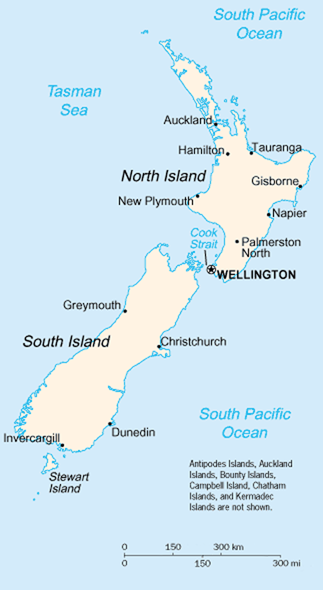
Map of New Zealand


There are several different types of gold deposit that are found in western New Zealand.  Orogenic gold deposits are found in both fault and shear zones at all crustal levels in quartz veins found within and around brittle ductile transition zones. 

The framework of New Zealand is controlled by two major faults the Wellington fault in North Island that terminates at the Bay of Plenty to the south coast, and the Alpine Fault that traverses South Island. New Zealand was rifted from Australia millions of year ago.  There is a subduction zone to the east that today drives the volcanoes found on the west side of North Island.  It is these volcanoes and earlier volcanism that has formed the gold deposits of the Islands.

Together these two faults represent a suture zone that runs the length of the islands.  It is a well known fact that many metal deposits are found associated with suture zones, and that is true in New Zealand.  Another mineral that is often found in suture zones is nephrite that is commonly called jade.  Jade is found in areas of high pressure-low temperature metamorphism commonly in blue schist grade rocks.

These deposits originated ranging from 3 km to 12 km deep with hot water from 200o to 400o C.  The gold deposits were brought to the surface by earth movements and erosion. The gold deposits are found mostly in regionally metamorphosed Paleozoic sediments that are found including those found at Golden Blocks in the northwest at Nelson, Reefton and Lyell.  Other deposits are found at Preservation Inlet in Fiordland where gold bearing quartz veins are found dipping steeply and are generally striking parallel to the axes of folding in greywacke and argillite slate host rocks.  Most of these veins are found to de discordant to the bedding. 

The lodes in these locations are usually less then a meter wide and 200 meters long.  The Birthday Reef at Blackwater, Reefton is the largest quartz vein found in the Paleozoic rocks.  This vein averages about 60 cm wide and has been mined for a distance of 1070 m that extend to a depth of 830 m.  There is also disseminated gold deposits that are next to the quartz lodes at Globe-Progress as well as others at the Reefton deposits.

There are also deposits of gold found in the Mesozoic rocks in the schist of the Otego and Marlborough as well as the greywacke found in the Southern Alps.  Here the lodes are typically lensoidal in shape that are rarely more then a meter wide and are localized along single or multiple shear zones that are parallel that usually dip steeply and are discordant to the bedding of the country rocks.  One exception is a lode vein found at McRaes where the deposits are found in the Hyde McRaes shear zone.  These gold bearing veins have a strike of more 25 km.

Many of the gold deposits are found in saddle reef deposits similar to those found in eastern Australia where they occur as veins of quartz that approach near horizontal deposits of quartz found parallel to the bedding planes in turbidites ranging in age from Silurian to Devonian in age.  A good example of this kind of deposit can be found at the Hill End Gold Field in New South Wales.  This deposit was developed in regional metamorphism over a considerable length of time.

Gold deposits can be found the length of New Zealand, but are mostly found on the western side of the islands.

Wednesday, April 20, 2011

Gold Occurrences in South Dakota

Before it closed in 2002 the Homestake Mine in Lead, South Dakota was the deepest gold mine in North America. It had operated almost continuously since 1874 where the gold was found in association with cummingtonite schist. The depressed price of gold at the time the mine was closed in 2002. The mine has been since converted by the National Science Foundation into an underground laboratory devoted to the search for neutrinos and other subatomic particles from space.

Until the recent discoveries of large gold deposits in the Carolinas and Georgia South Dakota had the distinction of being the eastern most state that was a large producer of gold. It also has the distinction of having a war between the Indians and Whites over the gold deposits in the Black Hills, an area that was considered sacred by the Sioux. This led to the Battle of Little Bighorn in eastern Montana where the 7th Cavalry under George Armstrong Custer was virtually wiped out by the Sioux warriors.

Airforce One flying over Mt. Rushmore in the Black Hills of South Dakota

Within a year of the Battle of Little Bighorn the Black Hills were swarmed with thousands of gold seekers. Although gold was known to occur in the Black Hills it was not a safe place for white men to venture because it was considered as sacred ground by the Sioux. The gold discoveries came fast and furious until he finally culminated in the discovery of the Homestake mine in 1876.

During the early days of the gold rush in the Black Hills mostly action was centered around Deadwood where the famous Western gunfighter Wild Bill Hickok was gunned down while playing poker holding the dead men hand of aces and eights.  It wasn't too long before gold was discovered on the other side of the mountain in Lead that was developed into the Homestake mine. The mine is now owned by Barringer Gold and they have not decided to reopen gold-mining here, but there were plenty of other gold mines in the Black Hills that over the years also produced gold.

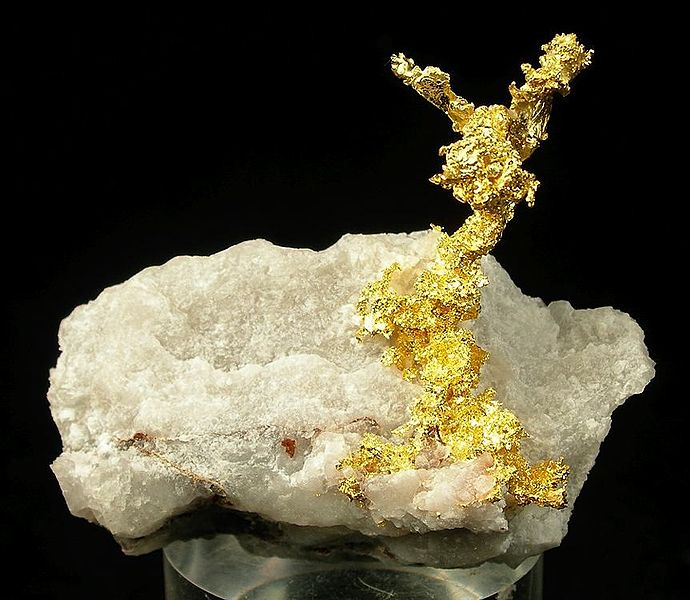
Crystalline Gold from South Dakota

There are still plenty of opportunities for small-scale miners in the Black Hills, but you have to keep in mind that the early prospectors were pretty thorough in their search for gold. What they lacked were some of the modern devices for finding gold that we now have. These new devices make it possible to find gold that the old-time prospectors missed. Placer gold can be found in many of the rivers and streams of the Black Hills as well as rivers that lead out of the Black Hills.

Another place where metal detector comes in handy is prospecting in rivers and creeks. Every year more gold is eroded from the banks of creeks that finds its way into the water courses. This does not mean that you shouldn’t overlook the use of more conventional tools like gold panning kits and dredges for mining placer gold.
The other gold that is present here is what is termed lode gold that is found throughout the bedrock of the central Black Hills. This is an area of pre-Cambrian rock that was thrust up through the sedimentary rocks that surround it by earth actions in four different geologic episodes in the past.
Erosion from the rocks of the Black Hills has reached as far east as Minnesota in the form of a conglomerate. Gold is often associated with conglomerates as fossilized placer deposits. The conglomerates east of the Black Hills may prove to be another area containing gold. The largest gold mining district in the world is the Witwatersrand in South Africa that has produced more gold than all the other mining districts in the world combined is also hosted by an ancient deposit of conglomerate.

Sunday, March 13, 2011

Gold Occurrences in Ohio

Gold does occur in Ohio in the glacial drift that covers the state where it has been brought down from Canada by two separate episodes glaciation the Wisconsinan and the Illinoian in the past 300,000 years. There is no lode gold in Ohio because the crystalline bedrock of the state is buried beneath thousands of feet of sedimentary rocks. Since the crystalline basement rocks are an extension of the Canadian Shield it is safe to assume that there is gold bearing mineralization under the overlying sedimentary rock as there is in the Abitibi gold belt to the north in Canada.

Glacial Deposits in Ohio
By Ohio Geological Survey


All the gold that is found in Ohio is placer gold that was brought down from the Abitibi region of Ontario during the last two ice ages that is widely distributed all the way from Lake Erie all the way to the Ohio River. The placer gold deposits in the state cover about two thirds of its area and even they are covered by younger lake bottom and wind borne deposits. Just about any river or stream in Ohio has the capability of carrying placer gold. Although gold is not plentiful in Ohio there is enough to attract the interest of many part-time gold miners and prospectors.

The discovery of gold in Ohio probably dates back to the return home of some California gold miners that started exploring the local rivers and streams for placer gold, and found some. The most plentiful gold in Ohio is found in the deposits that were laid down in front of glaciers in areas that are called terminal moraines. Just about any flowing water in this area will have gold bearing sands.

The glacial map of Ohio narrows down the most likely places to find gold in the state so study the map carefully. This map is available from the Ohio Geological Survey in a much more readable scale than is possible on the computer. They also publish a paper called GeoFacts No, 9 that is titled “Gold in Ohio” that should be read by any goldseekers that want to find gold in Ohio. and the Illinoian in the past 300,000 years. There is no lode gold in Ohio because the crystalline bedrock of the state is buried beneath thousands of feet of sedimentary rocks. Since the crystalline basement rocks are a seller and extension of the Canadian Shield it is safe to assume that there is gold bearing mineralization under the overlying sedimentary rock as there is in the Abitibi gold belt to the north in Canada.

All the gold that is found in Ohio is placer gold that was brought down from the Abitibi region of Ontario during the last two ice ages that is widely distributed all the way from Lake Erie's all to the Ohio River. The placer gold deposits in the state cover about two thirds of its area and even they are covered by a younger lake bottom and wind borne in deposits. It just about any river or stream in Ohio has the capability of carrying placer gold. Although gold is not plentiful in Ohio there is enough to attract the interest of many part-time gold miners and prospectors.

The discovery of gold in Ohio probably dates back to the return home of some California gold miners that started exploring the local rivers and streams for placer gold, and found some. The most plentiful golden Ohio was found in the positives that were laid down in front of the glaciers in areas that are called terminal moraines. Just about any flowing water in this area will have gold bearing sands.

The glacial map of Ohio narrows down the most likely places to find gold in the state so study the map carefully. This map is available from the Ohio Geological Survey in a much more readable scale than is possible on the computer. They also publish a paper called GeoFacts No, 9 that is titled “Gold in Ohio” that should be read by any goldseekers that want to find gold in Ohio.

Thursday, March 3, 2011

Gold Occurrences in Virginia

The first printed reference the gold being found in Virginia was in 1782, when it was reported by Thomas Jefferson involving a 4 pound piece of gold bearing rock that was found on a north side of the Rappahannock River at a distance of about 4 miles below its falls. This was only the first report because gold was produced in Virginia amounting to about 100,000 troy ounces dating from 18 42 1947 when the last of the over 301 gold mines and prospects in the state closed down.

Alluvial (Placer) Gravel containing placer gold.
Photo by Dennis Garrett

The bulk of this gold was discovered in the so-called Gold-Pyrite Belt that essentially includes the Piedmont and the eastern slopes of the Blue Ridge Mountains. By May of 1995 the division of mineral resources had documented 301 mines and prospects producing gold and silver or places where they are known to have occurred.

Besides the placer deposits that are found in the areas of the Piedmont and Blue Ridge Mountains that contain gold; it is also found as free gold in quartz veins, or it may occur with pyrite as thin films on the crystal faces between individual pirate crystals. Gold also is known to occur as an alloy with other base metals in various massive sulfide deposits. It is the weathering of these kind of deposits that produces placer gold that can occur as grains, flakes or sometimes even nuggets of free gold.

The first lode deposit of gold that was discovered in Virginia occurred during 1806 at the Whitehall mine that was 1.5 miles to the northwest of the Shady Grove Church in the western part of Spotsylvania County. The Virginia Mining Company of New York has the title of being the first mining company in Virginia to produce lode gold. This company operated a lode deposit of gold in the so-called “Grasty” tract along Mine Run in Orange County for over 100 years from 1831 to 1934 of over a century. Old records show that at least five mining companies operated in the general area in period from 1831 until 1910 having several different episodes of substantial mining activity.

During the early 1800s: Virginia was often extracted from what are termed shallow saprolites that were formed by deep weathering of the rock that contained lode gold. The type of gold mining that occurred in these deposits was relatively simple because labor was cheap so they were able to use hand shoveling; panning, sluicing and dredging that could be accomplished without any further processing. This type of deposit is able to produce gold at a profit in 1837 if there was a dollar's worth of gold available from every bushel of ore. At the time it was estimated the cost of mining 100 pounds of rock was about $.35 per bushel. Deposits of this type were mined until the deposits were exhausted.

Once saprolite deposits were used up the miners had to resort to underground mining methods for the recovery of gold. Operating in underground gold mine is far more expensive than working placer deposits because the ore is in the form of a hard rock that has to be pulverized before any kind of recovery system can be used. During the decades preceding the Civil War it has been estimated that lode gold mines of Virginia produced about 3000 ounces of gold every year.

It was the California Gold Rush of 1849 that really spell the death knell to gold mining in Virginia because many of the miners moved to California allowing gold production in Virginia to decline. During the Civil War gold mining operations throughout the South were destroyed as a matter of policy by the Union Army.

During a meeting of the Prospectors and Developers Association of Canada (PDAC) in early March of 2008 the author was speaking with some other mining executives where it was revealed that one of the main targets for exploration in the near future would be in the southern Appalachians. Even if the big boys haven't arrived yet there are hundreds of part-time gold miners that have been combing the hills and valleys of Virginia for gold.

Wednesday, February 23, 2011

Gold Occurrences in Pennsylvania

Pennsylvania has a long and rich tradition of mining especially for anthracite and bituminous coal as well as iron. What is not generally known however is the state is also produced a considerable amount of gold. It has a well-trained workforce of miners many of whom have a tendency to be prospectors. Because of this some iron miners down around Cornwall have actually produced more than 61,000 ounces of gold while they were mining the magnetite iron ore. Aside from the mine at Cornwall another mine that reportedly produced gold from magnetite was the Grace mine in Morgantown.

There were a series of three openings to the iron deposit in Cornwall located at Big Hill, Middle Hill and Grassy Hill that were originally owned by the Cornwall Ore Banks Co., but were eventually owned by Bethlehem Steel who eventually closed the mines in 1979.  This deposit of magnetite was produced by the replacement of limestone by hydrothermal activity during the Jurassic from a diabase intrusive, so in effect the deposit is a skarn.

The eastern part of the state is covered with crystalline rocks producing potential gold lodes as well as placer gold. This gold weathers out of the crystalline rocks and is collected in the rivers and streams of eastern Pennsylvania. This is not the only source of gold however, in the northern part of the state the last glacier left placer gold in the terminal moraines found in Pennsylvania.

There are several streams producing placer gold that came in Lancaster and York Counties in glaciers that have advanced into the state during the past million years. Any of these glaciers were capable of bringing gold down from Canada where one of the richest gold belts the world the Abitibi is found in Québec and Ontario. According to some geologists there have been as many as 24 episodes of glaciation that have affected the northern part of the United States in the past 2.5 million years.
Although the eastern part of the state is mostly covered with crystalline rocks that produce gold as lode gold that weathers out so it becomes placer gold that collects in the rivers and streams found in eastern Pennsylvania.
One of the places where gold has been found is along the Susquehanna River where it has been found as both nuggets and flakes of gold. Generally Wyoming County has been a good place to look for gold as well as in the surrounding counties.  In York County  placer gold is associated with the deposits of diabase that make up the tops of many ridges. The action of weathering releases the gold from bedrock allowing it to migrate downhill into the streams and rivers in the area.
During the Civil War the great battle at Gettysburg was fought on some of these diabase ridges with names like Little Round Top or Cemetery Ridge. There is no doubt that the rivers and streams around the Gettysburg Battle Site undoubtedly contain gold. 
The best way to find out where the gold is in Pennsylvania is to research old newspapers and town histories.  The state only keeps track of commercial mining operations and not that of individual prospectors. Old newspapers are often the source of stories about where one of the local citizens has found gold in their town.
Helpful Links:


There are several gold prospecting clubs that are active in Pennsylvania that can supply more information about Pennsylvania gold.

Our thanks to Stephen Shanks of the Pennsylvania Geological Survey for additional information.

Tuesday, February 8, 2011

Gold occurrences in Finland

The adit of a mine in Finland


One of the last places in the world you would expect gold is Finland, but it does have a very diverse geological history that has led to the creation of many different types of gold deposits of a variety of ages and different styles of mineralization. In the past any gold produced in Finland occurred as a byproduct from the mining of various Volcanogenic Massive Sulfides (VMS). It is only within the past decade that this situation has changed because of the closure of some of the baseball to mines, and the beginning of production from some of the recently discovered gold only deposits.

The gold deposits occurred during several distinct episodes of the crustal evolution of Finland. Gold deposits began in Finland during the Archean word forms and greenstone belts with low-grade copper, cobalt and nickel massive sulfides were formed. The same geologic setting created low grade ranging from 0.1 to1.0 ppm of gold but it is in very large deposits. Another type of gold deposit is found in the Tampere schist belt in southern Finland that is host to the Kutemajarvi gold deposits that in the period ranging from 1994 to 2003 produced 13 tons of gold from 1.4 million tons of ore. This mine was reopened in June 2007 by Dragon Mining that now operates under the name of “Orivesi Mine.”

The gold deposits in Finland are mainly associated with the Baltic Shield, but in the northern part of the country they are found in the greenstone belts of central Lapland where there are very few deposits having atypical mineralization.  Many of these deposits contain a significant enrichment of copper, cobalt, nickel and in some deposits uranium.  The areas having the largest potential for gold are to be found in the Paleoproterozoic greenstone belt located in eastern Finland and Lapland.  In the western Central Lapland greenstone belt there is the possibility of finding iron oxide, copper and gold deposits.  These systems are found in the western part of the Central Lapland greenstone belt.

In Central Lapland the greenstone belt is found in the northern part of the Fennoscandian Shield.  The mineral deposits found in this area are mainly sulfides and sulfoansenides in nature that also have gold values.  In this they resemble BHP Billiton’s deposits at Olympic Dam Mine located in Australia.


Sunday, January 23, 2011

Gold Occurrences in New York State

Although gold is known to occur in New York State a law dating back to the birth of the United States in 1776 dictates that any gold found in the state will remain the property of the State of New York. The effect of this law that is still on the books has acted as a damper on any efforts to find gold. Even if you were to find gold in your own backyard if you read the fine print on your deed you will find that gold does not belong to you but to the state. Efforts are now being made to change that law to date it is still in effect. Not only gold is affected by this law, but so is silver. Plainly the law says all gold and silver deposits found in New York will remain the property of the state. This law has been amended several times over the years allowing the finder of a gold deposit a period of several years to work his claim.

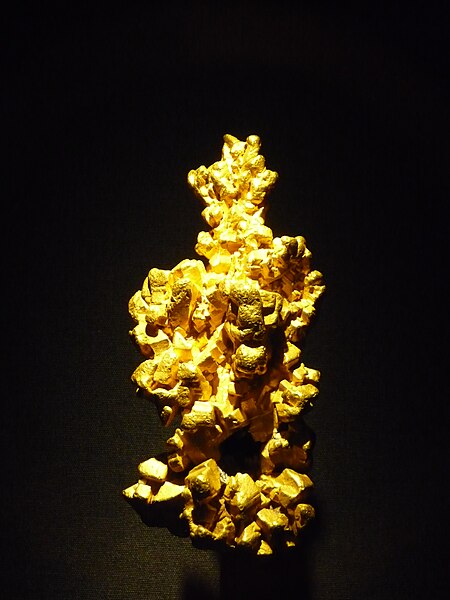
This is what gold looks like in the form of the Latrobe Nugget on display in the London Natural History Museum.
Photo by Gump Stump

Looking at a geological map of New York State it is easy to see that there are several environments in the state that are likely to contain both lode and placer gold. Probably the most likely place where you can find lode gold is in the Adirondacks, and the second most likely place is in the Hudson Highlands, and strangely enough right in New York City. These are areas in New York State where the bedrock is made up of crystalline rocks that may, or may not be the host for gold.

There is a lineation associated with the west bank of the Hudson River called Logan's line that marks the westernmost part of the Taconic orogeny. Anywhere to the east of this line it may be possible to find gold especially in the quartz veins found in the Slate belt of eastern New York along the border with New England.

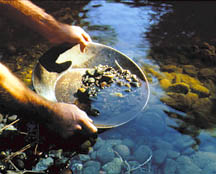
This is how you pan for gold.  USGS

Two of the counties gathering attention are Columbia and Saratoga counties. Although the particulars of these deposits are not clear from examining the geology found in those counties it is apparent they are probably lode deposits.

Another potential source for gold is found in the conglomerate of both the Schwangunks and Catskills where it was weathered out of high mountain ranges that light to the east. The rocks that are found in the Schwangunks were deposited in the Queenstown Delta, and the conglomerates that are found in the Catskills were eroded from another later mountain range that light even further east. These ancient conglomerates could be the host of fossilized placer deposits similar to the Witwatersrand Reef in South Africa, the world's largest deposits of gold.

It may look like Manhattan, but there is likely to be gold under its streets.
Wikimedia Commons

There is likely to be gold found in placer deposits across the length and width of New York that were brought down by the action of continental glaciers in at least three glaciations in the past 1 million years. Immediately to the north of New York State lies the Abitibi Gold Belt of QuĂ©bec and Ontario. This extends for over 500 miles from Wawa, Ontario to Val ‘Dor, QuĂ©bec. The scouring action of the glacier removed any gold that was loose in the soil of these provinces and took it south to be deposited across the width of New York State.

Just to the north of the Pennsylvania State line is the terminal moraine of the last glacier. This is an area that would be no doubt be good for prospecting in the many streams and rivers that cut through the glacial deposits. The action of running water would tend to concentrate any gold that was deposited in this area by the melting of the glaciers.

The plunge pool under Niagara Falls probably contains gold if you can find a way to get it!
Wikimedia Commons

The other big terminal moraine in the state is Long Island, there is the possibility that a small amount of gold was brought down from New England by the glaciers forming deposits in the sand and gravel.

Although you may not get rich hunting for gold in New York State at least there is enough that may be found to at least see what it looks like. Maybe someday the state assembly will change the law about the possession of gold to where the average New Yorker will be able to keep any gold that he finds.  

Friday, January 21, 2011

Gold Occurrences in Connecticut

Gold has an early history in Connecticut where it was discovered and mined by the first governor ot the state, John Winthrop Jr. and one of his servants.  According to the story left by Winthrop they spent three weeks at Great Mountain near Cobalt, Connecticut mining, roasting, and assaying the ores from which they cast several gold rings.  Then he returned to his home in New London, Connecticut.  This was reported in the literary diary of Ezra Stiles the president of Yale University from 1778 to 1795.

Bedrock Geological Map of Connecticut
During the 1980s Prof. Anthony Philpotts and his geology class from the University of Connecticut discovered gold that assayed as high as 6 ounces per ton in the shaft of the old cobalt mine in Cobalt.  The discovery was made in the quartzite that overlies the cobalt deposit.  The assay work was done by the USGS.  The old time miners cut straight through the quartzite with no idea the gold was even present.

Dr. Philpotts got the credit for being the first discoverer of gold in Connecticut in modern times several years before that the author working with Newmont Mining that had a lab for assaying ores in Danbury, Connecticut found gold in the city of New Britain as an assessory mineral in a rock cut at the Columbus Avenue exit from Route 72.  The sample also contained several other metal sulfides including copper, lead, zinc and cadmium. The assay was performed at Newmont’s assay lab in Danbury.

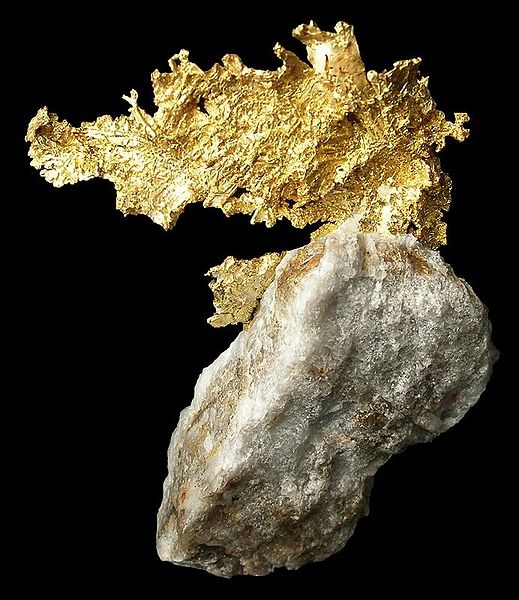
Gold in Quartz, this is similar to a specimen that came from Leadmine Brook in Thomaston, Connecticut
Photo by Rob Lavinsky 

In the period starting about 1968 to present the author has sampled most of the streams in western Connecticut and is found virtually all of them contain gold. The quantity of gold discovered in the streams is small, and not enough to make a living at, but they do contain enough gold so you can see what it looks like.

Winthrop's alleged success has caused virtually every part of the state of Connecticut to be explored and dug into by some would-be prospector who is absolutely confident he would find a rich deposit of gold. One of the many traditions of course concerns a lost mine, but a very rich deposit of gold in the town of Ridgefield. On Mt. Carmel in Ridgefield there is an excavation that reportedly has had gold taken from it, and our Mt. Sanford in the same town there is a man who swears he has a gold mine in his backyard.

In at least two or three cases there have been companies formed that sold stock, but apparently no gold was ever found. In 1886 one prospector by the name of August Prehn picked up a piece of quartz on Mill Road in West Haven upon which he got an analysis that showed traces of gold. On the strength of this report Mr. Prehn’s son quit his job in Pittsburg and returned home where he organized a mining company that sank three shafts.. The stories differ about the amount of ore those taken from this mine, or even if any was taken at all. The only thing the townspeople can agree on was that after a short time all mining efforts at the mine were abandoned.

This is interesting because on the bedrock geological map of Connecticut this area is mapped as having contained greenstone that is considered by many geologists to be the source for hydrothermal gold deposits where the gold is leached from the stone. According to the New Haven register there was another gold rush that occurred in West Haven during the 1930s.

Most of the gold bearing rocks in Connecticut are discovered to the west of the Connecticut River an area in which there are abundant crystalline rock deposits many of which may be the source of gold. There is gold to be found in Connecticut, but it appears that any placer gold is going to be sparse. It is also obvious that although gold is present there probably isn't enough to make anyone rich, let alone make a living.

Thursday, January 20, 2011

Gold Occurrences in Rhode Island

Gold occurrences in Rhode Island are not the subject of many reports, however there is the story of the Durfee Hill Gold Mine in Glocester, Rhode Island where there are reports of the remains of a stamping mill and cyanide vats on the site.  There are also some mine shafts that are sunk into the ground nearby.  There are no apparent reports of gold in quartz veins. There are however, reports of gold with pyrite in the quartz veins. The reports of the latter is from Kent County, to the west of Warwick.

Gold bearing pyrite crystals in quartz.
Photo by Rob Lavinsky

Gold that occurs in Rhode Island in three different types of deposits:

One type of gold is found in veins of hydrothermal deposits where the gold often occurs as the native metal in quartz veins.

The second type of gold is often found in his placer deposits in sand and gravel on the beds of streams or on beaches fronting on the ocean. Gold is often panned from this type of deposits by taking advantage of its great density in relation to other minerals. Gold is 19.3 times as dense as water and most of the minerals that occurs with our only three times as dense as water. Placer gold can be found in virtually any stream or river in the world in quantities large enough to see what it looks like.

Gold in quartz.
Photo by Rob Lavinsky

In a 1927 issue of the American Mineralogist by Lloyd Fisher and Charles G. Doll of Brown University in volume 12, pages 427 to 436 you can find a listing of the different minerals that are found in the state of Rhode Island.

This is what they said about the area around Durfee Hill, “Glocester (Durfee Hill) epidote, molybdenite, pyrite and phyrottite are present.


The third type of deposits are found in generally associated with pyrite and other metal sulfides where the gold actually appears as a thin film between the crystals of sulfide. 

Another area where gold was then reported in the past is around Johnstown where there are also some old mine workings were a dibase dike cuts across the granites and schists. This is another area that still has old cyanide vats and sluice boxes. When the local chemists reports that the locality has shown a trace of platinum group metals in the mine tailings.

Finally there has been Gold reported at the old South Foster gold mine locality where gold was produced mainly from pyriteferous quartz veins.  There are said to be still visible at this locality four open pits that are now filled with water along with the ruins of a large stamp mill.

One of the areas in Newport, Rhode Island, Purgatory Cliffs, has attracted the attention of the author because the cliffs are made out of a quartz pebble conglomerate with crystals of magnetite in the binding material between the pebbles. There is often an association between gold and magnetite. Another area is found in the black sands of the beaches in southern Rhode Island west of Narragansett Bay.

Although these last places are strictly speculative the geology is right for finding gold, and as far as that goes the entire set of rocks along the western side of Rhode Island where borders with Connecticut is another area that geologically is a good place to search for gold especially in placer deposits in the streambeds of the area.

Wednesday, January 19, 2011

Gold Occurrences in Alaska

Gold is found throughout Alaska, and the resources are as vast as the land itself. One of the prominent features found in Alaska is the Tintina Gold Province (TGP) an arching curve that extends all the way from northern British Columbia, the southwestern part of the Yukon Territory and crosses the entire state of Alaska where it finally vanishes into the sea northwest of Anchorage. This gold belt has produced several gold rushes over the years probably the most famous is the Klondike Gold Rush that occurred in the late 1890s.

A gold dredge working on the TGP
Photo by Chris Lot

The TGP covers roughly 150,000 km² that is bounded on the north by the Kaltag Tintina fault and on the south by the Farewell-Denali fault. Geologically it could be considered a suture zone where one tectonic plate collided with another one. Throughout most of this vast area you can only find a few roads one of which is the famous Alcan Highway that goes to Fairbanks. The apex of the TGP arc is just about centered on Fairbanks, Alaska. Altogether the TGP is one of largest gold provinces in the world at 1200 km long and about 200 km wide.

The Tintina Gold Belt superimposed on a Landsat image.   USGS

The regional climate that is associated with the TGP is generally subarctic that includes several different physiographic regions and ecoregions like that Yukon-Tanana upland, the Yukon River low lands and the Kuskokwin Mountains.

Geologically Alaska is made up of several different terranes with the Tintina gold belt being only one of many. Although the TGP is the largest one in Alaska gold can be found throughout the state. Most of the Gold that has been recovered in the TGP to date has been placer gold, but new methods of mining and metallurgy have allowed some previously known deposits to be brought online.

Virtually all of the known gold deposits in the state have already been staked, but it is still possible in the state of Alaska to buy or lease a claim. There is a lot of information about doing this on the Internet. We put into our web browser, “Mining claims for sale in Alaska” and had more than 9,600,000 hits.


In addition to the gold deposits found in the TGP that also contains many other deposits of Volcanogenic Massive Sulfide (VGM) minerals. Some of the other metals that are produced in the TGP include copper, lead, zinc and tungsten.


Friday, December 24, 2010

Gold Occurrences in Maine

This article explains some of the gold occurrences found in Maine where gold can be had from three different sources as placer gold, lode gold where it occurs in quartz veins and as a trace element associated with metal sulfides especially pyrite where it occurs in thin films between individual pyrite crystals.

According to the Maine Geological Survey placer gold has been found in the following streams:

Sream
Township
County
Swift River and its tributaries
Byron area
Oxford, Franklin
Sandy River
Madrid to New Sharon
Franklin
South Branch-Penobscot River
Sandy Bay; Bald Mtn; Prentiss
Somerset
Gold Brook
Bowman
Oxford
Gold Brook
Chain of Ponds; Kibby
Franklin
Gold Brook
Chase Stream
Somerset
Gold Brook
T5 R6; Appleton Township
Somerset
Nile Brook
Dallas; Rangeley
Franklin
Kibby Stream
Kibby
Franklin
St. Croix River
Baileyville
Washington

This is the kind of mountain stream where you can expect to find gold.
This list is by no means conclusive because virtually any other stream in the vicinity of those listed can also contain gold. The bed load of the streams eventually reaches the Atlantic Ocean where the litterol current carries in parallel to the coastline depositing its load of gold onto the sand and gravel beaches of Maine. As a teenager the author did some prospecting along these beaches discovering that the gold that was present was mainly flowered gold. The most gold was discovered near the mouths of the rivers running into the ocean. 

Ogunquit Beach, Maine where as a teenager we panned for gold.  Notice the small stream entering the ocean on the left side of the picture it was here where we had our most luck panning.

Because gold is 19 times denser than water another place that might be profitable to look is in the lower reaches of sand and gravel deposits where the deep deposits are at rest on bedrock or a bed of clay. Another factor that has to be taken into consideration is stream migration. Since the time of the glacier melting around 12,000 years ago the stream channel may have migrated several hundred feet to the West of its original position. To the practiced eye this can be readily seen by an area of flat terrain with the higher banks on the west side of the stream.  This is a situation that not only exists in Maine, but is a worldwide phenomenon where ever you have flowing water.

Gold on Quartz   Photo by Rob Lavinsky

Placer gold is that the only variety of gold found in the state of Maine.  Maine also has lode gold where gold is found in quartz veins. Even more complicated is gold deposits found as trace elements in base metal sulfides where gold is found as an impurity that must be recovered when the metal ore is smelted.  Finally gold is often associated with iron pyrite where it is a thin film between the crystal faces of pyrite.

You can purchase all kinds of supplies and equipment through our associate Amazon.com needed for operating a placer gold mining site.  By using the Amazon Searchbox you can access both new and used equipment.