Total Pageviews

Showing posts with label gneiss. Show all posts

Friday, May 4, 2012

Gold Occurrences in Brazil


Coat of Arms of Brazil


Within its borders Brazil is the fifth largest country in the world; it touches upon all the countries in South America except Ecuador.  The country also has an astonishing variety of mineral deposits including iron, gold, gemstones, diamonds and oil.  There are literally hundreds of active mining companies found in Brazil.  Brazil also enjoys a rising economy and has a stable government with the future for mining being extremely bright.

The Amazonian shield covers much of the eastern portion of the South American continent and provides many of its gold mines.  Prospecting in the area is similar to prospecting in Canada’s Abitibi Gold Province in Ontario with a repeat of its greenstone belts with alternating gneiss’s.  There are also many deposits of turbidite hosted paleo-gold deposits similar to those found in the Witwatersrand in South Africa.  To the north of the Amazonian shield is the Guyana shield, to the south are the Rio Apa and Platian cratons and in the west is the Sao Francisco craton.  All of these areas are gold bearing.

Brazil covers 8.5 million square kilometers with 7,500 kilometers of coastline making it the largest country in South America, a size that dwarfs all its neighbors.  Its size is on continental size contains a vast resource base making it a prime target for attracting foreign investors and miners as well as Brazilian mining companies.  The country also has a long history of gold mining dating back into the 16th century.

It is estimated that less then 30% of the country has been adequately mapped so there is plenty of room for prospecting in both placer and lode gold deposits. Placer deposits can be found throughout Brazil except in the depths of the Amazon Basin, and there are plenty of gold deposits found in the Precambrian Shield areas that dot the country.

One of the biggest problems facing the Brazilian mining industry are the number of artisanal mining operations that keep popping up; there was a gold rush in the 1990s that centered on the Guyana shield that reportedly attracted over 90,000 miners to the area.  These miners for the most part disregarded good environmental practices resulting in large areas that were contaminated with mercury and other contaminants.

It has been found that artisanal mining is today the largest source of mercury release into the environment not only in Brazil but other countries too.  One of the sites mentioned that is the largest is in the Tapajos River Basin in the Amazon region of Brazil.  The Global Mercury Project (GMP) under the auspices of the United Nations is aiming to reduce this mercury contamination.

Brazil as a whole is mining friendly and enjoys a now stable government and a rapidly expanding economy that welcomes miners from around the world.  There are still vast amounts of the country that have not been explored, so one never knows what might be found just around the next bend of the river.

Thursday, February 17, 2011

Gold in Greenstone Belts

Gold is often associated with greenstone belts that according to geologists are a group of variably metamorphosed mafic to ultra mafic volcanic sequences that are often associated with sedimentary rocks that can be found in Archean and Proterozoic terrenes where they are found nested in between bodies of gneiss and granite.

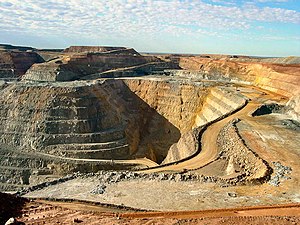
An openpit gold mine operating in a greenstone belt in Australia

The name greenstone comes from the greenish color that is present in many of the metamorphic materials that are found in the rocks composing a greenstone belt. This color is often imparted by actinolite, chlorite and other green amphibole minerals that are typically found associated with these green colored belts of rock.

Many geologists feel that the gold found in greenstone belts is leached from the greenstone by supercritical water to be deposited in the surrounding rocks in quartz veins or as disseminated gold.

Pillow lava typical of that found in a greenstone belt.
Greenstone belts are typical of continental cratons that can range from as little as several dozen to several thousand kilometers in length. Most greenstones contain a great number of individual rock units that is considered a stratigraphic grouping in its own right when they are found on continental sized scales. They are considered by geologists as basically metamorphosed volcanic belts that are associated with ancient oceanic spreading centers or is even island arcs.

Although greenstone belts are usually composed of volcanic rocks with the most prevailing being basalt there are also small amounts of sedimentary rocks that are interwoven, or interleaved with the various volcanic rocks. One of the most common rocks associated with greenstone belts is conglomerate that is often gold bearing as it is in the Abitibi Greenstone Belt in Canada.

The following list of greenstone belts shows how pervasive they are worldwide:

Africa

[edit]Asia
Taishan greenstone belt (Southeast Asia)

[edit]North America
Abitibi greenstone belt (Quebec/Ontario, Canada)
Bird River greenstone belt (Manitoba, Canada)
Flin Flon greenstone belt (Manitoba/Saskatchewan, Canada)
Hunt River greenstone belt (Newfoundland and Labrador, Canada)
Isua greenstone belt (Southwestern Greenland)
Temagami greenstone belt (Ontario, Canada)

]Oceania