Total Pageviews

Showing posts with label Archean. Show all posts

Friday, April 22, 2011

Gold, Uranium and Carbon in Detrital Deposits

One of the common associations with gold in detrital deposits is the association of gold with uranium and carbon. This holds true in the Witwatersrand and all the other gold deposits of a detrital nature.  For many years the origin of the carbon was hotly debated with the most recent evidence holding that it is from primitive life forms that lived in the distant past in the Archean. 
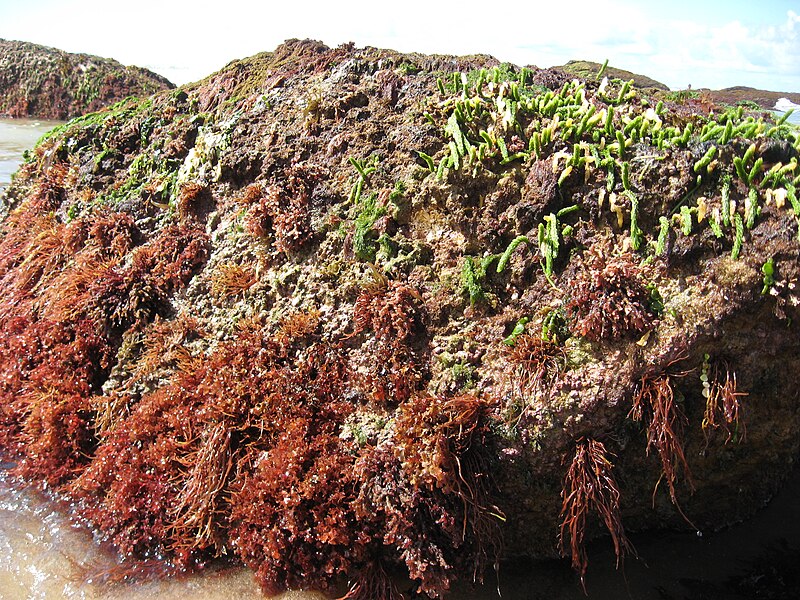

Algae exposed at the intertidal zone similar to the ancient algae that trapped gold.  Even today this kind of mat could be a good place to search for gold.
Photo by Leonardo de Jorge


It has been posited that these algae formed great mats similar to stromatolites that acted as a trap for the gold particles and uranium minerals in the same manner that modern mats of algae work to snare gold particles in a modern environment.  It is common practice to use an artificial mat of the same nature in a sluice box to entrap gold.

Although the deposits can be several thousand feet deep now, but at the time of depositation they were relatively shallow at the bottom of running water that was only a few tens of meters deep subsequent Earth processes have buried them to their present depth. 


An angular uncomformity with a basel layer of conglomerate that would be a good place to look for gold.   The best place is right at the uncomfority.
Photo by Lamprus


At the time many of these gold bearing deposits were at the bottom of a braided stream channel that by being deposited in this manner explains the stringers of gold found in such a deposit.  These stringers of gold are common in detrital gold deposits.  Sometimes there is a layer of carbon that is as thin as a pencil line that is so rich in gold and other minerals that they are mineable. In many detrital deposits the slim lines occur at a regular frequency to the extent that the entire deposit is mined so that I can undergo further ore dressing to free the gold so it can undergo even further treatment usually by being leached with a solution of cyanide.

Even today if you encounter a mat of algae in the bottom of the stream or river is a good place to search for gold that has been caught in the mat by the action of running water.

Thursday, February 17, 2011

Gold in Greenstone Belts

Gold is often associated with greenstone belts that according to geologists are a group of variably metamorphosed mafic to ultra mafic volcanic sequences that are often associated with sedimentary rocks that can be found in Archean and Proterozoic terrenes where they are found nested in between bodies of gneiss and granite.

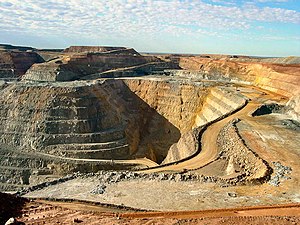
An openpit gold mine operating in a greenstone belt in Australia

The name greenstone comes from the greenish color that is present in many of the metamorphic materials that are found in the rocks composing a greenstone belt. This color is often imparted by actinolite, chlorite and other green amphibole minerals that are typically found associated with these green colored belts of rock.

Many geologists feel that the gold found in greenstone belts is leached from the greenstone by supercritical water to be deposited in the surrounding rocks in quartz veins or as disseminated gold.

Pillow lava typical of that found in a greenstone belt.
Greenstone belts are typical of continental cratons that can range from as little as several dozen to several thousand kilometers in length. Most greenstones contain a great number of individual rock units that is considered a stratigraphic grouping in its own right when they are found on continental sized scales. They are considered by geologists as basically metamorphosed volcanic belts that are associated with ancient oceanic spreading centers or is even island arcs.

Although greenstone belts are usually composed of volcanic rocks with the most prevailing being basalt there are also small amounts of sedimentary rocks that are interwoven, or interleaved with the various volcanic rocks. One of the most common rocks associated with greenstone belts is conglomerate that is often gold bearing as it is in the Abitibi Greenstone Belt in Canada.

The following list of greenstone belts shows how pervasive they are worldwide:

Africa

[edit]Asia
Taishan greenstone belt (Southeast Asia)

[edit]North America
Abitibi greenstone belt (Quebec/Ontario, Canada)
Bird River greenstone belt (Manitoba, Canada)
Flin Flon greenstone belt (Manitoba/Saskatchewan, Canada)
Hunt River greenstone belt (Newfoundland and Labrador, Canada)
Isua greenstone belt (Southwestern Greenland)
Temagami greenstone belt (Ontario, Canada)

]Oceania