Total Pageviews

Showing posts with label gneissic rocks. Show all posts

Thursday, February 17, 2011

Gold in Greenstone Belts

Gold is often associated with greenstone belts that according to geologists are a group of variably metamorphosed mafic to ultra mafic volcanic sequences that are often associated with sedimentary rocks that can be found in Archean and Proterozoic terrenes where they are found nested in between bodies of gneiss and granite.
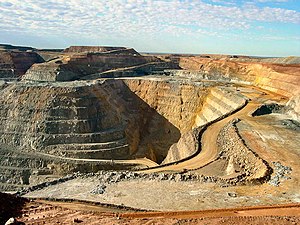
An openpit gold mine operating in a greenstone belt in Australia

The name greenstone comes from the greenish color that is present in many of the metamorphic materials that are found in the rocks composing a greenstone belt. This color is often imparted by actinolite, chlorite and other green amphibole minerals that are typically found associated with these green colored belts of rock.

Many geologists feel that the gold found in greenstone belts is leached from the greenstone by supercritical water to be deposited in the surrounding rocks in quartz veins or as disseminated gold.

Pillow lava typical of that found in a greenstone belt.
Greenstone belts are typical of continental cratons that can range from as little as several dozen to several thousand kilometers in length. Most greenstones contain a great number of individual rock units that is considered a stratigraphic grouping in its own right when they are found on continental sized scales. They are considered by geologists as basically metamorphosed volcanic belts that are associated with ancient oceanic spreading centers or is even island arcs.

Although greenstone belts are usually composed of volcanic rocks with the most prevailing being basalt there are also small amounts of sedimentary rocks that are interwoven, or interleaved with the various volcanic rocks. One of the most common rocks associated with greenstone belts is conglomerate that is often gold bearing as it is in the Abitibi Greenstone Belt in Canada.

The following list of greenstone belts shows how pervasive they are worldwide:

Africa

[edit]Asia
Taishan greenstone belt (Southeast Asia)

[edit]North America
Abitibi greenstone belt (Quebec/Ontario, Canada)
Bird River greenstone belt (Manitoba, Canada)
Flin Flon greenstone belt (Manitoba/Saskatchewan, Canada)
Hunt River greenstone belt (Newfoundland and Labrador, Canada)
Isua greenstone belt (Southwestern Greenland)
Temagami greenstone belt (Ontario, Canada)

]Oceania

Saturday, November 27, 2010

Raymond A. Kukkee on the Association of Biotite and Gold

As the result of a question somebody asked that was engaged in diamond core drilling on a gold deposit in Canada about the association of biotite and gold prompted me to put the question up to a friend in Ontario.  Mr. Kukkee has been a professional prospector in Ontario for more then thirty years, this is his answer. . .

“As far as I have seen,  and from what I've stumbled across  putzing around in the bush,  I would have conclude that   biotite mica can certainly  associated  with gold,  ( or gold can be found with biotite mica).  I found some, so  the association is most certainly not impossible.   Any time you find thick bands of  biotite in situ  suggests there is high-grade shearing of the rock structures  at hand  --and those contact structures are the most likely targets for gold.  On the other hand you can see flecks  biotite in gneissic rocks at times which doesn't seem to mean much. 

Many people think biotite is only black, but  it can be  black, dark brown, and even green yet! )     It's got a lot of iron in 
it, the green cast  can be  from chromium,  and of course biotite mica  itself  is  a silicate.   Logically, iron and silicates  are often associated with gold.

In prospecting  field work,  and being a persistent type,  I always looked at it this way, gold is where you find it, and it's most likely to be found in contact areas.   Where there are contacts showing   slickensides and schistose rocks  which are often  associated with gold  ( and/or  perhaps sulphide mineralization with  shearing)  , there most certainly can be biotite  in those structures, so why not use the reverse association as well?  It's a good indicator.   

 I would guess that direct gold/biotite association is more likely  found where there is physical metamorphism caused by  shearing,  as opposed to gold solutions being injected into biotitic structures after-the-fact ?   Maybe in the long-term scheme of things-- D-2 and even D3 events ( is there such a thing as a D3?) ,  maybe  that  could happen too ?  
 
 One of my old  low-grade gold finds had a  band  or dike  of rotten biotite (maybe  a foot across)  between  silicate/quartz  gold-bearing rocks  and a structure, (I interpreted it as  foot rock)  that had sections full of garnet ( the garnet-bearing layers were metamorphic rock).  The adjacent  biotite-bearing rock did carry some gold. 
That's about all I know about gold and biotite, I've probably forgotten more than that I imagine..LOL


It's interesting that prospectors might  overlook biotite as a barren mineral , it's not really very  exciting stuff, but if you happened to  find a big enough  deposit,   the vermiculite industry would be interested in it. 
China exports vermiculite for up to about  200-$400  USD/metric tonne,  at least they were  a couple of years ago.  The key is to find the stuff without any asbestos content.   I wonder if the Chinese worry about that?   the expanded vermiculite/perlite/agricultural/construction  market is huge if you can find just  the right stuff.”

That's about it,  how's the weather down there?  It quieted down here, about -10 C,,,,stopped snowing, not bad for Nov. 27th.