Total Pageviews

Showing posts with label contact structures. Show all posts

Monday, February 21, 2011

The Association of Gold and Magnetite

One common type of gold deposit is one where the gold is associated with the mineral magnetite where the gold is formed in skarns of granular magnetite.  The mineral has a chemical formula Fe3O4 that is often found in contact metamorphosed areas associated with intrusions of magma into carbonate or silico-carbonate rocks the intrusion itself is usually granite or monzonite-syenite. In such deposits the common minerals that are found include pyroxenes, amphiboles, garnet and lesser amounts of scapolite, vesuvianite and other silicates, but the most important is magnetite. 

Chalcopyrite deposited on magnetite.  The magnetite is the black crystals.
Photo by Rob Lavinsky

In the field magnetite is one of the most easily found of all minerals because it is magnetic and is attracted to a magnet; some of this mineral possess weak magnetism itself, so it is called lodestone.  The ancients were aware of this, and used it to make the first primitive compasses from magnetite carvings many of which looked like spoons whose handle pointed north. 

To prospector the first Association of gold and magnetite occurs in the bottom of your cold pan in the form of black sand that contains small specks of gold. This black sand along with other heavy minerals is considered to be ore in its own right, and is often refined away from streamside to recover its gold content.
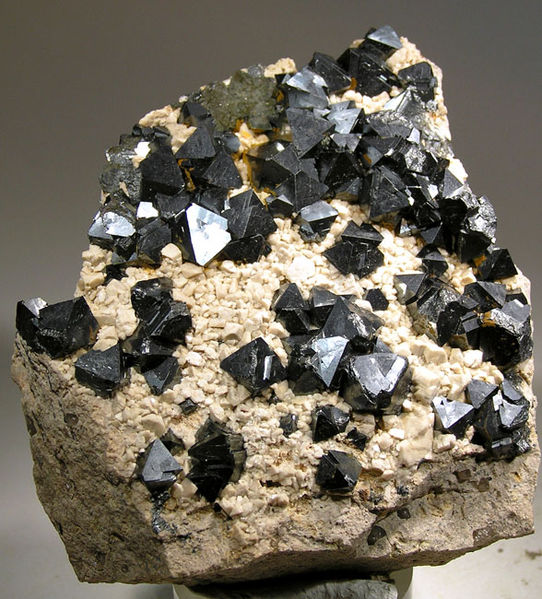
Magnetite crystals in a matrix of feldspar.
Photo by Rob Lavinsky

Gold bearing magnetite may be found in massive deposits where the gold is often invisible to the naked eye with the gold often being disseminated throughout the entire deposit of magnetite. The lower bodies in this type of deposit can be presented as one in particular, tubular or more rarely as sheet deposits.

The sulfide minerals found in such a deposit are usually secondary in nature that have been deposited by mineral laden hydrothermal waters. In some deposits of this type goals is also associated with the sulfides, particularly arseno-pyrite as well as other sulfide minerals.

If gold is present in one of these deposits it is not to be disseminated through the body of the rock and quantities that are so small much of the gold is invisible to the naked eye, or there may be small specks of gold that are visible. The usual tenor of this sort can vary from that measured in grams to about 4 ounces per ton.

A great deal of gold can be recovered from magnetite because of the vast quantities of four that are present coupled with the recovery of gold values using the heap leaching process that takes advantage of the ability of sodium or potassium cyanide to dissolve gold. As a rule of thumb that takes approximately 2 ounces of cyanide in solution to treat gold over in this manner. Cyan night is extremely poisonous as it only takes 2/10 of a gram to kill a person. It also presents some very serious environmental issues that have to be addressed. If the proper environmental safeguards are in place the use of cyanide for gold extraction is extremely cost-effective. 

Saturday, November 27, 2010

Raymond A. Kukkee on the Association of Biotite and Gold

As the result of a question somebody asked that was engaged in diamond core drilling on a gold deposit in Canada about the association of biotite and gold prompted me to put the question up to a friend in Ontario.  Mr. Kukkee has been a professional prospector in Ontario for more then thirty years, this is his answer. . .

“As far as I have seen,  and from what I've stumbled across  putzing around in the bush,  I would have conclude that   biotite mica can certainly  associated  with gold,  ( or gold can be found with biotite mica).  I found some, so  the association is most certainly not impossible.   Any time you find thick bands of  biotite in situ  suggests there is high-grade shearing of the rock structures  at hand  --and those contact structures are the most likely targets for gold.  On the other hand you can see flecks  biotite in gneissic rocks at times which doesn't seem to mean much. 

Many people think biotite is only black, but  it can be  black, dark brown, and even green yet! )     It's got a lot of iron in 
it, the green cast  can be  from chromium,  and of course biotite mica  itself  is  a silicate.   Logically, iron and silicates  are often associated with gold.

In prospecting  field work,  and being a persistent type,  I always looked at it this way, gold is where you find it, and it's most likely to be found in contact areas.   Where there are contacts showing   slickensides and schistose rocks  which are often  associated with gold  ( and/or  perhaps sulphide mineralization with  shearing)  , there most certainly can be biotite  in those structures, so why not use the reverse association as well?  It's a good indicator.   

 I would guess that direct gold/biotite association is more likely  found where there is physical metamorphism caused by  shearing,  as opposed to gold solutions being injected into biotitic structures after-the-fact ?   Maybe in the long-term scheme of things-- D-2 and even D3 events ( is there such a thing as a D3?) ,  maybe  that  could happen too ?  
 
 One of my old  low-grade gold finds had a  band  or dike  of rotten biotite (maybe  a foot across)  between  silicate/quartz  gold-bearing rocks  and a structure, (I interpreted it as  foot rock)  that had sections full of garnet ( the garnet-bearing layers were metamorphic rock).  The adjacent  biotite-bearing rock did carry some gold. 
That's about all I know about gold and biotite, I've probably forgotten more than that I imagine..LOL


It's interesting that prospectors might  overlook biotite as a barren mineral , it's not really very  exciting stuff, but if you happened to  find a big enough  deposit,   the vermiculite industry would be interested in it. 
China exports vermiculite for up to about  200-$400  USD/metric tonne,  at least they were  a couple of years ago.  The key is to find the stuff without any asbestos content.   I wonder if the Chinese worry about that?   the expanded vermiculite/perlite/agricultural/construction  market is huge if you can find just  the right stuff.”

That's about it,  how's the weather down there?  It quieted down here, about -10 C,,,,stopped snowing, not bad for Nov. 27th.