Total Pageviews

Showing posts with label gold prospector. Show all posts

Monday, February 21, 2011

The Association of Gold and Magnetite

One common type of gold deposit is one where the gold is associated with the mineral magnetite where the gold is formed in skarns of granular magnetite.  The mineral has a chemical formula Fe3O4 that is often found in contact metamorphosed areas associated with intrusions of magma into carbonate or silico-carbonate rocks the intrusion itself is usually granite or monzonite-syenite. In such deposits the common minerals that are found include pyroxenes, amphiboles, garnet and lesser amounts of scapolite, vesuvianite and other silicates, but the most important is magnetite. 

Chalcopyrite deposited on magnetite.  The magnetite is the black crystals.
Photo by Rob Lavinsky

In the field magnetite is one of the most easily found of all minerals because it is magnetic and is attracted to a magnet; some of this mineral possess weak magnetism itself, so it is called lodestone.  The ancients were aware of this, and used it to make the first primitive compasses from magnetite carvings many of which looked like spoons whose handle pointed north. 

To prospector the first Association of gold and magnetite occurs in the bottom of your cold pan in the form of black sand that contains small specks of gold. This black sand along with other heavy minerals is considered to be ore in its own right, and is often refined away from streamside to recover its gold content.
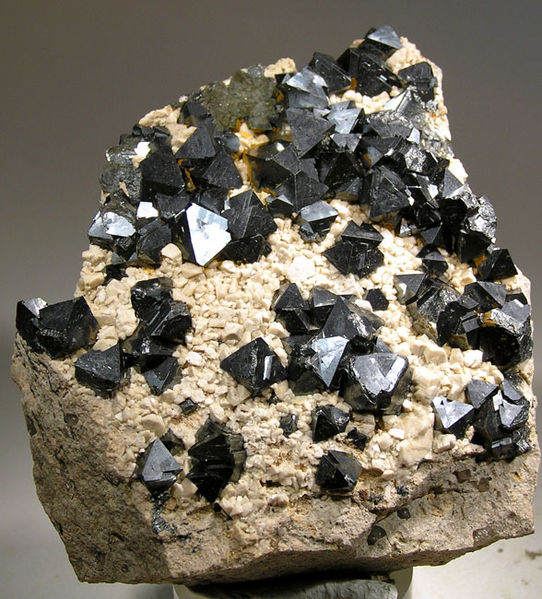
Magnetite crystals in a matrix of feldspar.
Photo by Rob Lavinsky

Gold bearing magnetite may be found in massive deposits where the gold is often invisible to the naked eye with the gold often being disseminated throughout the entire deposit of magnetite. The lower bodies in this type of deposit can be presented as one in particular, tubular or more rarely as sheet deposits.

The sulfide minerals found in such a deposit are usually secondary in nature that have been deposited by mineral laden hydrothermal waters. In some deposits of this type goals is also associated with the sulfides, particularly arseno-pyrite as well as other sulfide minerals.

If gold is present in one of these deposits it is not to be disseminated through the body of the rock and quantities that are so small much of the gold is invisible to the naked eye, or there may be small specks of gold that are visible. The usual tenor of this sort can vary from that measured in grams to about 4 ounces per ton.

A great deal of gold can be recovered from magnetite because of the vast quantities of four that are present coupled with the recovery of gold values using the heap leaching process that takes advantage of the ability of sodium or potassium cyanide to dissolve gold. As a rule of thumb that takes approximately 2 ounces of cyanide in solution to treat gold over in this manner. Cyan night is extremely poisonous as it only takes 2/10 of a gram to kill a person. It also presents some very serious environmental issues that have to be addressed. If the proper environmental safeguards are in place the use of cyanide for gold extraction is extremely cost-effective. 

Saturday, February 5, 2011

Doing Field Analysis with a Blowpipe

Rather then give you a long winded Blog about blowpipe analysis instead we are giving you a URL to a textbook that is completely about using the blowpipe technique for field analysis.  Any serious prospector should become familiar with this low-cost method of mineral analysis since it can save them both time and money.

This is Chandler Hall at Lehigh University, Pennsylvania that used to be the chemical lab where blowpipe chemical analysis was conducted during the 19th century stressing its importance as a method of chemical analysis.

The blowpipe is traced back to the ancient Egyptians, and even though it has mainly fallen into disuse today it is still a powerful tool for mineral analysis in the hands of somebody who knows how to use one.


Monday, January 17, 2011

Wild Animals and the Gold Prospector

Most gold prospecting takes place in the wilds meaning that you are likely to encounter wild animals as you are prospecting.  Most wild animals will go out of the way to avoid you, but always keep in mind that any wild animal is not your friend.  The truth is any large animal can be dangerous, and many of them look at you as something for lunch.  Other animals have venomous bites including some kinds of snakes and lizards.

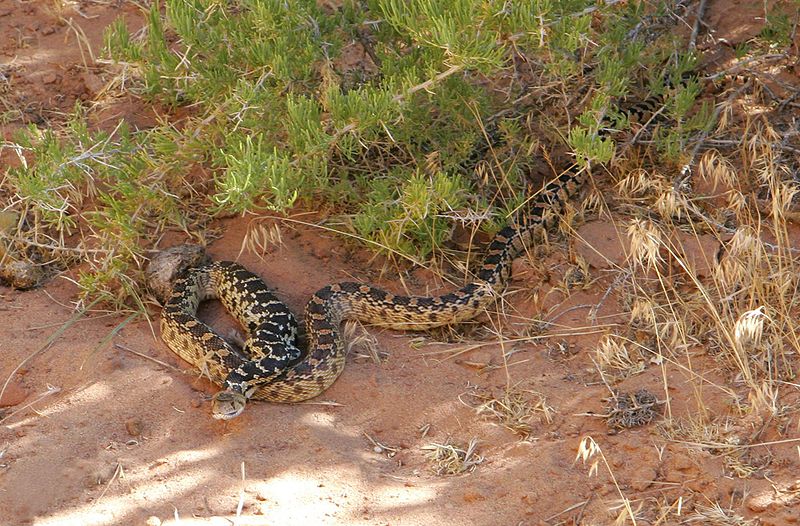
A rattle snake in his natural habitat. 

The encounter Nancy Twinkie had with a large water snake gave her a good scare, but under the circumstances had that snake been venomous that encounter could have resulted in a tragedy.  If a snake bite doesn’t kill you they are extremely painful, disfiguring and take a long time to heal.

You are apt to encounter venomous snakes near bodies of water, rocky places or any other place that offers concealment like old mines.  Years ago we had a lease on a mine in the central Berkshires of Massachusetts that had so many venomous snakes (rattlesnakes) that before you could do any work in the mine first you had to clear the snakes.  On another occasion we were prospecting in an old mine dump when my partner encountered a whole den of venomous snakes.  He wasn’t bit, but he sure moved fast!

A whitetail buck during rutting season.
Photo by Clinton and Charles Robertson

Snakes aren’t the only dangerous animal you are likely to meet in the wilds.  One of the most dangerous is any member of the deer family.  The members of the deer family are not the noble animal depicted in fiction, in reality they can be outright dangerous especially during the rutting season when the bucks will charge anything that moves.  The bull moose, a member of the deer family, have even known to charge locomotives during the rutting season.

A bull moose during rutting season.

One of the most dangerous situations we ever faced in the wilds is a pack of feral dogs.  These are somebody’s pet dogs that have gone wild.  Because they are familiar with people they do not fear man, and believe me a pack of these dogs can be absolutely dangerous. 

Feral Dogs.

When I was an active field geologist we had two encounters with bears, one of these encounters was with a family of four bears a female, a yearling and two cubs.  You don’t want anything to do with a female bear with cubs.  The other encounter was being stalked by a polar bear.  Polar bears look upon humans as some sort of seal their natural food, and this one was thinking about lunch.  We were forced to kill the bear when he charged us.

A polar bear similar to the one that stalked us while prospecting in the Arctic.

The strangest encounter you can have with an animal is with a large bird.  One morning I was walking my dog in a swampy area when I came around a clump of bushes and had en eyeball to eyeball encounter with a great blue heron.  These birds have a long sharp bill that they use to catch fish or to defend them selves usually aiming at their attacker’s eyes.

A great blue heron
photo by Ken Thomas

Wild animals aren’t your friends, but by exercising due caution you can usually keep most of them away by being noisy, and even whistling.  Some people even go to wearing bells to ward off most animals.  Probably the best thing to do if there are large carnivorous animals in an area is simply to avoid going into the locality. 

A mountain lion there are several reports of fatalities every year from these big cats in the United States

When going into any unfamiliar area the best policy is to exercise due diligence!