Total Pageviews

Showing posts with label ammonoosuc gold belt. Show all posts

Monday, February 21, 2011

The Association of Gold and Magnetite

One common type of gold deposit is one where the gold is associated with the mineral magnetite where the gold is formed in skarns of granular magnetite.  The mineral has a chemical formula Fe3O4 that is often found in contact metamorphosed areas associated with intrusions of magma into carbonate or silico-carbonate rocks the intrusion itself is usually granite or monzonite-syenite. In such deposits the common minerals that are found include pyroxenes, amphiboles, garnet and lesser amounts of scapolite, vesuvianite and other silicates, but the most important is magnetite. 

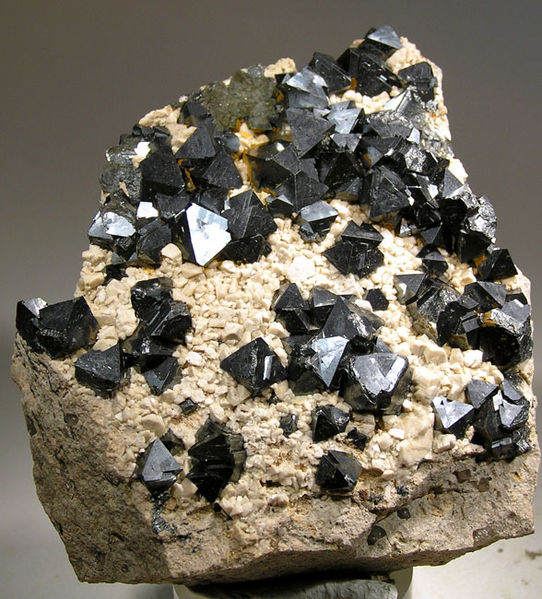
Chalcopyrite deposited on magnetite.  The magnetite is the black crystals.
Photo by Rob Lavinsky

In the field magnetite is one of the most easily found of all minerals because it is magnetic and is attracted to a magnet; some of this mineral possess weak magnetism itself, so it is called lodestone.  The ancients were aware of this, and used it to make the first primitive compasses from magnetite carvings many of which looked like spoons whose handle pointed north. 

To prospector the first Association of gold and magnetite occurs in the bottom of your cold pan in the form of black sand that contains small specks of gold. This black sand along with other heavy minerals is considered to be ore in its own right, and is often refined away from streamside to recover its gold content.

Magnetite crystals in a matrix of feldspar.
Photo by Rob Lavinsky

Gold bearing magnetite may be found in massive deposits where the gold is often invisible to the naked eye with the gold often being disseminated throughout the entire deposit of magnetite. The lower bodies in this type of deposit can be presented as one in particular, tubular or more rarely as sheet deposits.

The sulfide minerals found in such a deposit are usually secondary in nature that have been deposited by mineral laden hydrothermal waters. In some deposits of this type goals is also associated with the sulfides, particularly arseno-pyrite as well as other sulfide minerals.

If gold is present in one of these deposits it is not to be disseminated through the body of the rock and quantities that are so small much of the gold is invisible to the naked eye, or there may be small specks of gold that are visible. The usual tenor of this sort can vary from that measured in grams to about 4 ounces per ton.

A great deal of gold can be recovered from magnetite because of the vast quantities of four that are present coupled with the recovery of gold values using the heap leaching process that takes advantage of the ability of sodium or potassium cyanide to dissolve gold. As a rule of thumb that takes approximately 2 ounces of cyanide in solution to treat gold over in this manner. Cyan night is extremely poisonous as it only takes 2/10 of a gram to kill a person. It also presents some very serious environmental issues that have to be addressed. If the proper environmental safeguards are in place the use of cyanide for gold extraction is extremely cost-effective. 

Tuesday, February 15, 2011

Gold Occurrences in Madagascar

Although in the past Madagascar was a significant gold producer but because of its tumultuous political history for many years it remained in the doldrums. Today Madagascar is considered to be an up-and-coming place for mining now the political situation has become more stable. Today Madagascar has become a beacon for the mining and exploration industry that right now is largely undeveloped.

Madagascar is shown in red.

For those who don't know where Madagascar is, is approximately 400 km due east of the African mainland. It is separated from Africa by the Mozambique Channel.

Although the island has a vast potential for hosting valuable mineral deposits right now the country does not have a well-developed mining industry. As little as 30 years ago it was one of most geologically studied areas in the African region, but then the country underwent a period of political instability resulting in mineral exploration being put on the back burner. It wasn't until 1993 that the political instability vanished when the country returned to a liberal democratic form of government. It wasn't until recently however, that it began to regain some of the lost footing it once had in exploration and mining.

Although Madagascar is considered to be a part of the African Continent the island geologically is a micro-continent between Southern Africa and India. This becomes readily apparent when you start looking at the local geology and the flora and fauna. The geology of the island is more akin to that of Sri Lanka and India that is anything found in Africa.

Madagascar's primary gold deposits are similar to those of the Abitibi region of Canada than anything else. Like the Abitibi the gold is associated with greenstone belts, quartz reefs and veins, and is also found the fuse for the country rock in deposits similar to those of the Carlin Trend in Nevada.  There is a great deal of gold that is also associated with that volcanogenic massive sulfide (VMS) deposits similar to those that are found at the kidd Creek Mine in Timmins, Ontario or the Horne Mine in Rouyn-Noranda, Québec. Both of these mines are in the Abitibi Gold Belt of Canada.

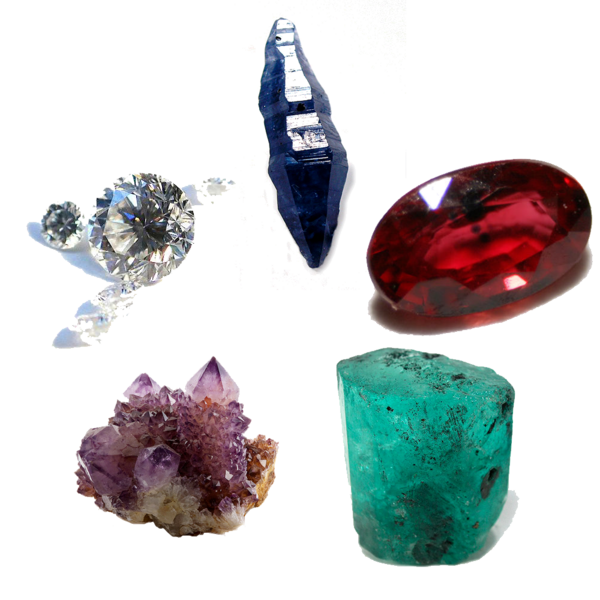
Gold isn't the only thing found in Madagascar that is worth money.
Photo by Rob Lavinsky

Alluvial gold is also been recovered from both ancient and recent placer deposits as well as lateritic earth. Aside from the gold deposits found in Madagascar is also the home of many valuable gemstones including those of the ruby and sapphire family that are mined mainly by artisanal miners although in some cases a few of these mines have been mechanized.

Although the primary gold deposits found on the island predate the breakup of Gondwana one of the two continents that made up the supercontinent Pangaea. This is very important to remember because it makes the regional tectonics arrival into the emplacement of gold deposits. Madagascar's gold bearing rocks are all part of its suite of basement rocks. These rocks are divided into three different systems with the youngest being the Vohibory System, the middle is the Graphite System and the oldest is the Androyen System. Most of the gold however is found in the graphite system. There are also some interesting gold deposits in the Vohibory System.

Friday, January 21, 2011

Gold Occurrences in Connecticut

Gold has an early history in Connecticut where it was discovered and mined by the first governor ot the state, John Winthrop Jr. and one of his servants.  According to the story left by Winthrop they spent three weeks at Great Mountain near Cobalt, Connecticut mining, roasting, and assaying the ores from which they cast several gold rings.  Then he returned to his home in New London, Connecticut.  This was reported in the literary diary of Ezra Stiles the president of Yale University from 1778 to 1795.

Bedrock Geological Map of Connecticut
During the 1980s Prof. Anthony Philpotts and his geology class from the University of Connecticut discovered gold that assayed as high as 6 ounces per ton in the shaft of the old cobalt mine in Cobalt.  The discovery was made in the quartzite that overlies the cobalt deposit.  The assay work was done by the USGS.  The old time miners cut straight through the quartzite with no idea the gold was even present.

Dr. Philpotts got the credit for being the first discoverer of gold in Connecticut in modern times several years before that the author working with Newmont Mining that had a lab for assaying ores in Danbury, Connecticut found gold in the city of New Britain as an assessory mineral in a rock cut at the Columbus Avenue exit from Route 72.  The sample also contained several other metal sulfides including copper, lead, zinc and cadmium. The assay was performed at Newmont’s assay lab in Danbury.

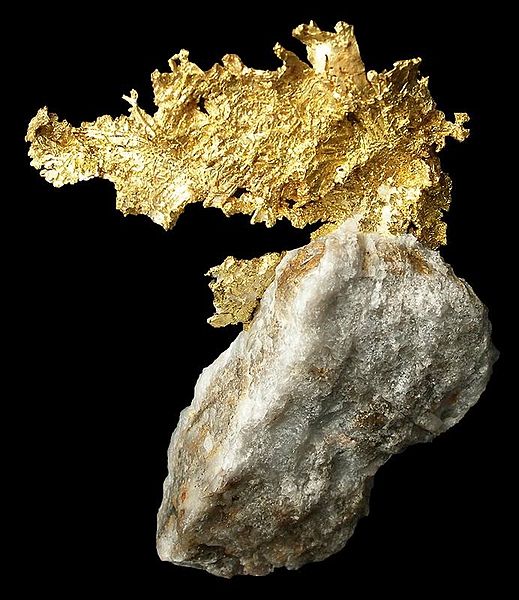
Gold in Quartz, this is similar to a specimen that came from Leadmine Brook in Thomaston, Connecticut
Photo by Rob Lavinsky 

In the period starting about 1968 to present the author has sampled most of the streams in western Connecticut and is found virtually all of them contain gold. The quantity of gold discovered in the streams is small, and not enough to make a living at, but they do contain enough gold so you can see what it looks like.

Winthrop's alleged success has caused virtually every part of the state of Connecticut to be explored and dug into by some would-be prospector who is absolutely confident he would find a rich deposit of gold. One of the many traditions of course concerns a lost mine, but a very rich deposit of gold in the town of Ridgefield. On Mt. Carmel in Ridgefield there is an excavation that reportedly has had gold taken from it, and our Mt. Sanford in the same town there is a man who swears he has a gold mine in his backyard.

In at least two or three cases there have been companies formed that sold stock, but apparently no gold was ever found. In 1886 one prospector by the name of August Prehn picked up a piece of quartz on Mill Road in West Haven upon which he got an analysis that showed traces of gold. On the strength of this report Mr. Prehn’s son quit his job in Pittsburg and returned home where he organized a mining company that sank three shafts.. The stories differ about the amount of ore those taken from this mine, or even if any was taken at all. The only thing the townspeople can agree on was that after a short time all mining efforts at the mine were abandoned.

This is interesting because on the bedrock geological map of Connecticut this area is mapped as having contained greenstone that is considered by many geologists to be the source for hydrothermal gold deposits where the gold is leached from the stone. According to the New Haven register there was another gold rush that occurred in West Haven during the 1930s.

Most of the gold bearing rocks in Connecticut are discovered to the west of the Connecticut River an area in which there are abundant crystalline rock deposits many of which may be the source of gold. There is gold to be found in Connecticut, but it appears that any placer gold is going to be sparse. It is also obvious that although gold is present there probably isn't enough to make anyone rich, let alone make a living.

Thursday, January 20, 2011

Gold Occurrences in Rhode Island

Gold occurrences in Rhode Island are not the subject of many reports, however there is the story of the Durfee Hill Gold Mine in Glocester, Rhode Island where there are reports of the remains of a stamping mill and cyanide vats on the site.  There are also some mine shafts that are sunk into the ground nearby.  There are no apparent reports of gold in quartz veins. There are however, reports of gold with pyrite in the quartz veins. The reports of the latter is from Kent County, to the west of Warwick.

Gold bearing pyrite crystals in quartz.
Photo by Rob Lavinsky

Gold that occurs in Rhode Island in three different types of deposits:

One type of gold is found in veins of hydrothermal deposits where the gold often occurs as the native metal in quartz veins.

The second type of gold is often found in his placer deposits in sand and gravel on the beds of streams or on beaches fronting on the ocean. Gold is often panned from this type of deposits by taking advantage of its great density in relation to other minerals. Gold is 19.3 times as dense as water and most of the minerals that occurs with our only three times as dense as water. Placer gold can be found in virtually any stream or river in the world in quantities large enough to see what it looks like.

Gold in quartz.
Photo by Rob Lavinsky

In a 1927 issue of the American Mineralogist by Lloyd Fisher and Charles G. Doll of Brown University in volume 12, pages 427 to 436 you can find a listing of the different minerals that are found in the state of Rhode Island.

This is what they said about the area around Durfee Hill, “Glocester (Durfee Hill) epidote, molybdenite, pyrite and phyrottite are present.


The third type of deposits are found in generally associated with pyrite and other metal sulfides where the gold actually appears as a thin film between the crystals of sulfide. 

Another area where gold was then reported in the past is around Johnstown where there are also some old mine workings were a dibase dike cuts across the granites and schists. This is another area that still has old cyanide vats and sluice boxes. When the local chemists reports that the locality has shown a trace of platinum group metals in the mine tailings.

Finally there has been Gold reported at the old South Foster gold mine locality where gold was produced mainly from pyriteferous quartz veins.  There are said to be still visible at this locality four open pits that are now filled with water along with the ruins of a large stamp mill.

One of the areas in Newport, Rhode Island, Purgatory Cliffs, has attracted the attention of the author because the cliffs are made out of a quartz pebble conglomerate with crystals of magnetite in the binding material between the pebbles. There is often an association between gold and magnetite. Another area is found in the black sands of the beaches in southern Rhode Island west of Narragansett Bay.

Although these last places are strictly speculative the geology is right for finding gold, and as far as that goes the entire set of rocks along the western side of Rhode Island where borders with Connecticut is another area that geologically is a good place to search for gold especially in placer deposits in the streambeds of the area.

Sunday, January 16, 2011

The Geologic Framework of a Gold Bearing Suture Zone: Part One

The estimated abundance of gold in the earth’s crust is 4x10⁻³ milligram per kilogram meaning this is the average amount of gold found in every kilogram found in the earth’s crust.  Although gold can be found virtually every place on earth the trick is to find it where it has been concentrated by geological processes to make it profitable to mine.  The necessary conditions are found in several places on earth that within reason have similar conditions that are called by several different names.  One of the most common names is “Gold Belt” another is “Gold Province.”  Names like these are used to define primary deposits of gold that have been deposited by the action of hot salt brines that are in excess of 100o C that deposit their dissolved gold either when its temperature drops below a certain point, or encounters conditions that cause the chemical precipitation of gold by reacting with other rocks.

A map showing modern tectonic plates.

Gold is also deposited when it has been eroded from the rock where it was primarily deposited as detritus in the beds of streams or a similar environment.  In this form gold is called “Placer or alluvial gold.”  Aside from being found in stream sediments it can also be found in sandstone or conglomerate that are really nothing other then fossilized sedimentary deposits.  The largest known deposit of gold is in one of these fossilized conglomerate deposits, the Witwatersrand in South Africa.  The mines here are the deepest on earth some of them are in excess of 13,000 feet deep.

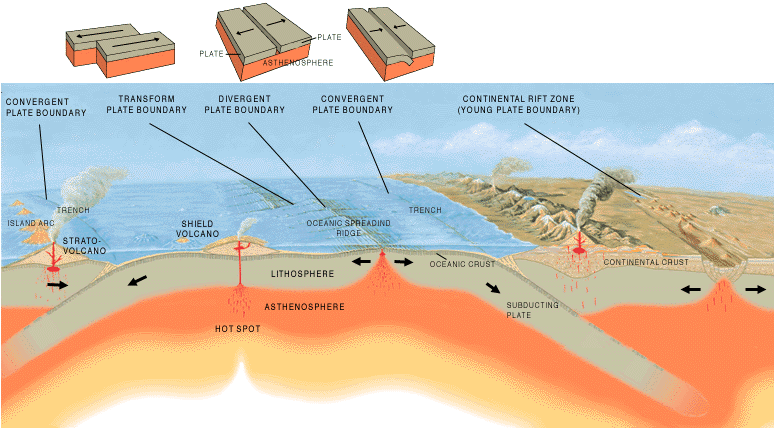
Tectonic Plate boundaries.

Primary gold deposits accompanied by placer deposits are found mainly in suture zones where one tectonic plate collides with another.  In some cases the oceanic plate is subducted beneath a continent with little affect.  In other cases two continental land masses collide throwing up ranges of great mountains.  There are several examples of this on earth today.  The grand daddy of all mountain ranges caused by such a collision is the Himalayas caused by the collision of two continents, the Asian and the Indian plates.  Between these plates there used to be an ocean called the Tethys Sea that vanished when the collision occurred.  Other examples of similar mountain ranges can be found all over the face of the earth, some of the more recent are: the Appalachians, the Alps, the Andes, the Rockies to name a few of many.

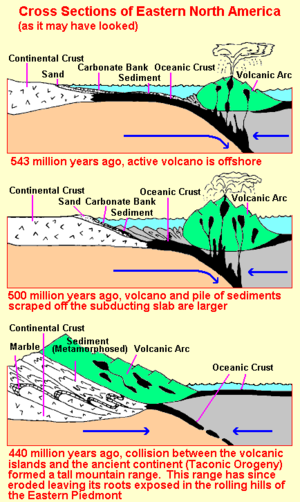
A suture zone is depicted in this series of charts.

Because of the nature of this subject it will require several separate articles to treat it as it should be.  The next article in this series will explain how mineral deposits are emplaced in a suture zone including gold.


Friday, January 14, 2011

Gold Occurrences in Vermont

Did you ever know that Calvin Coolidge the 30th president of the United States as a young man was a gold miner in Plymouth, Vermont where he was born. Virtually all the rivers and streams on the east flank of the Green Mountains are gold bearing. This gold belt crosses the Connecticut River as part of the Ammonoosuc gold belt of New Hampshire and extends northwards into Québec. This is part of a larger gold belt found in the northern Appalachians that extends all the way from Staten Island, New York to Baie Verte on the north coast of Newfoundland. On the landward side there is a continuous thrust fault that goes by many names but is continuous from one end to the other.

In this case however we are only considering the gold bearing areas in the state of Vermont. These are found in the eastern flank of the Green Mountains in the so-called Iapetus Suture Zone an area that is bounded on its west side by large intrusions granite. On its Eastside it is bounded by the Connecticut River. Virtually anywhere in this zone It is possible to find both lode and the placer gold.

The Waits River one of the many goldbearing streams of Vermont.

Even though the idea of finding gold causes us to have dreams of fabulous wealth in Vermont although there is gold there is not enough that has been discovered so far to make anyone wealthy. Several years ago there were unproven rumors about someone finding a gold pocket in the Williams River that produced over $2800 worth of gold in one afternoon.

Aside from gold there are also many occurrences of sulfide minerals in Vermont lying within the Connecticut Valley -- Gaspé Synclinorium and the Bronson Hill Anticlorium as well as the Appalachian province of Stratabound massive sulfide minerals. There are also isolated occurrences that are associated with the Green Mountain Anticlinorium Tectonic Province.

While a great many of the soleplate minerals have been discovered in Vermont that include lead, zinc, copper, molybdenum and arsenopyrite, copper was the only sulfide mineral that was mined on a large scale. Most of these sulfides contain gold as a byproduct.

At the present time, other than gold, no other metallic minerals are being mined in Vermont at the present time. The copper sulfide ore was originally discovered in Orange County as early as 1793, but it took another four years in the early 1830s before was finally mined. Until the discovery of copper on the Keweenah Peninsula of Michigan in 1846 Vermont was the largest producer of copper in the United States.

To this day the Orange County Mining District is a scar on the landscape. The site of the mine is at present listed on CERCLIS the EPA's database showing potential hazardous waste sites that will eventually be remediated under the Superfund program.

The first reports of gold in Vermont surfaced in 1845 when the State Geologist C.B. Adam's in his First Annual Report on the Geology of Vermont reported finding gold in the town of Somerset, Vermont.

It was four years later when the California gold rush caused many Vermonters to search for gold in California. By the mid-1850s many of these gold seekers had returned home. One of these 49ers by the name of Capt. Abial Slayton had struck it rich on his California gold claim. When he returned to Vermont in 1855 he went on to discover gold in what was then Hull's Brook that has since been renamed Gold Brook in Stowe. At the time of his discovery Slayton set up a sluicing operation that employed several people. Although this gold discovery never produced the amount of gold be found in California it did produce enough so that in 1887 the builders of the Mount Mansfield Electric Railroad drove the last spike that was coated with some of Slayton's gold.

An old fashioned gold pan used by the 49ers.
Photo by Nate Culi


In 1854, a mine containing gold, silver, lead and copper was opened in Bridgewater, Vermont. In this mine called was found as small irregular grains in quartz. It was noted in 1867 by Dr. C. T. Jackson that the so-called great Appalachian gold belt passed through both Plymouth and Bridgewater.

By the early 1900s even though gold was present in Vermont it was determined that it didn't occur in commercial quantities. There had been gold bearing rocks discovered in Plymouth and Bridgewater that were mined only it cost more to mind the metal than it was worth. By that time it was determined that it is useless to spend time and money trying to find a fortune in gold mining in Vermont.

It was the placer deposits that were found in the Plymouth area around 1855 that Calvin Coolidge later worked for gold when he was a young man. Even though there are plenty of indications that no one will get rich mining gold in Vermont, gold hunters are still out there looking for gold during the summer months when many people converge on the gold bearing streams in the state trying to recover “free gold” from stream gravels found in the beds of rivers and streams throughout the state.

Wednesday, January 12, 2011

Gold Occurrences in New Hampshire

Too many of us the very thought of gold mining produces visions of the California gold rush or trekking into the Klondike during the Klondike Gold Rush. Our thoughts immediately bring up the picture of some grizzled old prospector with a donkey looking for gold in some far-off desert, or a frozen waste in some icebound part of the far North. To everyone's surprise gold is not unknown in the Granite State of New Hampshire.

When some New Hampshire miners return from the California gold rush they went poking around in the hills and mountains of their native state, and they discovered that both lode and placer gold could be found in them thar hills. Most of gold from the New Hampshire is located in Grafton County where it occurs as both veins in the country rock and is placer deposits in the rivers and streams of the county. Gold is found in many different geological environments ranging all the way from igneous rocks, metamorphic rocks, sedimentary rocks and then detritus such as sand and gravel or any other soil that is found in New Hampshire.         
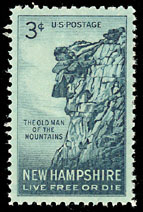
A postage stamp of the Old Man of the Mountains New Hampshire's state symbol that used to be in Franconia Notch
Gold is considered a noble metal because it resists corrosion and any other kind of chemical weathering it is only dissolved by a mixture of nitric acid and hydrochloric acid that is called aqua regia or in solutions of alkaline metal cyanide usually in the form of potassium cyanide. It also combines with mercury to form a gold/mercury amalgamate. Many of its unique properties are taken advantage of in the process of refining gold. It is also the same standoff property from other elements that causes gold to be found in its native form sometimes almost pure, and at other times alloyed with silver in a pale brassy colored metal called electrum.

Gold Panning in New Hampshire  
Photo by Alan Souter

Gold is extremely malleable so that it can be beaten into thin sheets only a few atoms thick that are called goldleaf that is used for gilding many objects of art. It is the same property that forms gold nuggets it's in streams when the metal is being transported by water.

Gold is found in lode deposits where it is held loosely in the intracrystalline spaces in quartz veins as a special alloy with silver that is called electrum, As disseminated deposits like the deposits in Nevada's Carlin Trend where the gold is so fine it can only be seen with an electron microscope. The metal is also found is placer deposits in the beds of streams, or beach deposits and sometimes in stratified glacial drift.

Gold is one of the metals that tends to be fractionated from late stage hydrothermal fluids that form during the cooling of igneous rocks such as granite. In rock metamorphism gold tends to be quite mobile especially when the rocks hold an abundant amount of brine, usually a salty brine.

The Ammonoosuc River spanned by a covered bridge at Bath, New Hampshire

Gold is usually associated with granitic rocks, but also with those rocks that are known serpentinite that theoretically are fragments of rock from the ocean bottom that were originally basalt that have been altered into serpentine by the process of metamorphism. Another name for serpentinite is greenstone and it is assumed that greenstone contained gold that was leached out by the action of salt brine and deposited in quartz veins. One of the largest greenstone belts in the world is the Abitibi Gold Belt found in Québec and Ontario, Canada.

For the most part now that rocks that are now abundant in the state are usually found associated with the granitic rocks of the White Mountains. It is estimated that about 50% of the rocks in the state are metamorphic that in part are derived from rocks that were originally of volcanic origin.

Mount Washington from Bretton Woods
Photo by W. Woods

In New Hampshire most groundwater contains trace amounts of gold that is usually less than 1 ppb for the most part are of scientific interest only but can be used for geochemical exploration that is often be used for locating lode deposits of gold and other metals.
Although gold can be found widely dispersed across the entire state of New Hampshire to rocks that are of the most interest to the mineral exploration companies are those in which gold is finely disseminated in deposits similar to the Carling Trend of Nevada. Modern gold exploration is today centered on low-grade, large volume deposits than on high-grade deposits such as those found in quartz veins.

Such lode deposits however are an important source of specimens for the rock and mineral collectors that are found throughout the state. Placer gold is Gold that has been weathered out of rocks and has been transported by water and redeposited in the bed of streams. Placer deposits are often found on beaches or offshore marine sediments especially when they are near the mouths of rivers and streams entering the sea.

It would be nice if this gold was found in New Hampshire, but it came from Alaska
Photo by Alaskan Miner

In the state of New Hampshire recreational gold panners or the operators of sluice or rocker boxes and portable dredges are not regulated by New Hampshire statutes. However large-scale dredging and similar operations are regulated by the state understand statues RSA 482 -- A and RSA 485 -- a: 17 because of their potential for causing environmental damage. In all cases it is necessary to have landowner’s permission before commencing any gold covering operations on private property, and if you are planning any large-scale operations unit better contact the state first for the latest regulations.

You can get detailed information about permitting from:
New Hampshire wetlands Bureau
P.O. Box 95, Hazen Drive
Concord New, Hampshire 03302 -- 0095
Phone (603) 271 – 2147

The use of power equipment is not permitted in the White Mountains National Forest for the recovery of gold that includes sluice boxes, rocker boxes and dredges, but recreational gold panning is allowed.

Even though gold mining has never been done on a commercial scale in New Hampshire mining interest dates all the way back to colonial times with the possibility of a major gold find being found within the context of modern gold genetic models similar to the Carlin trend in Nevada.

There have been found in New Hampshire many anomalous occurrences of gold that were well documented by the mid-19th century. Many of these deposits were found by 49ers returning home from the California Gold Fields that realized many of the local rocks were similar to those that were found in the California Gold Fields. The first deposits that were found by these miners were along the Ammonoosuc River in Grafton County where even today it is possible to pan for gold. By 1864 there were several small mines that were open supporting 2 operations that produced about $50,000 worth of gold that at the time there was valued at $20 per ounce. This gold was shipped to the Philadelphia Mint before economic circumstances closed the mines.

A bit later in 1878 a smaller amount of gold that was shipped to the Philadelphia Mint that was produced at Diamond Ledge mine in Ossipee. The richest area in the state is centered on the Ammonoosuc district where it is found in veins of sulfide minerals such as pyrite for his free gold that is the positive in quartz veins, or dispersed in sheared chloritic schist.

The Ammonoosuc Gold District is centered on the towns of Lyman, Monroe and Bath. It can also be found in southwestern little plum, northwestern Landaff and Western Lisbon extending north to the Connecticut Lakes. Any of the streams running westward to the Connecticut River in this district are all likely to be gold bearing.