Total Pageviews

Showing posts with label exploration. Show all posts

Thursday, August 9, 2012

Some Handy Gear for the Prospector

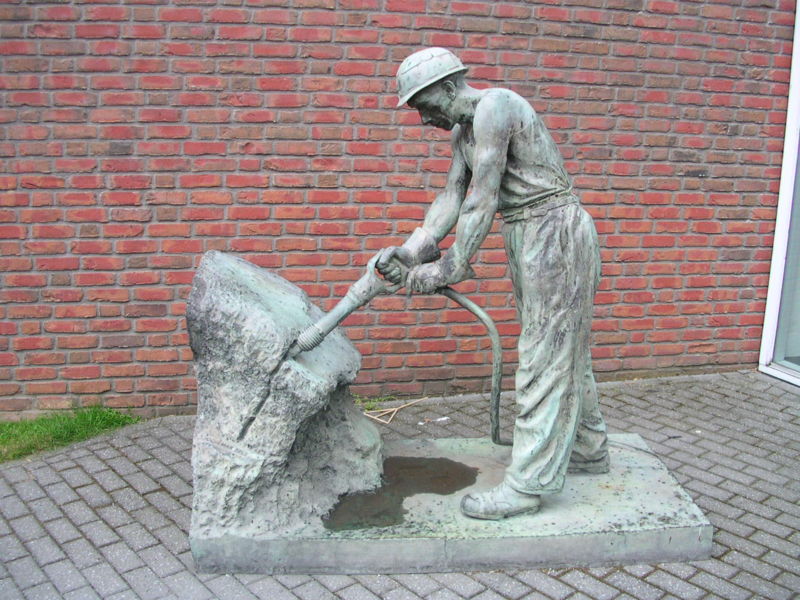
Hardrock miner
Photo by Norbert Schnitzler


There are several items that over the years we have found to be handy added to our exploration kit.  Probably one of the handiest and incidentally the heaviest is a steel anvil 3 inches in diameter by 1 inch thick.  This is used for a simple test for gold.  Gold is malleable and can be flattened with repeated blows with a hammer.  So-called fools gold is brittle breaking up into several fragments, and if reduced to powder turns black.  Gold will retain its true color everything else turns black or in the case of mica turns white.

A hat to shield your punkin head from the hot sun is one of the most valuable things you can have during a prospecting expedition.  A hat also keeps the rain off your head if it starts raining. A simple bill cap will help, but a broad brimmed hat like the cowboy’s wear is even better.  The best one is a hard hat to protect your head from falling objects.

Gloves are another thing you shouldn’t be without because after a day of shoveling or hammering you are likely to find that one of the things you’ve got is a good set of blisters among other things.  The best work gloves for the prospector are leather work gloves.

If you are hunting for gold anywhere there are snakes, and there are always plenty of snakes wherever there is gold you need a pair of snake proof boots.  A rattlesnake can strike so hard that even with snake boots you can still be bruised through your boots.  A snake bite can ruin your day.  If you are messing around in streams one of the most handiest things you can have is a pair of rubber boots, preferably hip boots.

One of the handiest things you can have on a prospecting expedition is a good jeweler’s 10X loup.  Why a 10X because it has a depth of field that is deep enough to bring things into focus.  Loupes larger then a magnification of 10x have a much shorter depth od field to render them virtually useless.  In the same vein a pad and pencil also comes in handy for making notes.  A surveyor’s pad works best because they have water-proof paper.  You could also include a ball point pen.

The really most handy things to have is a good handheld GPS unit.  You can set it at your base station so you will always be able to return.  It is also handy for finding other places where you have been.  Another use for one of these is using it for laying out claims.

Tuesday, May 15, 2012

Gold Occurrences in Paraguay

Map of Paraguay   - CIA

Paraguay is the next area in South America slated for heavy mineral exploration including gold.  Already more then 15 permits have been awarded for the exploration of gold in the country.  Concessions for gold exploration have already been awarded in the southern department of Guaira where several gold nuggets have been already found in the process of exploration.  In addition there are several other interesting areas that are yet to be explored.

In addition to the gold mining prospects there has also been considerable interest in diamonds and platinum group metals combined with nickel.  Most of the companies involved in exploration are still in the prospecting stage.  One of the companies involved in diamond exploration is Toronto-based Rex Diamond (TSX-RXD) that recently asked the government for a six month extension of its license.

The undersecretary also indicated that there are other mid-sized mining companies looking for gold and diamonds throughout the country.  Many of these companies are looking to develop small scale mining operations on their finds.  Meanwhile the Paraguayan Congress is working to overhaul the country’s mining code that will give the authorities and mining industry a greater measure of security for investors and clarify many aspects of the mining code.

Although there has been no recent volcanism in Paraguay there are at least two ancient volcanic provinces in the country to provide heat engines for the depositation of gold.  These are the Alto Paraguay Department where 240 million year old alkaline volcanic rocks underlie younger sediments.  At one point these rocks were explored for their potential uranium and phosphate deposits.

The other area of volcanism is found in a narrow strip along the Parana River these tholetic basalts that belong to the Parana Traps makes up most of the bedrock and underlies younger sedimentary rocks.  These traps also are host to the famous amethyst geodes found in Paraguay and Uruguay.  These volcanics were erupted in the Early Cretaceous as the opening of the South Atlantic Ocean and created minor outcrops seen today in a graben structure seen between Asuncion and Villarrica in the Amambay Department.  Cretaceous volcanism was also responsible for small sodic alkaline intrusions found in the Misiones Department of southern Paraguay.

The rivers that drain suspected gold bearing areas can contain much placer gold that in many cases is of viable commercial mines, but the same placer gold can be used to trace hard-rock gold deposits.  Gold can be found in areas that have undergone volcanism whether it is recent of something that has happened in the geologic past.


Gold Occurrences in Uruguay


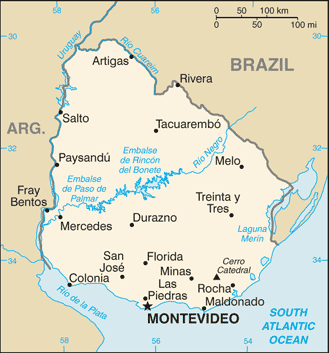
Map of Uruguay


Until 1997 gold was not mined in Uruguay although the potential for finding it existed and a gold mine named El Arenal in Rivera where a $30 million investment created a mine that was expected to last for six years.  This start-off created a sustained growth in the mining industry that is still ongoing.

Although Uruguay has long been noted for its exploitation of non-metallic industrial minerals it has only been within the past few years that metallic minerals have been exploited.  That coupled with significant foreign investment has brought about a rise in production.  The processing of granite is one of the benefactors of this as well as the production of gemstones especially large amethyst lined geodes some as large as houses and other metallic minerals.

Uruguay is a country that has been little explored until recently with the outlook promising for further exploration.  The future of the mining industry in Uruguay is very forward looking with many licenses for mineral exploration having been granted in recent years with national interests driving the further exploration.  Attracting foreign investment is one of the aims of the present government.

Before the continents of Africa and South America split apart millions of years ago Uruguay was joined to Namibia in Africa making it entirely that both gold and diamonds could be found in the country.

Although there are no volcanoes today in Uruguay there is plenty of evidence of past volcanoes and volcanism.  The amethysts are associated with vast flows of basalt that heralded the splitting of the continent of Gondwanaland when the Atlantic Ocean opened during the Triassic/Jurassic to form today’s deposits of basalt.  Earlier volcanic activity occurred during the Precambrian.  These episodes of ancient volcanism provided the heat engines to cause gold to be deposited in favorable places.

Although gold is known to exist in Uruguay it still remains one of the most under-explored countries on the face of the earth.  There is known gold that has already been contracted to a Canadian Mining Company and there are at least two other areas containing gold that haven’t been let out on contract as of yet.  Today the country is like a treasure chest waiting to be opened.

Tuesday, March 20, 2012

Gold Occurrences in Ecuador


Coat of Arms of Wcuador

Ecuador is nestled between Colombia and Peru, but has seen nowhere the amount of exploration the other two countries have, a statement that is especially true of Peru.  According to some of the giants of the gold mining industry like Barrick and Newmont Ecuador is the prime place for exploration.  This is where the gold discoveries are going to be made, not in Peru where they are already mining gold.  Even though Colombia and Peru contain some really big deposits of gold Ecuador just hasn’t seen the level of exploration that has gone on in these other countries.

A great deal of gold has been found over the ages in south-eastern Ecuador including the gold used by the Incas from Pizzaro in the early 1500s.  This was enough gold to fill a room, but the Spaniards still executed the last of the Inca emperors.  The gold found here is epithermal in nature with drilling results by Aurelian Resources indicating a multi-million ounce deposit at their Fruta Del Norte project.

Today there are several exploration companies that are uncovering the enormous potential of this little explored region of South America.  Many of these exploration companies are working within a few kilometers from where Aurelian has its Fruta Del Norte property.  Many of these companies are exploring deposits that could potentially yield many ounces of gold.

Chimborazo one of the many volcanoes found in Ecuador that have epithermal gold deposits associated with them.
Photo by David Torres Costales


The majority of these companies are from Canada that are talking among themselves about arranging joint ventures.  The country of Ecuador is clearly open for business with all indications they have a government that is open for business and are prepared to act in a responsible manner.

Most of the Canadian and other companies are concentrating on the potential of developing lode gold deposits although there is plenty of room for placer deposits along the rivers and streams of Ecuador.  A great many of the deposits in this district are along tributaries of the Amazon River.

The potential for finding gemstones in this part of the world is also high it is just across the border in Colombia where some of the largest emerald mines in the world are located.  Years ago your author while exploring another of the tributaries of the Amazon discovered several sandbars that were littered with gem grade topaz that also contained placer gold.

Monday, January 2, 2012

The Importance of a Business Plan in Gold Mining

A collection of classical capitals.


One of the most important document in gold mining or exploration, any mining or any business ventures is a good business plan that acts not only as a road map as to how the operations will proceed, but is also necessary to get capital for the operations of the business. Yes, gold mining in this sense is like any other business whether it is selling shoelaces or building rocket ships all business have to have a roadmap to their success.

If you are not familiar with a business plan it is a formal statement of the goals of your business. It also includes the reasons why you believe those goals are achievable and how you expect they can be achieved, and the way you are going to reach these goals. The business plan may also contain information about the personalities that will be conducting the operations necessary to achieve these goals.

A well-written business plan will also target whatever changes that may occur as to how the public perceives the business and its branding by the customer, client, taxpayer or the larger community as a whole. When your operations assume a major change such as the gold turning the copper at depth as often happens. It can be also used for planning new ventures or additional minds. Most principals or investors require a 3 to 5 year business plan since investors will look for their annual return of investment in that length of time.

There is a great deal of information about business plans on the Internet that can be found by Googling the phrase business plan. In addition there are also many, many templates that are available online where literally all you have to do is fill in the blanks and your business plan is written. Using one of these blanks is very helpful, however the best way to write an effective business plan is by scratch. At the very least by Googling business plan you can quickly gather a great deal of information as to how to write one.

No matter whether you use a pre-existing template or start writing your business plan from scratch you will quickly discover how much smoother everything goes for you. The business plan will not only direct you in operating the mine have but also make raising money far easier. There is not any operation on earth that does not benefit from a well written business plan.

Tuesday, August 16, 2011

Gold Occurrences in New Brunswick


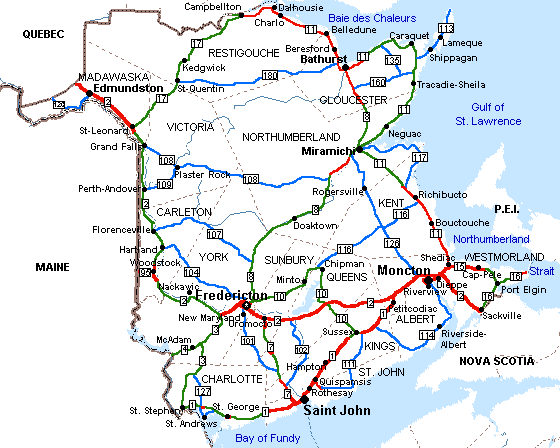
Road Map of New Brunswick


Because New Brunswick shares an extremely complex geological past with the New England States further south combined with government policy to develop their mineral resources the province has many mines in both the Bathurst camp in northeastern New Brunswick and at the Mt. Pleasant Camp producing a wide variety of metals ranging from the base metals of copper, lead and zinc to the precious metals of gold and silver finishing with rare metals such as indium. At Mt. Pleasant with sizeable amounts of indium occur with deposits of tin, tungsten and molybdenum. The province also exports sizeable amounts of cadmium, bismuth and antimony to a worldwide market.  In the southwest portion of the province there is extensive exploration for gold ongoing along the Clarence Stream.

By virtue of its diverse geological history New Brunswick has several different ways in which gold can occur.  In northern New Brunswick gold is found in the form of epigenetic formations in quartz veins following major faults and shear zones.  It is also found in gossens caused by the oxidation of volcanogenic massive sulfide (VMS) deposits of metals including pyrite and other iron sulfides. 

One of the largest faults found in North America passes through Newfoundland, Nova Scotia and Quebec just Missing New Brunswick by passing just to the north of the province.  This fault continues south through New England finally vanishing into the Atlantic Ocean south of Staten Island, New York.  Through its length it has several different names starting in New York it is called Cameron’s Line through Connecticut.  At the Connecticut/Massachusetts Border it is renamed the Whitcomb Summit Fault through Vermont where it passes along the west shore of Lake Memphramagog where it enters Quebec where it is renamed the Brampton/Baie Verte Fault.  When the continents divided during the Jurassic its northern end passed through the British Isles, and finally it went into the western edge of Norway where it finally vanishes.  This fault in reality is where North America collided with an island arc that was far out in the Iapetus Ocean that preceded the Atlantic Ocean.  In Greek Iapetus was the father of Atlantis for whom the Atlantic Ocean is named..

Like all suture zones its companion fault is interpreted to be a subduction zone with many metallogenic features that are remnants of the ancient ocean floor.  Most of the mineral deposits are found on the oceanic side of the fault where there are many VMS deposits and altered oceanic crust containing gold and other metals.  The altered oceanic crust is greenstone that is suspected to be the source rock for gold deposits.  The Abitibi Gold Belt of Quebec and Ontario has a similar history, but is much older.

There are two major gold producing areas in New Brunswick when this in the northern part of the province and is related to the Bathurst mining district. The other is along the bay in Fundy in the southern part of the province that is called the Annidale Belt. New Brunswick is located at the northern end of the Appalachian Orogen and shares its convoluted geology with the rest of the Appalachian Oregen.  The convoluted geology found in northern New Brunswick can be traced all the way to Staten Island NY.

Another place where placer gold has been found is in the Carboniferous rocks found in central New Brunswick that laps over into the province from Nova Scotia.  One of the places where you might find gold is in the later conglomerates that are products of erosion that washed down from older mountains.

Tuesday, February 15, 2011

Gold Occurrences in Madagascar

Although in the past Madagascar was a significant gold producer but because of its tumultuous political history for many years it remained in the doldrums. Today Madagascar is considered to be an up-and-coming place for mining now the political situation has become more stable. Today Madagascar has become a beacon for the mining and exploration industry that right now is largely undeveloped.

Madagascar is shown in red.

For those who don't know where Madagascar is, is approximately 400 km due east of the African mainland. It is separated from Africa by the Mozambique Channel.

Although the island has a vast potential for hosting valuable mineral deposits right now the country does not have a well-developed mining industry. As little as 30 years ago it was one of most geologically studied areas in the African region, but then the country underwent a period of political instability resulting in mineral exploration being put on the back burner. It wasn't until 1993 that the political instability vanished when the country returned to a liberal democratic form of government. It wasn't until recently however, that it began to regain some of the lost footing it once had in exploration and mining.

Although Madagascar is considered to be a part of the African Continent the island geologically is a micro-continent between Southern Africa and India. This becomes readily apparent when you start looking at the local geology and the flora and fauna. The geology of the island is more akin to that of Sri Lanka and India that is anything found in Africa.

Madagascar's primary gold deposits are similar to those of the Abitibi region of Canada than anything else. Like the Abitibi the gold is associated with greenstone belts, quartz reefs and veins, and is also found the fuse for the country rock in deposits similar to those of the Carlin Trend in Nevada.  There is a great deal of gold that is also associated with that volcanogenic massive sulfide (VMS) deposits similar to those that are found at the kidd Creek Mine in Timmins, Ontario or the Horne Mine in Rouyn-Noranda, Québec. Both of these mines are in the Abitibi Gold Belt of Canada.

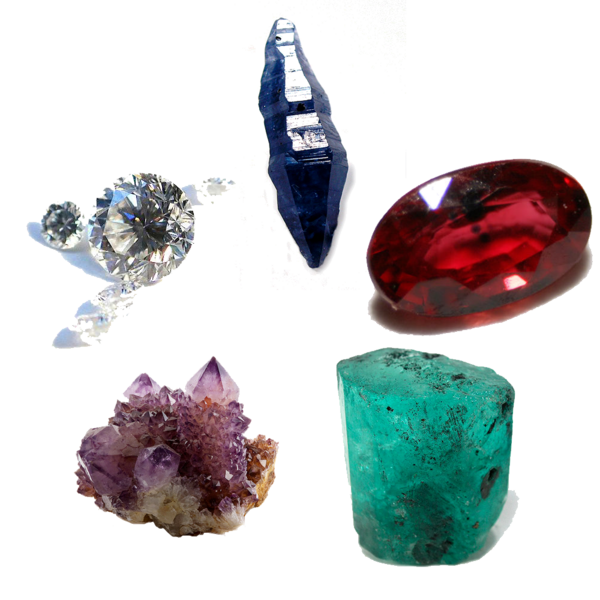
Gold isn't the only thing found in Madagascar that is worth money.
Photo by Rob Lavinsky

Alluvial gold is also been recovered from both ancient and recent placer deposits as well as lateritic earth. Aside from the gold deposits found in Madagascar is also the home of many valuable gemstones including those of the ruby and sapphire family that are mined mainly by artisanal miners although in some cases a few of these mines have been mechanized.

Although the primary gold deposits found on the island predate the breakup of Gondwana one of the two continents that made up the supercontinent Pangaea. This is very important to remember because it makes the regional tectonics arrival into the emplacement of gold deposits. Madagascar's gold bearing rocks are all part of its suite of basement rocks. These rocks are divided into three different systems with the youngest being the Vohibory System, the middle is the Graphite System and the oldest is the Androyen System. Most of the gold however is found in the graphite system. There are also some interesting gold deposits in the Vohibory System.