Total Pageviews

Showing posts with label volcanism. Show all posts

Monday, May 28, 2012

The Lost Dutchman Gold Mine


Weaver's Needle in the Superstition Mountains where the Dutchman hid his gold.
Photo by Alan English


Of all the lost mines in America the most famous is the Lost Dutchman Gold Mine that according to its legend is hidden away in the Superstition Mountains located near Apache Junction, east of Phoenix, Arizona.  Other people claim its way past the Superstitions in Mexico.  No one really knows where the mine is located.

The Superstition Mountains can be divided into three distinct groups that can be divided into (1) rock type, (2) structure and (3) process.  Most of the rock type consists of volcanic extrusives that are associated with volcanism.  The structure is consistent with the landform types found accompanying volcanic action and tectonic activity.  This is just the place where you would go looking for gold.  Erosion and mass wasting account for any placer gold that is present.  There are some small areas of sedimentary and metamorphic rocks as well as some Precambrian granite intrusions to be found.  Most of the volcanic activity is from fissure eruptions rather then volcanoes.
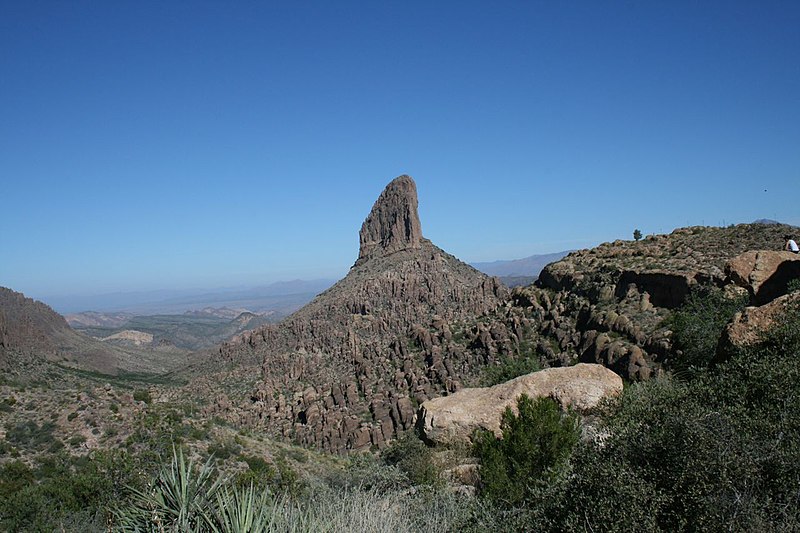
Another view of Weaver's Needle
Photo by Ihelewa


The Lost Dutchman Gold mine that is also known by many other similar names is the tale of a very rich gold mine hidden away in the Superstition Mountains, but because Jacob Waltz, the Dutchman, kept the secret of its location to himself.  There are several different tales about how to find the mine and each year there are people that go hunting for it.  Some of these gold seekers have even died in the process.

The mine itself was named after the German immigrant Jacob Waltz that the locals mistakenly called the “Dutchman” that was American slang for a German.  This is derived from the German word for German – “Deutsch.”  The Lost Dutchman is no doubt the most famous lost mine in American history rivaling tales of Captain Kidd’s lost treasure or the Lost Pegleg Mine in California.

Prior to Waltz’s reported discovery in the 1840s the Mexican family, the Peraltas were reported to mine gold in the Superstitions where in 1848 a large group of the Peraltas was ambushed by the Apaches with only one or two members escaping.  There is plenty of evidence of this massacre to be found in the Massacre Grounds where old mining equipment, old weapons, assorted gear and the remnants of a pack train have been found.

The legend goes on to say the Peraltas covered the mines with large rocks to hide their riches from others.  Since then many men have claimed to have found the hidden mines from the number of old maps that have surfaced.  However the men making such claims are unable to return to these mines due to any number of calamities and disasters.  These tales lend truth to the tales of the “Curse of the Superstitions.”

During the 1970’s “the Dutchman” aka Jacob Waltz supposedly found one of Peralta’s gold mines with his partner Jacob Weiser another German.  The story goes on to say they hid some of the gold they found in the area around Weaver’s Needle.  Later Weiser was killed either by the Apaches or Waltz himself.

Waltz later moved to Phoenix where he died in 1891.  Before he died he described the location of the mine to Julia Thomas his landlady.  She became one of the first treasure hunters in 1892, she or other treasure hunters have never been able to find the lost mine since.  Many of them came to a sudden end due to foul play, murder, death or the curse hanging over the Superstition Mountains.

It has been estimated that 8,000 treasure seekers a year have been looking for the Dutchman’s mine since 1892.  Many claim there is no basis to the tale and it is nothing more then a legend, although it is claimed there is some basis in fact to the tales.  Many versions of this tale claim the mine is either cursed, or protected by some kind of guards, usually the Apaches that keep the location of the mine secret.


Tuesday, May 15, 2012

Gold Occurrences in Paraguay

Map of Paraguay   - CIA

Paraguay is the next area in South America slated for heavy mineral exploration including gold.  Already more then 15 permits have been awarded for the exploration of gold in the country.  Concessions for gold exploration have already been awarded in the southern department of Guaira where several gold nuggets have been already found in the process of exploration.  In addition there are several other interesting areas that are yet to be explored.

In addition to the gold mining prospects there has also been considerable interest in diamonds and platinum group metals combined with nickel.  Most of the companies involved in exploration are still in the prospecting stage.  One of the companies involved in diamond exploration is Toronto-based Rex Diamond (TSX-RXD) that recently asked the government for a six month extension of its license.

The undersecretary also indicated that there are other mid-sized mining companies looking for gold and diamonds throughout the country.  Many of these companies are looking to develop small scale mining operations on their finds.  Meanwhile the Paraguayan Congress is working to overhaul the country’s mining code that will give the authorities and mining industry a greater measure of security for investors and clarify many aspects of the mining code.

Although there has been no recent volcanism in Paraguay there are at least two ancient volcanic provinces in the country to provide heat engines for the depositation of gold.  These are the Alto Paraguay Department where 240 million year old alkaline volcanic rocks underlie younger sediments.  At one point these rocks were explored for their potential uranium and phosphate deposits.

The other area of volcanism is found in a narrow strip along the Parana River these tholetic basalts that belong to the Parana Traps makes up most of the bedrock and underlies younger sedimentary rocks.  These traps also are host to the famous amethyst geodes found in Paraguay and Uruguay.  These volcanics were erupted in the Early Cretaceous as the opening of the South Atlantic Ocean and created minor outcrops seen today in a graben structure seen between Asuncion and Villarrica in the Amambay Department.  Cretaceous volcanism was also responsible for small sodic alkaline intrusions found in the Misiones Department of southern Paraguay.

The rivers that drain suspected gold bearing areas can contain much placer gold that in many cases is of viable commercial mines, but the same placer gold can be used to trace hard-rock gold deposits.  Gold can be found in areas that have undergone volcanism whether it is recent of something that has happened in the geologic past.


Monday, November 28, 2011

Gold Occurrences in Guatemala


Coat of Arms


Guatemala is the northern most country in Central America adjoining Mexico on its southern border.  Gold mining has been practiced in Guatemala since before the days of the Spaniards by the Maya Indians, and is still being practiced today.. the country is mounted on the north by Mexico, on the northeast by Belize and on the South by Honduras. The Caribbean Sea lies to the east, and the Pacific Ocean to the West.

Some of the core rocks of Guatemala were laid down around 370 million years ago that have since been overlaid by tertiary volcanism many of these mountains contain iron, copper, lead, zinc and traces pf gold and silver that are still being mined today.  The Tertiary period when dinosaurs roamed the Earth was when this massive layer of volcanic rocks were laid down with their accompanying mineral deposits.  The eruptions did not stop during the Tertiary there are volcanoes still erupting today in Guatemala

Volcan Flores one of the many volcanoes of Guatemala
Photo by Rick Wunderman (Smithsonian Museum)


As recently as 23,000 years a very large eruption occurred for me a call barrel that is now occupied by Lake Atitlan in the Guatemalan highlands.  One recent eruption of Mt. Santa Maria in 1902 was one of the most violent eruptions of the 20th Century.  As recently en eruption of the volcano Pacaya in September 2010 caused 1,800 people to flee their homes as the volcano spewed ash, lava and rocks over the surrounding countryside.  The eruption was also blamed for at least three deaths.

It is a well known fact that gold is often found in the vicinity of former volcanic eruption's in deposit great amounts of gold by the action of hot water. Even today there are many hot springs to be found in Guatemala in it which could still be bearing gold laden waters. An especially good place to look for gold is around ancient volcanoes especially those that have created calderas. Gold is not usually found in the center of a caldera but rather at its edges. Many times these gold deposit a company magnetic highs that are found at the outer edges of a caldera eruption.

A great deal of Guatemala is covered by tropical rain forest combined with the rugged terrain and it's prospecting in the country very difficult although not impossible. This condition prevails through all of Central America. In Guatemala there are both placer and lode deposits of gold.  Gold can be found in most of the rivers and streams flowing down from the highlands of the country. Because of ground cover finding lode gold is more difficult although not impossible if you use modern geophysical instruments.

Gold is often accompanied by deposit so magnetite that is sensitive to a flux gate magnetometer. There are other advanced methods of exploring for gold including one very accurate means that involves taking soil samples, and subjecting the samples to analysis by an atomic absorption spectrometer.

It is possible that the area encompassed by Central America could well prove to be one of the most mineral rich areas in the world. 

Saturday, March 5, 2011

Epithermal Gold Deposits

Epithermal gold deposits are typically found in a near surface environment where the gold and other metals are deposited usually within 1.5 km from the surface. This type of deposit is always associated with volcanism either of the surface of the earth or in spreading centers at the bottom of the sea where their physical manifestation is hot springs, or are found associated with black smokers. They are commonly found in the vicinity of volcanoes either presently active or extinct where they form a halo around the point of eruption.

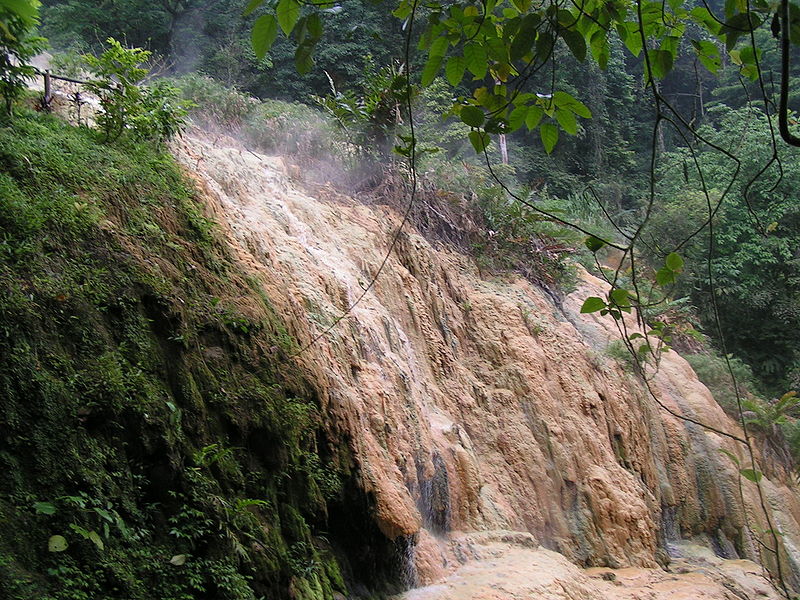
This is the type of mineral deposits that can be laid down by a hot spring.

An area where a epithermal deposits are common and is in the caldera of Yellowstone National Park where various mineral deposits are being deposited to this day due to the action of geysers, hot Springs and other geothermal events. This can be observed in the deposits of sinter that builds up around the geysers and hot springs. Yellowstone park itself is in a giant caldera that was caused by an eruption that occurred about 640,000 years ago. The hot spring activity that is associated with the park is caused from a magma chamber that is relatively close to the surface.

A prospector I know is working in volcanic terrain where the last eruption was 3 million years ago where the erosion rate is ~1 mm/year indicating that about 3 km of rock has eroded from the site since it had its last eruption.  In this terrain that is located within an ancient caldera enough of the surface rock has eroded away so that most if not all the epithermal deposits that were present, but around the periphery of the caldera one is more apt to discover epithermal deposits of gold and other metals then inside the caldera itself.

This is gold deposited on barite a common association in epithermal deposits.
Photo by Rob Lavinsky

This does not mean that gold deposits can’t be present in such an environment it just means that they are not likely to be epithermal deposits.  Although epithermal deposits are precluded by the depth of erosion it does not preclude other types of other hydrothermal deposits. Since epithermal deposits occur within a low-temperature environment that occurs less than 1.5 km below the surface it stands to reason that if there are still hot springs in this caldera it is still possible to have epithermal deposits occurring as secondary deposits superimposed on other deposits of hydrothermal origin.

Epithermal deposits occur in three different phases depending upon how much sulfur is present in the epithermal water. Deposits of this nature are classified as high sulfidation, intermediate sulfidation and low sulfidation each of these types of deposits are identified by their alteration mineral assemblages, occurrence, texture and in some cases are even identified by the associated element. Pyrite is the most common of these minerals, but you can also find mercury, antimony, arsenic and tellurium. Included in this suite it is also possible to find the base metals copper, lead and zinc as well as gold and silver. Gold and silver may be alloyed together as the alloy electrum.