Total Pageviews

Showing posts with label metals. Show all posts

Sunday, June 3, 2012

Gold Occurrences in Angola


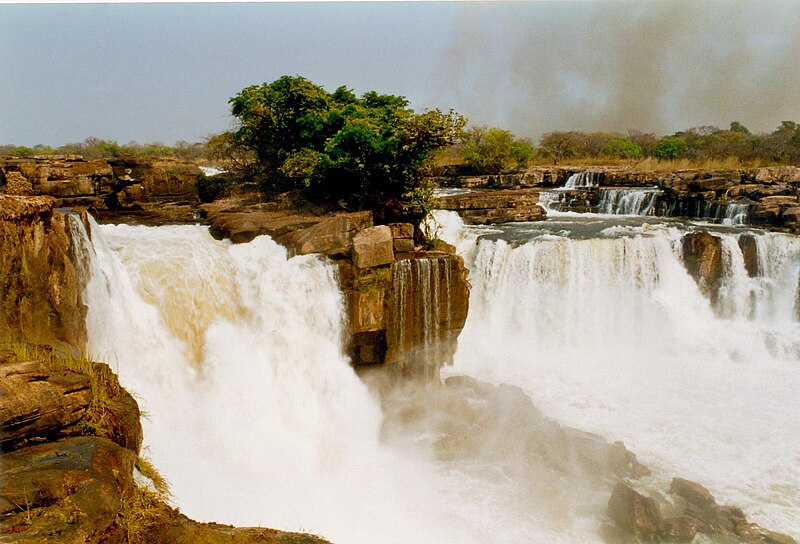
Tazua Falls on the Rio Cuango is one of the richest diamond and gold rivers in Angola
Photo by Brian Harrington Spier


Gold and base metal potential remains in Angola, but because of the ongoing civil war in Angola much of this potential remains unexploited.  Even though the country has been wracked by this conflict mining still provides the country with some foreign exchange with about 98% of it coming from diamonds.  The rest of the countries earnings are from oil.  Before the civil war Angola was an important producer of gold and other metals.  Because of the ongoing civil war it is difficult to reach much of the country from the outside.  No doubt there are world class deposits of gold waiting to be discovered in Angola.

Geologically Angola was once part of Southern Brazil until the Atlantic Ocean commenced opening during the Triassic period 220 million years ago; today the two countries are separated by the Atlantic Ocean.

Twelve billion barrels of oil have been found in the deep waters off the coast of Angola since it was first discovered in 1955.  Officials at Sonangol, the country’s oil company say this is only a small part of the total potential.

Upper Proterozoic Fold Belts of the Pan African are found along the margins of Angola’s Precambrian shield.  Among the most important are the West Congo, Damara and the Maiombe-Macongo.  This fold belt displays the occurrence of both gold and base metals along with a wide variety of industrial minerals.

The Lower Protozoic and Archean rocks are composed of the Angloan, Maiombe, Cassai and Bangwelo shields along with the granitic, gneissic rocks sedimentary (greenstone) belts from the Angolan, Maiombe, Cassai and Bangwelo shields and the Kwanza meta-
Volcanic sedimentary (greenstone) belts are present in the south-central part of the country as the Cassinga and Menonque greenstone belts.  These rocks go on to the Cunene basic to ultra basic complex that occupies more then 20,000 sq. km in southwestern Angola.

Angola is blessed with mineral riches with most of the rivers flowing down from these areas bearing lode gold and there is plenty of areas bearing lode gold waiting to be explored.

Saturday, March 19, 2011

Gold of a Different Color

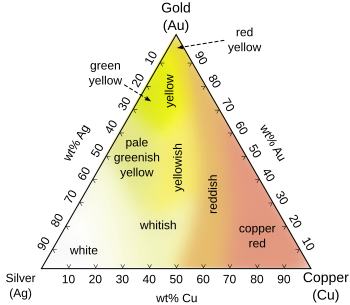
Everyone knows that pure gold is the color of the early morning sun, a great golden yellow, but one gold is pure it is too soft to be worn or have any other useful purpose other than its intrinsic value. Not all gold is golden yellow because when it is alloyed it is possible for the metal to assume different colors. The effective changing of the color of gold has been known to goldsmiths for thousands of years to create many of the effects that are seen in gold jewelry. This effect is produced by alloying gold with other base metals.

This is a phase diagram illustrating the various colors of gold alloys.
Image by Metallos

One of the most common ways that the color changes and gold are observed is when different alloys are combined as inlays in jewelry where the lighter color of a particular alloy is used in conjunction with a darker colored alloy.

Although most interesting varieties of jewelry made this way is what is termed Black Hills Gold. Most of the jewelry made from this kind of gold is 10 to 12 caret is carefully alloyed with other metals to create the colors.

A Tibetan gold statue from Mustang made from an alloy of gold and copper. 

Pink or rose gold is created by alloying copper with the gold causing it to acquire a pinkish or rose-colored caste. Another common alloy of gold creates a greenish caste by making an alloy containing silver.

Metallurgists will find them there recipes for different colors of gold. There is even a purple colored gold that is produced by alloying gold and aluminum.

Saturday, March 5, 2011

Epithermal Gold Deposits

Epithermal gold deposits are typically found in a near surface environment where the gold and other metals are deposited usually within 1.5 km from the surface. This type of deposit is always associated with volcanism either of the surface of the earth or in spreading centers at the bottom of the sea where their physical manifestation is hot springs, or are found associated with black smokers. They are commonly found in the vicinity of volcanoes either presently active or extinct where they form a halo around the point of eruption.

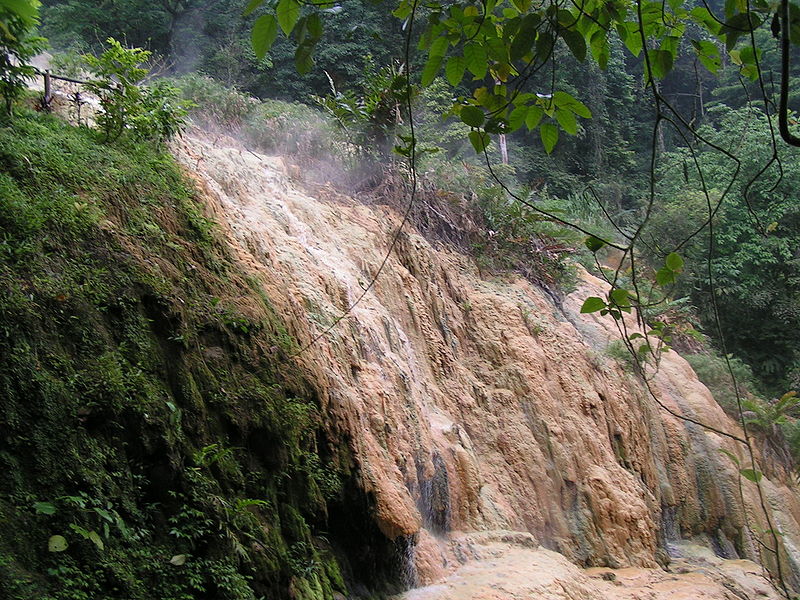
This is the type of mineral deposits that can be laid down by a hot spring.

An area where a epithermal deposits are common and is in the caldera of Yellowstone National Park where various mineral deposits are being deposited to this day due to the action of geysers, hot Springs and other geothermal events. This can be observed in the deposits of sinter that builds up around the geysers and hot springs. Yellowstone park itself is in a giant caldera that was caused by an eruption that occurred about 640,000 years ago. The hot spring activity that is associated with the park is caused from a magma chamber that is relatively close to the surface.

A prospector I know is working in volcanic terrain where the last eruption was 3 million years ago where the erosion rate is ~1 mm/year indicating that about 3 km of rock has eroded from the site since it had its last eruption.  In this terrain that is located within an ancient caldera enough of the surface rock has eroded away so that most if not all the epithermal deposits that were present, but around the periphery of the caldera one is more apt to discover epithermal deposits of gold and other metals then inside the caldera itself.

This is gold deposited on barite a common association in epithermal deposits.
Photo by Rob Lavinsky

This does not mean that gold deposits can’t be present in such an environment it just means that they are not likely to be epithermal deposits.  Although epithermal deposits are precluded by the depth of erosion it does not preclude other types of other hydrothermal deposits. Since epithermal deposits occur within a low-temperature environment that occurs less than 1.5 km below the surface it stands to reason that if there are still hot springs in this caldera it is still possible to have epithermal deposits occurring as secondary deposits superimposed on other deposits of hydrothermal origin.

Epithermal deposits occur in three different phases depending upon how much sulfur is present in the epithermal water. Deposits of this nature are classified as high sulfidation, intermediate sulfidation and low sulfidation each of these types of deposits are identified by their alteration mineral assemblages, occurrence, texture and in some cases are even identified by the associated element. Pyrite is the most common of these minerals, but you can also find mercury, antimony, arsenic and tellurium. Included in this suite it is also possible to find the base metals copper, lead and zinc as well as gold and silver. Gold and silver may be alloyed together as the alloy electrum.