Total Pageviews

Showing posts with label effects. Show all posts

Tuesday, May 15, 2012

Gold Occurrences in Bolivia


A scene from Potosi a famous Bolivian mining center.  Note the volcano in the background a source of gold deposits.
Photo by Idobi


Although Bolivia is noted for its tin production especially in the area around Potosi gold mining and prospecting proceeded at a brisk rate during the late 1980s.  Gold is found throughout the country with more then 300 cooperatives and over 10,000 prospectors producing gold.

Bolivia like many other countries in the world now faces a trade-off between economic growth vs. the environment.  The country derives much of its foreign exchange from the mining industry with zinc being its largest mining export followed by tin, gold and silver. As a result of this dilemma Bolivian mining companies have developed tighter rules with gold mining being an important source of foreign exchange for the country.  Things get difficult because Bolivian and U.S. environmental groups continue to fight prospecting and mining efforts because of their devastating effects on the local environment.

The practices of the mining industry leads to soil erosion combined with pollution of the country’s fresh-water resources.  This leaves the peons of the country torn between mining and jobs or protecting the environment that fails to bring Bolivia much needed jobs.

Mining is the mainstay of Bolivia’s economy with around 50% of its foreign exchange coming from this source.  The country’s private mining sector has continued to grow led by Canadian and U.S. companies.  The government has set aside a large area about 120 km north of LaPaz for gold mining and exploration.

There are plenty of active and extinct volcanoes in Bolivia to provide heat engines to drive the hydrothermal waters responsible for building gold deposits when the water reaches conditions that will precipitate the dissolved gold from solution.  This volcanic activity has given birth to extensive deposits of hard rock gold and abundant placer deposits in the country’s rivers and streams.  There is both artisanal and full scale mining in Bolivia, and it’s still ongoing.

Mining has been going on in Bolivia since the days of the Spanish conquest that began in 1524 and was mainly completed in 1833.  In those days after the conquest what is now Bolivia was known as “Upper Peru.”  When it was founded in 1545 as a mining center Potasi quickly started pouring immense mineral wealth into the coffers of the Spanish Empire it quickly became the largest city in the New World with a population larger then 150,000.  The Spaniards were mainly interested in gold it was later that Potasi became known for its tin deposits.  Mineral wealth continues to pour from Bolivia. .   

Saturday, March 19, 2011

Gold of a Different Color

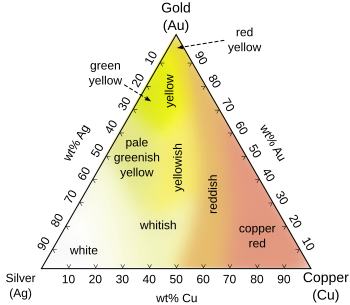
Everyone knows that pure gold is the color of the early morning sun, a great golden yellow, but one gold is pure it is too soft to be worn or have any other useful purpose other than its intrinsic value. Not all gold is golden yellow because when it is alloyed it is possible for the metal to assume different colors. The effective changing of the color of gold has been known to goldsmiths for thousands of years to create many of the effects that are seen in gold jewelry. This effect is produced by alloying gold with other base metals.

This is a phase diagram illustrating the various colors of gold alloys.
Image by Metallos

One of the most common ways that the color changes and gold are observed is when different alloys are combined as inlays in jewelry where the lighter color of a particular alloy is used in conjunction with a darker colored alloy.

Although most interesting varieties of jewelry made this way is what is termed Black Hills Gold. Most of the jewelry made from this kind of gold is 10 to 12 caret is carefully alloyed with other metals to create the colors.

A Tibetan gold statue from Mustang made from an alloy of gold and copper. 

Pink or rose gold is created by alloying copper with the gold causing it to acquire a pinkish or rose-colored caste. Another common alloy of gold creates a greenish caste by making an alloy containing silver.

Metallurgists will find them there recipes for different colors of gold. There is even a purple colored gold that is produced by alloying gold and aluminum.