Total Pageviews

Showing posts with label gold and silver. Show all posts

Wednesday, February 1, 2012

Cleaning up Concentrates containing Gold and Platinum

Hematite particles forming ferro-fluid with a rare earth magnet beneath a sheet of glass.

One of the problems in the recovery of gold,silver and platinum from concentrates of stream heavies is the removal of iron oxides that make up the majority of heavies. Most of the other heavies are composed of silicates and in rare cases oxides of various elements. In the case of iron oxide there are two types present in most heavies. The most easily removed is magnetite because it is attracted to an ordinary magnet with the best being an Alnico magnet. This will quickly remove the magnetite that is the easiest to remove. Hematite is the second iron oxide in heavies that is not attracted to an ordinary magnet, but is attracted to a rare earth magnet that can be ordered on the internet. The remaining heavies composed of mineral silicates and oxides being much less dense and having a far lower specific gravity then gold, silver or platinum that is left behind in the pan.

The iron oxides can be removed in two stages; the first is removing magnetite. There are commercial magnetic separators available, but for the small amount usually encountered an ordinary magnet will suffice. A small amount of concentrate that has been thoroughly dried is placed on a sheet of paper and the magnet is passed over the concentrate just above its surface, but high enough not to touch the concentrate. The magnetite present will stick to the magnet so you will have to periodically remove it from the magnet.

The hematite is removed in the second step by using a small rare earth magnet by repeating step 1 using the more powerful magnet the remaining concentrate containing heavies, gold, silver and platinum group metals. This concentrate is poured into a separate container for further work in the process.

Although geologists know ways of separating heavies using dense fluids, but they are all highly toxic and shouldn’t be used by an untrained layman. The best way to remove them is with a small ten inch gold pan immersed in water using conventional panning methods. Its tedious work, but the pan full of concentrate can be worked down until the only thing left in the pan is gold, silver and platinum group metals (PGM).

The remainder in the pan is gold, silver and PGMs that are saved for further processing; because of the length of the whole process we are going to divide it into several articles we will publish in the near future. Watch for them!

Saturday, March 19, 2011

Gold of a Different Color

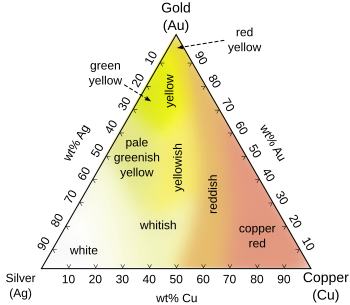
Everyone knows that pure gold is the color of the early morning sun, a great golden yellow, but one gold is pure it is too soft to be worn or have any other useful purpose other than its intrinsic value. Not all gold is golden yellow because when it is alloyed it is possible for the metal to assume different colors. The effective changing of the color of gold has been known to goldsmiths for thousands of years to create many of the effects that are seen in gold jewelry. This effect is produced by alloying gold with other base metals.

This is a phase diagram illustrating the various colors of gold alloys.
Image by Metallos

One of the most common ways that the color changes and gold are observed is when different alloys are combined as inlays in jewelry where the lighter color of a particular alloy is used in conjunction with a darker colored alloy.

Although most interesting varieties of jewelry made this way is what is termed Black Hills Gold. Most of the jewelry made from this kind of gold is 10 to 12 caret is carefully alloyed with other metals to create the colors.

A Tibetan gold statue from Mustang made from an alloy of gold and copper. 

Pink or rose gold is created by alloying copper with the gold causing it to acquire a pinkish or rose-colored caste. Another common alloy of gold creates a greenish caste by making an alloy containing silver.

Metallurgists will find them there recipes for different colors of gold. There is even a purple colored gold that is produced by alloying gold and aluminum.

Thursday, March 3, 2011

Gold Occurrences in Virginia

The first printed reference the gold being found in Virginia was in 1782, when it was reported by Thomas Jefferson involving a 4 pound piece of gold bearing rock that was found on a north side of the Rappahannock River at a distance of about 4 miles below its falls. This was only the first report because gold was produced in Virginia amounting to about 100,000 troy ounces dating from 18 42 1947 when the last of the over 301 gold mines and prospects in the state closed down.

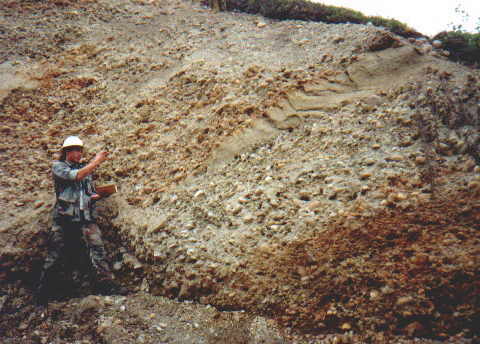
Alluvial (Placer) Gravel containing placer gold.
Photo by Dennis Garrett

The bulk of this gold was discovered in the so-called Gold-Pyrite Belt that essentially includes the Piedmont and the eastern slopes of the Blue Ridge Mountains. By May of 1995 the division of mineral resources had documented 301 mines and prospects producing gold and silver or places where they are known to have occurred.

Besides the placer deposits that are found in the areas of the Piedmont and Blue Ridge Mountains that contain gold; it is also found as free gold in quartz veins, or it may occur with pyrite as thin films on the crystal faces between individual pirate crystals. Gold also is known to occur as an alloy with other base metals in various massive sulfide deposits. It is the weathering of these kind of deposits that produces placer gold that can occur as grains, flakes or sometimes even nuggets of free gold.

The first lode deposit of gold that was discovered in Virginia occurred during 1806 at the Whitehall mine that was 1.5 miles to the northwest of the Shady Grove Church in the western part of Spotsylvania County. The Virginia Mining Company of New York has the title of being the first mining company in Virginia to produce lode gold. This company operated a lode deposit of gold in the so-called “Grasty” tract along Mine Run in Orange County for over 100 years from 1831 to 1934 of over a century. Old records show that at least five mining companies operated in the general area in period from 1831 until 1910 having several different episodes of substantial mining activity.

During the early 1800s: Virginia was often extracted from what are termed shallow saprolites that were formed by deep weathering of the rock that contained lode gold. The type of gold mining that occurred in these deposits was relatively simple because labor was cheap so they were able to use hand shoveling; panning, sluicing and dredging that could be accomplished without any further processing. This type of deposit is able to produce gold at a profit in 1837 if there was a dollar's worth of gold available from every bushel of ore. At the time it was estimated the cost of mining 100 pounds of rock was about $.35 per bushel. Deposits of this type were mined until the deposits were exhausted.

Once saprolite deposits were used up the miners had to resort to underground mining methods for the recovery of gold. Operating in underground gold mine is far more expensive than working placer deposits because the ore is in the form of a hard rock that has to be pulverized before any kind of recovery system can be used. During the decades preceding the Civil War it has been estimated that lode gold mines of Virginia produced about 3000 ounces of gold every year.

It was the California Gold Rush of 1849 that really spell the death knell to gold mining in Virginia because many of the miners moved to California allowing gold production in Virginia to decline. During the Civil War gold mining operations throughout the South were destroyed as a matter of policy by the Union Army.

During a meeting of the Prospectors and Developers Association of Canada (PDAC) in early March of 2008 the author was speaking with some other mining executives where it was revealed that one of the main targets for exploration in the near future would be in the southern Appalachians. Even if the big boys haven't arrived yet there are hundreds of part-time gold miners that have been combing the hills and valleys of Virginia for gold.

Sunday, January 23, 2011

Gold Occurrences in New York State

Although gold is known to occur in New York State a law dating back to the birth of the United States in 1776 dictates that any gold found in the state will remain the property of the State of New York. The effect of this law that is still on the books has acted as a damper on any efforts to find gold. Even if you were to find gold in your own backyard if you read the fine print on your deed you will find that gold does not belong to you but to the state. Efforts are now being made to change that law to date it is still in effect. Not only gold is affected by this law, but so is silver. Plainly the law says all gold and silver deposits found in New York will remain the property of the state. This law has been amended several times over the years allowing the finder of a gold deposit a period of several years to work his claim.

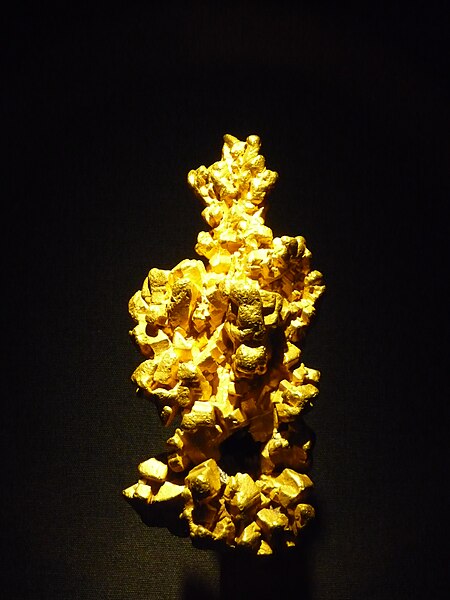
This is what gold looks like in the form of the Latrobe Nugget on display in the London Natural History Museum.
Photo by Gump Stump

Looking at a geological map of New York State it is easy to see that there are several environments in the state that are likely to contain both lode and placer gold. Probably the most likely place where you can find lode gold is in the Adirondacks, and the second most likely place is in the Hudson Highlands, and strangely enough right in New York City. These are areas in New York State where the bedrock is made up of crystalline rocks that may, or may not be the host for gold.

There is a lineation associated with the west bank of the Hudson River called Logan's line that marks the westernmost part of the Taconic orogeny. Anywhere to the east of this line it may be possible to find gold especially in the quartz veins found in the Slate belt of eastern New York along the border with New England.

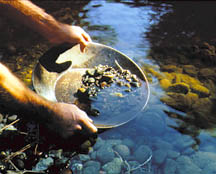
This is how you pan for gold.  USGS

Two of the counties gathering attention are Columbia and Saratoga counties. Although the particulars of these deposits are not clear from examining the geology found in those counties it is apparent they are probably lode deposits.

Another potential source for gold is found in the conglomerate of both the Schwangunks and Catskills where it was weathered out of high mountain ranges that light to the east. The rocks that are found in the Schwangunks were deposited in the Queenstown Delta, and the conglomerates that are found in the Catskills were eroded from another later mountain range that light even further east. These ancient conglomerates could be the host of fossilized placer deposits similar to the Witwatersrand Reef in South Africa, the world's largest deposits of gold.

It may look like Manhattan, but there is likely to be gold under its streets.
Wikimedia Commons

There is likely to be gold found in placer deposits across the length and width of New York that were brought down by the action of continental glaciers in at least three glaciations in the past 1 million years. Immediately to the north of New York State lies the Abitibi Gold Belt of Québec and Ontario. This extends for over 500 miles from Wawa, Ontario to Val ‘Dor, Québec. The scouring action of the glacier removed any gold that was loose in the soil of these provinces and took it south to be deposited across the width of New York State.

Just to the north of the Pennsylvania State line is the terminal moraine of the last glacier. This is an area that would be no doubt be good for prospecting in the many streams and rivers that cut through the glacial deposits. The action of running water would tend to concentrate any gold that was deposited in this area by the melting of the glaciers.

The plunge pool under Niagara Falls probably contains gold if you can find a way to get it!
Wikimedia Commons

The other big terminal moraine in the state is Long Island, there is the possibility that a small amount of gold was brought down from New England by the glaciers forming deposits in the sand and gravel.

Although you may not get rich hunting for gold in New York State at least there is enough that may be found to at least see what it looks like. Maybe someday the state assembly will change the law about the possession of gold to where the average New Yorker will be able to keep any gold that he finds.