Total Pageviews

Showing posts with label New York. Show all posts

Sunday, May 20, 2012

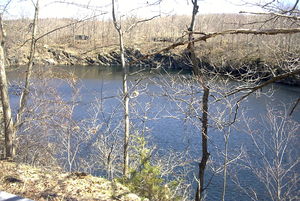
The Tilly Foster Mine


The Tilly Foster Mine as it appears today.


This isn’t a gold mine instead it was an iron mine and where my great-grandfather went to work when he first arrived in the United States after leaving Nova Scotia for poaching gold on the Queensland.  He left his wife and child behind in Halifax, Nova Scotia intending to bring them down to the States as soon as he earned enough money.  These events started in the spring of 1870 at the mine he worked as a mine rigger a job he had done earlier in Glace Bay.  Much of the work was stonemasonry, a job he pursued for the rest of his life.

The Tilly Foster Mine itself is today an abandoned iron mine that was the most active during the 1970s that is about two miles west of the village of Brewster, NY.  The mine is now filled with water, and is surrounded by a junk yard.  The mine was named after Tillingham Foster who bought it from George Beale that owned the land where it was located.  After he died in 1842 the mine site passed through several hands until it finally came into the possession of the Harvey Iron and Steel Company.  The mine finally opened in 1853.  After its opening it employed large numbers of Irish and Italian immigrants.  These workers were known by numbers since they had names that were too hard to pronounce by the “Apple Knockers” that owned the mine.  My great-grandfather must have been the only Scotchman working in the mine.

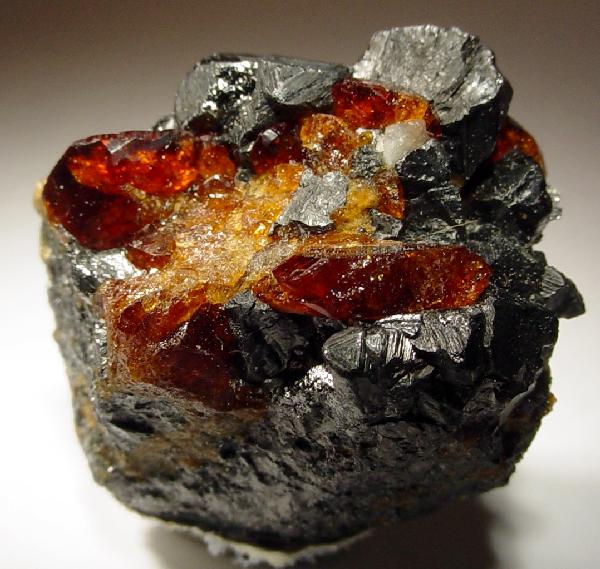
Chondrodite on magnetite from the Tilly Foster Mine
Photo by Rob Lavinsky


The main minerals produced from the mine were magnetite and chondrodite from a mine that employed 300 workers and reached a depth of 600 feet (180 meters).  At the height of its production they were producing 7,000 tons of ore a month where after mining it was shipped by train to New York City where large amounts of it were trans-shipped to Scranton, Pennsylvania where it was made into rails by the Lackawanna Steel Company for use on the Delaware-Lackawanna Railroad.

After reaching a point where it was no longer feasible to operate it as an underground mine it was converted into an open pit mine during the years 1887 to 1889.  In 1895 a major collapse occurred that killed thirteen miners.  The collapse of the mine spelled its death knell and it was flooded by a nearby reservoir that supplied New York City with drinking water.

In its day it was the largest open pit mine in the world that collapsed in 1895 killing thirteen miners when tons of rock came crashing down on their heads.  Many of these miners were only known by their numbers.  The cave-in of the Tilly Foster Mine was caused by heavy rains that soaked into a mass of soapstone near the surface of the mine.  The mine was described as a funnel shaped oval hole in the ground that at the time of the collapse was 400 feet deep.

During World War II the abandoned mine was pressed into service by the military where it was used as a site to test and train with diving equipment.  A collection of minerals and other artifacts from the mine can be seen at the Southeast Museum in Brewster, New York. 

Sunday, January 23, 2011

Gold Occurrences in New York State

Although gold is known to occur in New York State a law dating back to the birth of the United States in 1776 dictates that any gold found in the state will remain the property of the State of New York. The effect of this law that is still on the books has acted as a damper on any efforts to find gold. Even if you were to find gold in your own backyard if you read the fine print on your deed you will find that gold does not belong to you but to the state. Efforts are now being made to change that law to date it is still in effect. Not only gold is affected by this law, but so is silver. Plainly the law says all gold and silver deposits found in New York will remain the property of the state. This law has been amended several times over the years allowing the finder of a gold deposit a period of several years to work his claim.

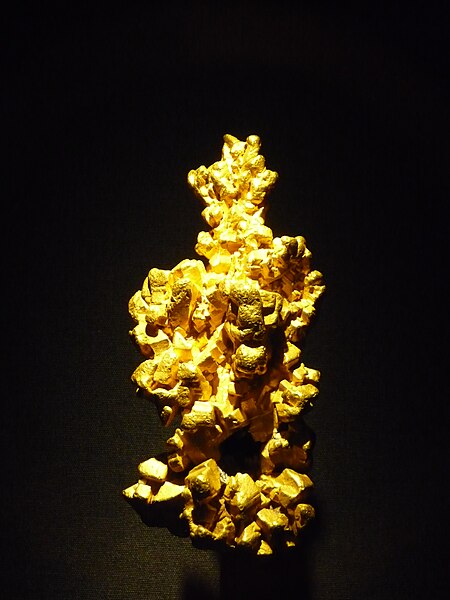
This is what gold looks like in the form of the Latrobe Nugget on display in the London Natural History Museum.
Photo by Gump Stump

Looking at a geological map of New York State it is easy to see that there are several environments in the state that are likely to contain both lode and placer gold. Probably the most likely place where you can find lode gold is in the Adirondacks, and the second most likely place is in the Hudson Highlands, and strangely enough right in New York City. These are areas in New York State where the bedrock is made up of crystalline rocks that may, or may not be the host for gold.

There is a lineation associated with the west bank of the Hudson River called Logan's line that marks the westernmost part of the Taconic orogeny. Anywhere to the east of this line it may be possible to find gold especially in the quartz veins found in the Slate belt of eastern New York along the border with New England.

This is how you pan for gold.  USGS

Two of the counties gathering attention are Columbia and Saratoga counties. Although the particulars of these deposits are not clear from examining the geology found in those counties it is apparent they are probably lode deposits.

Another potential source for gold is found in the conglomerate of both the Schwangunks and Catskills where it was weathered out of high mountain ranges that light to the east. The rocks that are found in the Schwangunks were deposited in the Queenstown Delta, and the conglomerates that are found in the Catskills were eroded from another later mountain range that light even further east. These ancient conglomerates could be the host of fossilized placer deposits similar to the Witwatersrand Reef in South Africa, the world's largest deposits of gold.

It may look like Manhattan, but there is likely to be gold under its streets.
Wikimedia Commons

There is likely to be gold found in placer deposits across the length and width of New York that were brought down by the action of continental glaciers in at least three glaciations in the past 1 million years. Immediately to the north of New York State lies the Abitibi Gold Belt of Québec and Ontario. This extends for over 500 miles from Wawa, Ontario to Val ‘Dor, Québec. The scouring action of the glacier removed any gold that was loose in the soil of these provinces and took it south to be deposited across the width of New York State.

Just to the north of the Pennsylvania State line is the terminal moraine of the last glacier. This is an area that would be no doubt be good for prospecting in the many streams and rivers that cut through the glacial deposits. The action of running water would tend to concentrate any gold that was deposited in this area by the melting of the glaciers.

The plunge pool under Niagara Falls probably contains gold if you can find a way to get it!
Wikimedia Commons

The other big terminal moraine in the state is Long Island, there is the possibility that a small amount of gold was brought down from New England by the glaciers forming deposits in the sand and gravel.

Although you may not get rich hunting for gold in New York State at least there is enough that may be found to at least see what it looks like. Maybe someday the state assembly will change the law about the possession of gold to where the average New Yorker will be able to keep any gold that he finds.  

Tuesday, January 18, 2011

Have Gold Prices gone into a Slump?

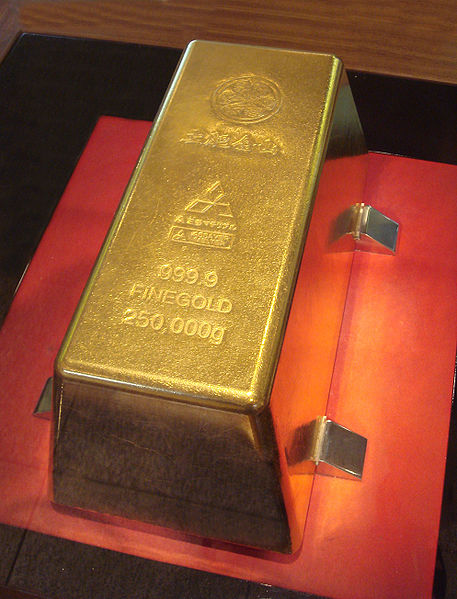
A 250 kilogram gold bar.

In December 2010 gold prices hit an all-time high of $1432.50 in New York, but by January 14, 2011 the price of gold had sunk to $1361.80 per ounce, a decrease of almost 5 percent. Right now gold prices are in this slump that coincides with the expectations of many investors that the economy is slowly recovering in the United States and the European Union. The question is now being asked is, are investors gaining more confidence in the economy by taking their money out of gold and putting it into more speculative ventures. The other question they are asking themselves is this only a small correction or does it indicate a continuing upward trend in the economy?

According to Bloomberg during the second week of January 2011 the price of gold fell on the New York Stock Exchange to its lowest settlement price in seven weeks. This was fueled by speculation that the leaders of the European Union would stabilize economy thereby ending the appeal of gold as a safe haven.

One economist, Dennis Gartman, was quoted as saying that the price of gold was now “toppy” recommending that investors cut their holdings by about one third saying that “Gold has run its course for a while.”

Right now gold and silver may not be the best investment in the world, but in the long run the price for both of these metals looks bright it is expected to rise to even higher levels. Many producers of gold expect to see the price topped $2000 per ounce.