Total Pageviews

Showing posts with label color. Show all posts

Saturday, March 19, 2011

Gold of a Different Color

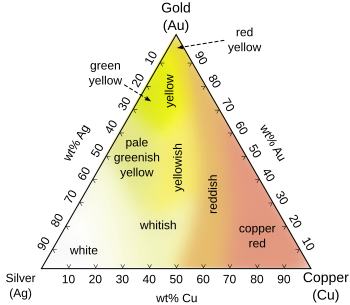
Everyone knows that pure gold is the color of the early morning sun, a great golden yellow, but one gold is pure it is too soft to be worn or have any other useful purpose other than its intrinsic value. Not all gold is golden yellow because when it is alloyed it is possible for the metal to assume different colors. The effective changing of the color of gold has been known to goldsmiths for thousands of years to create many of the effects that are seen in gold jewelry. This effect is produced by alloying gold with other base metals.

This is a phase diagram illustrating the various colors of gold alloys.
Image by Metallos

One of the most common ways that the color changes and gold are observed is when different alloys are combined as inlays in jewelry where the lighter color of a particular alloy is used in conjunction with a darker colored alloy.

Although most interesting varieties of jewelry made this way is what is termed Black Hills Gold. Most of the jewelry made from this kind of gold is 10 to 12 caret is carefully alloyed with other metals to create the colors.

A Tibetan gold statue from Mustang made from an alloy of gold and copper. 

Pink or rose gold is created by alloying copper with the gold causing it to acquire a pinkish or rose-colored caste. Another common alloy of gold creates a greenish caste by making an alloy containing silver.

Metallurgists will find them there recipes for different colors of gold. There is even a purple colored gold that is produced by alloying gold and aluminum.

Sunday, February 6, 2011

Flame Tests

Flame tests may not be the most accurate, nor do they work for gold, but they can be really effective for other elements.  Boron is one that imparts a greenish color to a flame.  This gives rise to the story of how the 20 Mule Team Borax Company got started.  It seems a prospector who was down on his luck was prospecting Death Valley, California with his wife when he tried a flame test on some of the dried salts he found in the dessert.  It burned green so he turned to his wife and said, “She burns green Ma, we’re rich!”

A chemist performing a flame test on copper sulfate.  Notice the blue color of the flame.

Flame tests are conducted on a length of thin platinum wire that is first dipped in a dilute solution of hydrochloric acid then in the pulverized sample of the substance to be tested; then it is held into a hot flame.

Depending on the element contained in the sample it colors the flame various colors.  This technique will present a pretty accurate idea of what king of substance you have, but the accuracy of the test can be improves with a spectroscope.

Table 1 shows the colors of the flame test of various elements:

Symbol
Name
Color
As
B
Ba
Pale/Apple green
Ca
Brick red
Cs
Blue-Violet
Cu(I)
Blue
Cu(II)
Copper(II) (non-halide)
Green
Cu(II)
Copper(II) (halide)
Fe
In
Blue
K
Li
Mn (II)
Manganese (II)
Mg
No colour
Mo
Na
P
Pb
Blue
Rb
Sb
Pale green
Se
Sr
Te
Pale green
Tl
Pure green
Zn
Bluish green