Total Pageviews

Showing posts with label oil. Show all posts

Sunday, June 3, 2012

Gold Occurrences in Angola


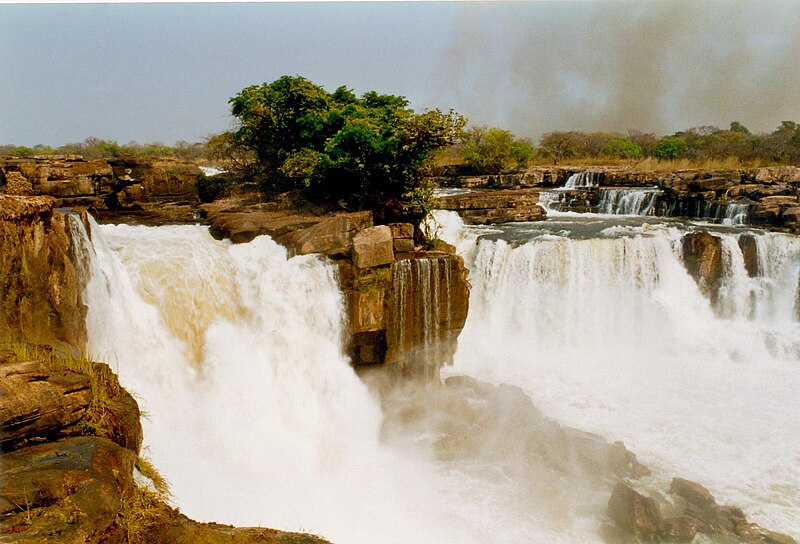
Tazua Falls on the Rio Cuango is one of the richest diamond and gold rivers in Angola
Photo by Brian Harrington Spier


Gold and base metal potential remains in Angola, but because of the ongoing civil war in Angola much of this potential remains unexploited.  Even though the country has been wracked by this conflict mining still provides the country with some foreign exchange with about 98% of it coming from diamonds.  The rest of the countries earnings are from oil.  Before the civil war Angola was an important producer of gold and other metals.  Because of the ongoing civil war it is difficult to reach much of the country from the outside.  No doubt there are world class deposits of gold waiting to be discovered in Angola.

Geologically Angola was once part of Southern Brazil until the Atlantic Ocean commenced opening during the Triassic period 220 million years ago; today the two countries are separated by the Atlantic Ocean.

Twelve billion barrels of oil have been found in the deep waters off the coast of Angola since it was first discovered in 1955.  Officials at Sonangol, the country’s oil company say this is only a small part of the total potential.

Upper Proterozoic Fold Belts of the Pan African are found along the margins of Angola’s Precambrian shield.  Among the most important are the West Congo, Damara and the Maiombe-Macongo.  This fold belt displays the occurrence of both gold and base metals along with a wide variety of industrial minerals.

The Lower Protozoic and Archean rocks are composed of the Angloan, Maiombe, Cassai and Bangwelo shields along with the granitic, gneissic rocks sedimentary (greenstone) belts from the Angolan, Maiombe, Cassai and Bangwelo shields and the Kwanza meta-
Volcanic sedimentary (greenstone) belts are present in the south-central part of the country as the Cassinga and Menonque greenstone belts.  These rocks go on to the Cunene basic to ultra basic complex that occupies more then 20,000 sq. km in southwestern Angola.

Angola is blessed with mineral riches with most of the rivers flowing down from these areas bearing lode gold and there is plenty of areas bearing lode gold waiting to be explored.

Saturday, April 2, 2011

Oil Seep in Carlin Type Gold Deposits

As reported in the July 15, 1991 issue of the Oil & Gas Journal an active oil seep has been found in the Yankee Gold Mine in White Pine County, Nevada.  This mine operates on the western side of Long Valley and is one of the Carlin Type Deposits that has made Nevada the premier gold mining state in the United States.

A naturally occurring oil seep in sandstone
Photo by Lidenke

Carlin type deposits are a hydrothermally altered limestone of Paleozoic age that contain deposits of gold measured in micron sizes that are only visible under an electron microscope.  The same deposits are also noted as containing disseminated deposits of arsenic and locally hydrocarbons.  The Yankee deposit is the only known deposit in Nevada that has active oil seeps.  The discovery of oil seeps here are felt to be important to further exploration for gold in the Carlin Trend gold deposits, but also in the search for oil.

The oil seep was originally discovered when an oil wildcatter was preparing to drill a 7,000 foot deep oil well in the area of the mine and asked the then operator of the mine Kennecott if he could hook up a telephone connection to his drill site from the mine.  The oil seep was brought up when a mine employee casually told him there were hydrocarbons seeping onto the mine that was operating in a calcerous shale that according to some other employees were pooling on the ground under the seep.

An oil seep in limestone similar to the one in the Yankee Mine in Nevada
Photo by Lidenke

Although the discovery of an oil seep is important in this formation for the discovery of oil and what is more interesting however is the description of gold deposits. These are found in sedimentary deposits that were formed during the Paleozoic from Cambrian through Mississippian carbonate and siliclastic rocks that have been permeated by hydrothermal fluids. Many of these deposits are found in siltstone and limestone although some of them are found in calcerous shales are siltstones.

These older deposits of been covered by later deposits of the tuffaceous sedimentary rocks of tertiery age and by andesites that are about 30 million years old. The deposits are also characterized by veinlets of quartz, kaolin and stibnite.  There are further deposits of realgar and cinnabar.