Total Pageviews

Showing posts with label gold mine. Show all posts

Saturday, June 23, 2012

Tales of the Devil: Was it really a Gold Mine?


This is the end of the tunnel and with all the quartz veins exposed it sure makes you a believer, but subsequent tests failed to show any concentration of gold that exceeded the normal background level of gold.
Photo by Landowner


The question really arises is this thing actually a mine? The history of the area suggests that it may be something else; a tunnel excavated for the purpose of aging cheddar cheese. During the early 19th century the cheddar cheese production in the United States was in Goshen, Connecticut and spread out over several other towns in Western Connecticut. The most popular cheese that was produced was made in the shape of a pineapple that at the time was called pineapple cheese. This cheese whether it was made to look like a pineapple or simply cheddar cheese wheels. This cheese was so popular that it enjoyed a worldwide distribution being exported to the Caribbean, Europe and the Far East notably China.

The shaft and tunnel were recently rediscovered revealing a mine shaft that was about 40 feet deep with a tunnel going off from the bottom of the shaft that was 6 feet wide, 7 feet high and 10 feet deep. At the time of its discovery we all thought it was probably an abandoned mine but subsequent work that was performed on the mine with an x-ray fluorescence spectrometer (XRF) reveals no apparent minerals associated with gold or gold in this shaft and tunnel. So this left the question of what were they mining?

John Carter brought up the possibility that this was actually used for aging cheese. This hypothesis brought up one major objection from the landowner, and so far the other investigators are not aware of this possibility that what we thought was a mine was actually an underground tunnel used for aging cheddar cheese.

The major objection was the simple fact that this alleged mine was making quite a bit of water into the tunnel as well as part of the shaft. At first this seemed like a valid objection but further research reveals that they had hoses capable of carrying water clear back to 400 BC. Depending on the age of this feature it could have used hose made from leather that was secured by copper rivets, or a type of hose made from knitted linen fibers that were invented in the early 1800s. Either of these hoses was capable of being used as a siphon that would've kept the water in the tunnel under control.

In the early 1800s cheddar cheese was covered by a thin layer of cotton cloth then covered with lard causing the cheese to become waterproof. At the same time this covering of cotton cloth and lard allowed the gases that were being generated as the cheese aged to escape through the covering that kept the water from coming back into the cheese as it aged. However the cheese still had to be aged in a cool dry place which this was far from; it made water that was capable of filling the shaft about three quarters full. Without continually pumping the shaft and tunnel this complex was useless.

There was another kind of pump that have been used since ancient times called the Archimedes screw it used a helical screw turning inside a tight fitting to that was capable of raising water up to 10 m or close to 40 feet the depth of the shaft. It is possible they used a device like this for keeping the water out of the tunnel and shaft.

Had the complex been able to be used for aging cheese there would have been a series of shelves for storing the cheese, but once again these were missing so it has to be assumed that the whole complex was abandoned once the diggers were convinced it was useless for aging cheese.  The fact that further work was intended is attested to by a series of drill holes inside the tunnel.  Ultimately the vast amount of water entering the complex caused its abandonment.  This waterflow has been estimated to exceed twenty gallons per minute.  It would have been a pretty good well, but no place to store cheese.

Thursday, May 31, 2012

The Homestake Gold Mine of South Dakota


The open pit portion of the Homestake Gold Mine in Lead, South Dakota.  This is only a small part of the mine because it extends into the earth for thousands of feet making it at one time the deepest mine in the western hemisphere.
Photo by Rachel Harris


This mine traces its origins all the way back to 1876 when it was discovered by Fred and Moses Manuel, Alex Engh, and Hark Harney in April, during the Black Hills Gold Rush.  The following year it was sold to a trio of gold entrepreneurs, George Hearst, Lloyd Tevis and James Ben Ali Haggin who bought the mine from the group that discovered it for the sum of $70,000.  In October 1877 George Hearst appeared at the scene of the mine where he took active control.  All the mining equipment used at the mine had to be hauled in by oxcart from the nearest railhead in Sidney, Nebraska.  Even though the mine had a remote location by July 1878 the 80-stamp mill started to crush the ore from the mine.

The mine is located in a domal uplift that is about 100 kilometers long and 60 kilometers wide straddling the border of South Dakota and Wyoming.  The Black Hills were uplifted during the Laramide orogeny that occurred between 60 and 65 million years ago, and are an outlier of the Rocky Mountains.  The rocks exposed in this range are from 2.7 billion years old to 60 million years old.  The core of the mine is composed of Precambrian phyllite, cummingtonite schist and granite with the Black Hills surrounded by younger sedimentary rocks.  Most of the gold deposits are associated with a Precambrian banded iron formation.

Hearst and his partners sold shares in the Homestake Mine and had it listed on the New York Stock Exchange in 1879 where it is too this day as one of the longest-listed stocks on the exchange.  The stock that has been listed the longest is Con Edison, whose original name was New York Gas Light whose listing dates back to 1824.

Under their control the mine’s holdings were increased sometimes by fair means or if that didn’t work by foul means.  They bought out some of the adjacent claims, but weren’t adverse about using the courts to obtain others.  There is even evidence that one man was murdered by one of the group’s men because he refused to sell his claim to them.  The case was dropped when all the witnesses to the murder vanished.  Hearst bought out the newspaper in Deadwood to sway public opinion his way, with the editor of the opposing newspaper was beaten up while walking down a Deadwood street.  Hearst himself realized that he could be murdered and asked his partners to take care of his family if he was; in the end though it was Hearst that walked away smiling, still alive and very rich.

Although the gold ore mined at Homestake was always low grade averaging less then an ounce per ton it existed in vast quantities.  During its lifetime the mine produced 39.8 million ounces of gold along with 9 million ounces of silver.  The mine is the only one in the Lead mining district was the second largest producer of gold in the United States.  The largest producer of gold is the Carlin Trend in Nevada.

At the end of 2001 production at the Homestake ceased for several reasons including low gold prices, poor ore quality combined with high operating costs.  There had been a merger with Barrick Gold Corporation and Homestake Mining Company in mid-2001.  They agreed to keep the mine dewatered while negotiations for its further use continued with DUSEL, but progress along these lines continued at a snails pace.  As negotiations dragged on it was costing Barrick $250,000 for maintaining the pumps and ventilation system so on June 10, 2003 Barrick threw the switch and closed the mine completely.

After being closed for six years researchers at Berkeley announced that the Homestake Mine would be used as a research facility causing it be reopened for the study of neutrinos and dark matter particles.


Monday, May 28, 2012

The Lost Dutchman Gold Mine


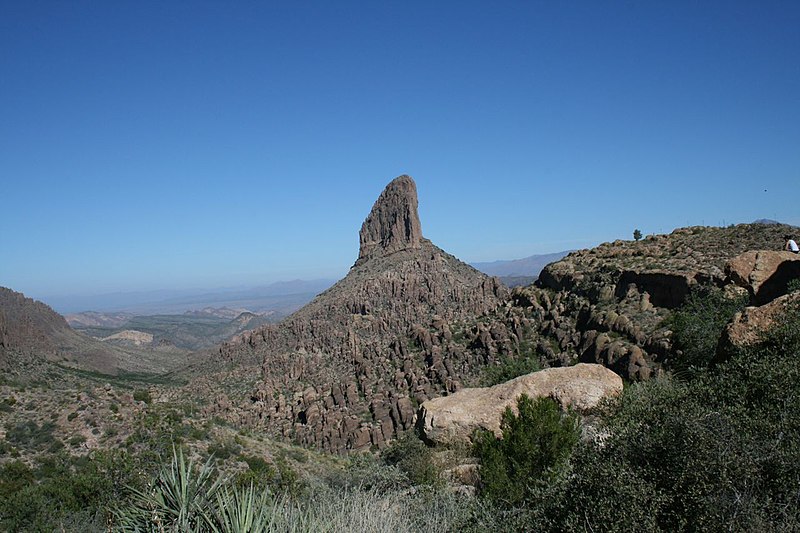
Weaver's Needle in the Superstition Mountains where the Dutchman hid his gold.
Photo by Alan English


Of all the lost mines in America the most famous is the Lost Dutchman Gold Mine that according to its legend is hidden away in the Superstition Mountains located near Apache Junction, east of Phoenix, Arizona.  Other people claim its way past the Superstitions in Mexico.  No one really knows where the mine is located.

The Superstition Mountains can be divided into three distinct groups that can be divided into (1) rock type, (2) structure and (3) process.  Most of the rock type consists of volcanic extrusives that are associated with volcanism.  The structure is consistent with the landform types found accompanying volcanic action and tectonic activity.  This is just the place where you would go looking for gold.  Erosion and mass wasting account for any placer gold that is present.  There are some small areas of sedimentary and metamorphic rocks as well as some Precambrian granite intrusions to be found.  Most of the volcanic activity is from fissure eruptions rather then volcanoes.

Another view of Weaver's Needle
Photo by Ihelewa


The Lost Dutchman Gold mine that is also known by many other similar names is the tale of a very rich gold mine hidden away in the Superstition Mountains, but because Jacob Waltz, the Dutchman, kept the secret of its location to himself.  There are several different tales about how to find the mine and each year there are people that go hunting for it.  Some of these gold seekers have even died in the process.

The mine itself was named after the German immigrant Jacob Waltz that the locals mistakenly called the “Dutchman” that was American slang for a German.  This is derived from the German word for German – “Deutsch.”  The Lost Dutchman is no doubt the most famous lost mine in American history rivaling tales of Captain Kidd’s lost treasure or the Lost Pegleg Mine in California.

Prior to Waltz’s reported discovery in the 1840s the Mexican family, the Peraltas were reported to mine gold in the Superstitions where in 1848 a large group of the Peraltas was ambushed by the Apaches with only one or two members escaping.  There is plenty of evidence of this massacre to be found in the Massacre Grounds where old mining equipment, old weapons, assorted gear and the remnants of a pack train have been found.

The legend goes on to say the Peraltas covered the mines with large rocks to hide their riches from others.  Since then many men have claimed to have found the hidden mines from the number of old maps that have surfaced.  However the men making such claims are unable to return to these mines due to any number of calamities and disasters.  These tales lend truth to the tales of the “Curse of the Superstitions.”

During the 1970’s “the Dutchman” aka Jacob Waltz supposedly found one of Peralta’s gold mines with his partner Jacob Weiser another German.  The story goes on to say they hid some of the gold they found in the area around Weaver’s Needle.  Later Weiser was killed either by the Apaches or Waltz himself.

Waltz later moved to Phoenix where he died in 1891.  Before he died he described the location of the mine to Julia Thomas his landlady.  She became one of the first treasure hunters in 1892, she or other treasure hunters have never been able to find the lost mine since.  Many of them came to a sudden end due to foul play, murder, death or the curse hanging over the Superstition Mountains.

It has been estimated that 8,000 treasure seekers a year have been looking for the Dutchman’s mine since 1892.  Many claim there is no basis to the tale and it is nothing more then a legend, although it is claimed there is some basis in fact to the tales.  Many versions of this tale claim the mine is either cursed, or protected by some kind of guards, usually the Apaches that keep the location of the mine secret.


Wednesday, May 16, 2012

The Lost Cabin Gold Mine


A canyon like the one with the Lost Cabin Gold Mine
Photo by Meckimac


There are countless stories of lost mines in all the gold producing areas of the world, but the “Lost Cabin Gold Mine” has the distinction of being the most sought after lost mine in the world.  This lost mine has been known by many names as Lost Adams, Gold Canyon, Sno-Ta-Hay, Zigzag Canyon and the Lost Cabin Mine.  There are claims that it is the richest source of gold in the world that is untouched.

The story of this lost mine started while the Civil War still raged in the East when a teamster named Adams, his first name is lost to history, along with some prospectors in Gila Bend, Arizona.  A Mexican Indian with the unlikely name of “Gotch Ear” approached them, and offered to show them a canyon filled with gold that was only 10 days ride away.  The miners took Gotch Ear at his word so together they rode away to get the gold.  On the way they crossed a road that Gotch Ear told them went to Ft. Wingate, Arizona and they should remember it in case they had to go for supplies at the fort.  True to Gotch Ear’s story at the end of 10 days they came upon a canyon having a blind entrance.  At the bottom of a “Z” shaped narrow canyon they found a creek that was rich in gold.

The men paid Gotch Ear off, and began panning the creek for gold when they were interrupted by a force of Apache warriors led by a chief Nana.  Nana told the miners they could look for gold in the creek as long as they did it below the waterfalls.  Eventually several of the miners began mining at the base of the waterfalls where they discovered two rich veins of gold.  It quickly became apparent to all of them these digging were extremely rich with some of the nuggets they found being the size of hen’s eggs.

There was so much rich gold they kept it under a stone in the hearth of the cabin they had built except one miner, a German who kept his gold separate.  Once he had collected all the gold he wanted he left the camp and was never heard from again.

After several days when the supplies started to run low a group of miners set out for Ft. Wingate to get more supplies.  After eight days when they hadn’t returned Adams and another miner named Davidson rode out to see why.  When they reached the top of the Z-shaped trail, they found five of the miners had been murdered along with three of their horses.  That was all of the party that has set out for supplies.  Adams and Davidson returned to their cabin when they discovered that in their absence the Apaches had returned, murdered the remaining miners and set fire to the cabin burning it down.

After a harrowing walk across the desert that lasted 12 days Adams and Davidson narrowly escaped when they finally stumbled on an army patrol that took them to the nearest fort where after 10 days Davidson died.  It took a decade before Adams finally lost his fear and returned to New Mexico to look for his lost mine.  Adams spent the rest of his life looking for the lost canyon that was packed with gold.   

Monday, January 2, 2012

Closing a gold mine


An open pit mine.


The formal name for closing a gold mine is mine closure that occurs when the ore extracting activities at the gold mine have ceased, and ushers in the final decommissioning of the mine and its reclamation. This usually entails laying off most of the workers that can have a very significant impact on the community around the mine and the local economy. This is the time that the end of the life of a mine when the majority of reclamation work is completed so as to make the land safe and useful for other purposes again.
In many of the countries where mining activity is prevalent much of the closure planning has not yet been formalized leading to a floor of unintended consequences that have the potential of becoming a sovereign risk if not well managed.
Closure planning is a development in mine closure that continues throughout the life of the mine that usually starts before the mine is ever in production and is an integral part of the mines business plan. The closure plan undergoes periodic updates throughout the time of active mining, and incorporates a final decommissioning plan for the mine. The Australian model for my enclosure is also followed in many other countries with this model being the standard.
Most miners follow a progressive reclamation plants throughout the life of the mine that reduces the reclamation burden on the mine when it is finally closed.
There are two types of mines that require closure one of them is the open pit mine it is usually closed by a special type of explosive round is called a quarry closure shot. This is done by drilling a regular shot pattern only the shot holes are progressively shorter to further from the quarry wall that you get. What you are left with is a graded pattern of shot rock that leaves a slope down from the former quarry walls. This slope is often covered with topsoil and planted.
An underground mine is treated differently where in many cases a large concrete plug about 3 feet thick is placed over the shaft effectively limiting access to the mine. Some underground mines are capped using large metal grates that are usually used on deep level shafts that allows airflow to occur through the deep tunnels that helps prevent subsidence.
Older mines typically used wood beams, a foot or more thick, under loose rock or dirt as caps. Eventually the wood rots and sinkholes might develop. These mines are typically recapped with concrete, steel plates, expanding foam, or a combination.
Steel plates are used primarily on horizontal shafts, but are used on vertical shafts occasionally. Doors are added if access is needed. Holes are cut into the plate to allow for drainage as well as for a bat entrance.
Expanding foam is used mainly with vertical shafts where the use of the shaft is no longer needed. It forms a plug 6 feet or more thick. A 4-to-6-inch (100 to 150 mm) pipe through the plug allows for pressure equalization as well as drainage, or even as a bat entrance.
Closure planning has two different components. On-site planning is mostly about environmental rehabilitation and returning the landform to a reasonable condition. Off-mine closure is about loss of livelihood, which is a more complex issue.[5] An element of this is generating an offset against the high cost of environmental remediation issues, which in certain cases can exceed the value of the mineral that was mined originally. [6]

Sunday, December 18, 2011

The World’s Deepest Gold Mine is cooled with Slush

A South African goldmine similar to the one in this article.
Photo by Babakathy

There is a certain amount of argument as to what is the world's deepest gold mine, but there is no doubt it is found in the Witwatersrand of South Africa. The latest contender for the title of world's deepest mine is the Mponeng mine of the West Wits district of the Witwatersrand.  The mine's name is derived from the Sotho word for “Look at me.” At 13,000 feet this presently holds the record as the worlds deepest mine. This record does not only apply to gold but any other product such as uranium that is mined from the deepest recesses of the earth.

This mine is so deep the only way it can be cooled to the highest temperature allowed by South African law of 83°F at the mine face is by refrigeration that makes a mixture of ice and water that we call slush.  There is several refrigeration units deep in the bowels of the mine made by IDE Industries headquartered in Israel that make slush as part of a scheme to make fresh water from sea water . The slush is held in readiness in underground reservoirs until it is piped to the working face of the mine.  After it has done its job of cooling the mine the warm water is pumped back to the surface where it originally came from by large electric pumps using tremendous amounts of electricity where it is allowed to cool off.

The mine contains 230 miles of shafts and tunnels that take the workers as much as 90 minutes to reach the working face of the mine allowing only five hours per shift at the working face.  The shaft is split into two sections causing the workers to have to walk to the second shaft before they can continue their journey to the bottom of the mine.  Most of the trip continues on rails that carry men, equipment and ore.  The final part of the journey is made in low tunnels that cause the men to walk hunched over with their miners lamps to brush the ceiling of the tunnels.  Some of the time they have to go down narrow stairways leading into the depths of the mine.

At present this mine is the deepest on earth, but it is possible to extend the depth of a mine to 33,000 feet with most of the work being done by robots.  This mine makes it too all apparent that no real changes have taken place in deep mining for more then 100 years, a situation that must change if we are going to continue extracting minerals from the depths of the earth.

We welcome comments on this subject!

Friday, October 28, 2011

How a Gold mine is Created

An open pit gold mine.
Photo by Patrick Huber


A recent question that was posed to the author on www.allexperts.com was how a gold mine came into being.  The questioner realized that a gold mine is usually large, but how they came into being just eluded him.  He thought spelunkers, cave explorers, discovered the gold minerals while exploring the cave.  A few working gold mines probably were discovered this way.  Most gold mines are purpose dug excavations with three types of gold mines that are recognized.  The people that develop a gold mine are called gold mine developers.  Although it is nothing more then a large construction job there are enough differences so sometimes this is a specialty in the construction industry.

A gold nugget from a placer mine.
Photo by Rob Lavinsky

The first of these gold mines is the placer gold mine where through the process of weathering the valuable gold minerals are released from the bedrock that encloses them.  Most of these deposits find their way through the process of soil creep to an ocean or river where they are found in the bedload mixed with many other lighter gold minerals.  Another type of gold mineral deposit found is the result of weathering in place.  The deposits are usually found in the tropics between 32 degrees north and south of the equator.  Many of these are found associated with quartz that remains in place while the other gold minerals are turned to clay around them.  The gold and other gold minerals stay more or less in place waiting to be gold mined.  A placer gold mine is usually limited to gold production although there are exceptions to the rule other placer gold mines also produce tin and rare earth gold minerals.

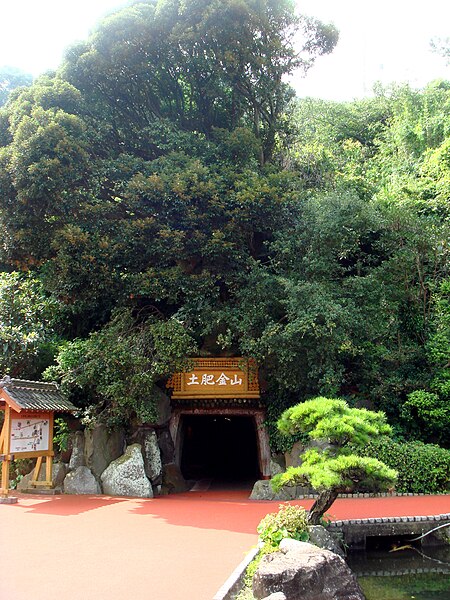
Entrance to a gold mine adit in Japan.
Photo by PHGCOM

Other gold mines are located in bedrock, and usually are called lode gold mines if they are for mining gold.  Basically there are two types open cast that is nothing other then a large hole in the surface of the earth.  The other type of bedrock is one underground.  Gold mines of this sort are further subdivided by their way of entrance.  One type of gold mine has a shaft going into the ground with tunnels reaching out from the bottom of the shaft.  Some of these gold mines have several layers reaching out from a central shaft.  Other gold mines of this sort have more then one shaft entering the gold mine.  The other type of bedrock gold mine uses an “Adit”  that is a tunnel going more or less horizontal to the surface of the ground.  It costs less to build a gold mine with an adit then one with a shaft.

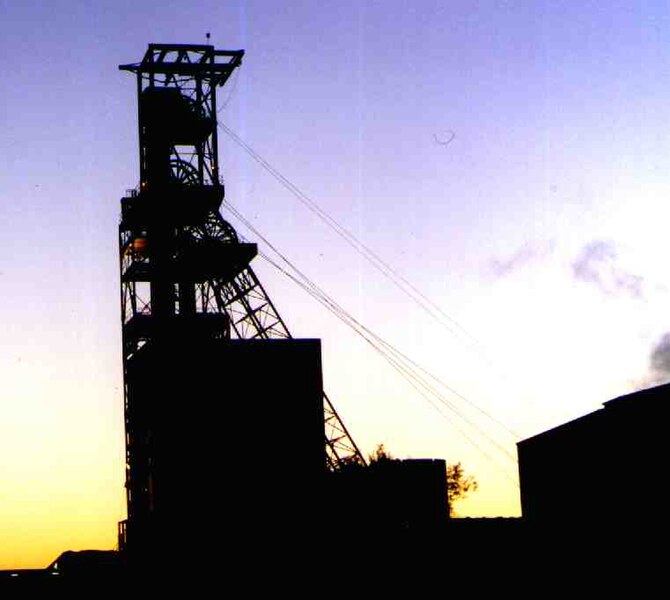
Headframe of the Oryx gold mine in South Africa.
Photo by Babakathy

Before any gold mine is created there must be lots of preliminary work done first.  Placer gold mines are called “poor mans gold mines” because the preliminary work is often kept to a minimum.  The work can be done by one man or a small workforce.  Bedrock gold mines are for more capital intensive then a placer gold mine sometimes for a truly large gold mine it exceeds 1 billion dollars before any ore is extracted.

Saturday, April 2, 2011

Oil Seep in Carlin Type Gold Deposits

As reported in the July 15, 1991 issue of the Oil & Gas Journal an active oil seep has been found in the Yankee Gold Mine in White Pine County, Nevada.  This mine operates on the western side of Long Valley and is one of the Carlin Type Deposits that has made Nevada the premier gold mining state in the United States.

A naturally occurring oil seep in sandstone
Photo by Lidenke

Carlin type deposits are a hydrothermally altered limestone of Paleozoic age that contain deposits of gold measured in micron sizes that are only visible under an electron microscope.  The same deposits are also noted as containing disseminated deposits of arsenic and locally hydrocarbons.  The Yankee deposit is the only known deposit in Nevada that has active oil seeps.  The discovery of oil seeps here are felt to be important to further exploration for gold in the Carlin Trend gold deposits, but also in the search for oil.

The oil seep was originally discovered when an oil wildcatter was preparing to drill a 7,000 foot deep oil well in the area of the mine and asked the then operator of the mine Kennecott if he could hook up a telephone connection to his drill site from the mine.  The oil seep was brought up when a mine employee casually told him there were hydrocarbons seeping onto the mine that was operating in a calcerous shale that according to some other employees were pooling on the ground under the seep.

An oil seep in limestone similar to the one in the Yankee Mine in Nevada
Photo by Lidenke

Although the discovery of an oil seep is important in this formation for the discovery of oil and what is more interesting however is the description of gold deposits. These are found in sedimentary deposits that were formed during the Paleozoic from Cambrian through Mississippian carbonate and siliclastic rocks that have been permeated by hydrothermal fluids. Many of these deposits are found in siltstone and limestone although some of them are found in calcerous shales are siltstones.

These older deposits of been covered by later deposits of the tuffaceous sedimentary rocks of tertiery age and by andesites that are about 30 million years old. The deposits are also characterized by veinlets of quartz, kaolin and stibnite.  There are further deposits of realgar and cinnabar.