Total Pageviews

Showing posts with label water. Show all posts

Saturday, June 23, 2012

Tales of the Devil: Was it really a Gold Mine?


This is the end of the tunnel and with all the quartz veins exposed it sure makes you a believer, but subsequent tests failed to show any concentration of gold that exceeded the normal background level of gold.
Photo by Landowner


The question really arises is this thing actually a mine? The history of the area suggests that it may be something else; a tunnel excavated for the purpose of aging cheddar cheese. During the early 19th century the cheddar cheese production in the United States was in Goshen, Connecticut and spread out over several other towns in Western Connecticut. The most popular cheese that was produced was made in the shape of a pineapple that at the time was called pineapple cheese. This cheese whether it was made to look like a pineapple or simply cheddar cheese wheels. This cheese was so popular that it enjoyed a worldwide distribution being exported to the Caribbean, Europe and the Far East notably China.

The shaft and tunnel were recently rediscovered revealing a mine shaft that was about 40 feet deep with a tunnel going off from the bottom of the shaft that was 6 feet wide, 7 feet high and 10 feet deep. At the time of its discovery we all thought it was probably an abandoned mine but subsequent work that was performed on the mine with an x-ray fluorescence spectrometer (XRF) reveals no apparent minerals associated with gold or gold in this shaft and tunnel. So this left the question of what were they mining?

John Carter brought up the possibility that this was actually used for aging cheese. This hypothesis brought up one major objection from the landowner, and so far the other investigators are not aware of this possibility that what we thought was a mine was actually an underground tunnel used for aging cheddar cheese.

The major objection was the simple fact that this alleged mine was making quite a bit of water into the tunnel as well as part of the shaft. At first this seemed like a valid objection but further research reveals that they had hoses capable of carrying water clear back to 400 BC. Depending on the age of this feature it could have used hose made from leather that was secured by copper rivets, or a type of hose made from knitted linen fibers that were invented in the early 1800s. Either of these hoses was capable of being used as a siphon that would've kept the water in the tunnel under control.

In the early 1800s cheddar cheese was covered by a thin layer of cotton cloth then covered with lard causing the cheese to become waterproof. At the same time this covering of cotton cloth and lard allowed the gases that were being generated as the cheese aged to escape through the covering that kept the water from coming back into the cheese as it aged. However the cheese still had to be aged in a cool dry place which this was far from; it made water that was capable of filling the shaft about three quarters full. Without continually pumping the shaft and tunnel this complex was useless.

There was another kind of pump that have been used since ancient times called the Archimedes screw it used a helical screw turning inside a tight fitting to that was capable of raising water up to 10 m or close to 40 feet the depth of the shaft. It is possible they used a device like this for keeping the water out of the tunnel and shaft.

Had the complex been able to be used for aging cheese there would have been a series of shelves for storing the cheese, but once again these were missing so it has to be assumed that the whole complex was abandoned once the diggers were convinced it was useless for aging cheese.  The fact that further work was intended is attested to by a series of drill holes inside the tunnel.  Ultimately the vast amount of water entering the complex caused its abandonment.  This waterflow has been estimated to exceed twenty gallons per minute.  It would have been a pretty good well, but no place to store cheese.

Monday, July 4, 2011

The Chemistry of Gold Extraction: Part 1. Simple Methods

A flotation cell similar to that used in the agglomeration process for gold recovery
by Dhatfield


Due to the complexity of this subject we are going to have to present it in several parts.

There are as many ways of extracting gold from its ores as there are ores it all depends upon which method is the most commercially viable and efficient. If the ore is amenable all that may be necessary is to reduce it to fine particles and extract the gold by gravity separation in water like any other method like panning or using a sluice box. A more advanced system is by using a “shaker table” a device that is slightly tilted in two directions.  The gold bearing fines are added at the top corner of the table with the lighter materials being washed by water off the lower edge of the table leaving behind the gold to be recovered from the surface.  There are several other schemes that have been developed over the years for affecting this process including the widely used “spiral classifier.”

A gold panner using a gold pan the simplest form of gravity separation
Photo by Alan Souter 


Gold agglomeration is a technique that is used for the recovery of gold when it is impossible to use cyanide or mercury because of environmental concerns.  The use of a process called coal-gold agglomeration makes use of a slurry made from finely divided coal and oil that works on the principle that gold is a hydrophobic material that won’t be wetted by water but will be attracted to the slurry.  After the gold has combined with the slurry, the slurry is burned causing the gold to form larger particles that can be extracted using gravity methods using water.

In an actual test of this process gold ore was finely divided and mixed with powdered charcoal, oil and water then stirred briskly for an hour that formed agglomerates containing gold.  Once the gold had formed a suitable agglomerate a collector such as potassium amyl xanthate (PAX) was stirred with the agglomerate for an additional fifty minutes.  The gold bearing agglomerate and the residue gangue was then ashed in a muffle furnace and the gold recovered from the ash using aqua regia. 

Greater gold concentration was obtained by increasing the viscosity of the oil or the increased size of the coal particles.  The rate of gold recovery was also influenced by the rate of stirring.  Stopping before after the optimum amount of stirring decreased the amount of gold recovery. By recycling the agglomerate showed that the amount of gold recovered could be further increased resulting in lowering the costs of the process.

Sunday, March 27, 2011

Gold in Glacial Outwash Plains

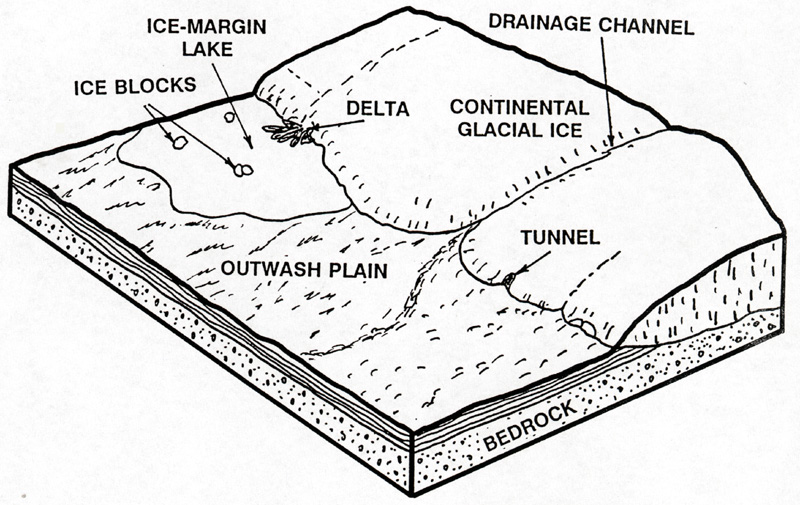
When a glacier melts there are large quantities of water that flows off its edge carrying large amounts of glacial debris that is deposited in front of the glacier.  The action of the rushing waters is characterized by being flat layers of sand and gravel or in some cases finer materials. This is called a "glacial outwash plain."

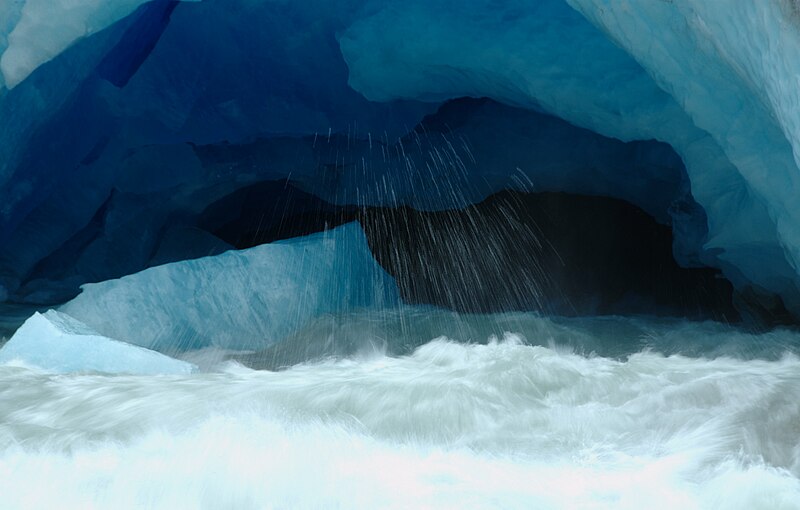
Glacial meltwater flowing from beneath a glacier.  Note the milky appearance of the water.
Photo by Siri Spjelkavik 

Another characteristic of outwash plains is the abundance of braided stream channels that are found in areas of a high concentration of sediments and running water.  This is a perfect environment for gold deposits to form wherever these is a sudden change in water velocity from fast to slow.

This glacial meltwater eventually flows off into the sea. If the land slopes up in front of the glacier it can form large glacial lakes of glacial melt water at the margin of the glacier.

Water flowing into these glacial lakes from gullies across the ice often form upraised deltas in the lake consisting of mostly sand and gravel. The bottom of the glacial Lake away from the delta deposits is covered with a layer of clay that forms a flat surface like a tabletop.

A glacial outwash plain, and how it is formed
After msu.edu 

The glacial melt water flowing across the glacier is so charged with suspended particles like silt and clay that it appears milky. This is called glacial milk that can be seen wherever glacial melt water is flowing off, or under a glacier.

Glacial outwash plains are recognized by their special kinds of agriculture that favors plants that grow best in a well drained soil. The most common crops found in one of these areas are potatoes.

Because these areas are usually well drained the glacial melt water has long since vanished, and it is difficult to recognize the drainage patterns of a braided stream channel as they now exist. One of the best methods of finding one of these ancient stream channels is by observing the amount of gravel that is present, and how it is deposited.

A stream channel can be recognized as an area containing abundant gravel. These ancient stream channels can often be seen when excavation exposes them to view. This is the most likely place to find gold in the glacial outwash plain.