Total Pageviews

Showing posts with label devil. Show all posts

Monday, July 30, 2012

Tales of the Devil to Date


The new entrance to Mine #1 The shaft is 40 feet deep with an adit going off from the bottom northweat for 10 feet that is 6 feet wide and 7 feet high.  The adit is well timbered and the shaft was filled with debris dating back to the 19th Century.
Photo by John Carter


We have rediscovered an old mining complex in western Connecticut that to date comprises two mine shafts with accompanying adits.  The first mine consists of a shaft approximately forty feet deep with an adit going off to the northwest that is ten feet long, six feet wide and sever feet high.  Town records reveal the first mine was a prospect hole that may have been created in pre-Revolutionary days; the second mine was just discovered on July 30, 2012 and is yet to be explored.  Town records indicate this mine may have an adit up to 140 feet long.

At the end of May 2012 a blue ribbon committee was convened at the site consisting of Charles Merguerian of Hofstra University, Nicholas Bellantoni of Uconn, Stefan Nicholescue of Yale, John Carter of Geotek and two engineers, none of us could determine what they were mining.  The town P&Z Officer finally discovered some old records that divulged the fact the second mine was dated to 1858.  The mineral mined was chalcocite an ore of copper.

The mines were found within two miles of Cameron’s Line a major fault system that extends from Staten Island, NY the western mountains of Norway under a series of different names.  There are several important mines located in the proximity of this suture zone producing gold, silver and copper.  The largest copper mine in the U.S. before the discovery of copper in the Keweenah Peninsula of Michigan was the Argo Mine in Vermont that is also associated with this large fault system.

The property where these mines are located is highly mineralized containing in addition to chalcocite, malachite, pyrites, quartz, kyanite, ilmenite, magnetite, cerrussite, beryl and many other minerals yet to be identified.  Although there are no plans to resume mining operations at these old mines mineral specimens will be available for sale.  For further information contact John Carter at geotekllc@gmail.com or 860-469-4804.

Many of the specimens of kyanite, ilmenite and magnetite are of museum quality and are really spectacular.  Some of these specimens are on display at the Yale Peabody Museum in New Haven, CT.

Tuesday, July 10, 2012

Tales of the Devil: The Hammer of Thor


The new find on the site


Somebody asked me why we named this series, Tales of the Devil. Well back in 1819 one of the sources wrote in the American Journal of Science 1st Edition a paper about minerals found in Litchfield County.  Then he got religion and during the 1850’s wrote a tract called “Tales of the Devil.”  By then he must have been a full-fledged geologist from Yale.  At least he knew his subject matter.  However, “Tales of the Devil” fits this place as well as any other story, but finally some old records came to light that explained the whole place.

Since its rediscovery in March 2012 this site has had at least five PhDs tugging their forelocks trying to figure out what in blue blazes went on there.  Finally one of them found a collection of old records that explained the whole deal and even named some of the historical personages that were involved with the site including P.T. Barnum and Thomas Edison.

The first shaft and adit that was discovered was apparently a prospecting pit, or if you prefer a gopher hole. This consisted of the mineshaft that was 40 feet deep with an adit at its bottom going off that was 10 feet deep by 6 feet wide by 7 feet tall. It is apparent from the records that this may have existed since pre-Revolutionary War times. Most of the mining occurred in the mid-19th century and according to the records underground mining in the location included an adit that was more than 140 feet long.

Because of the geology on the site being similar to those where gold was found we assumed that was what they were looking for, and probably was. According to the old records covering the site what they were actually found was copper, and it was in the form of the copper sulfide mineral called chalcocite, a grey colored mineral.

Actually this tale doesn’t have anything to do with Thor except there’s a Norwegian involved in its telling. He was one of the PhD's.  Another one came from Transylvania.

Saturday, June 23, 2012

Tales of the Devil: Was it really a Gold Mine?


This is the end of the tunnel and with all the quartz veins exposed it sure makes you a believer, but subsequent tests failed to show any concentration of gold that exceeded the normal background level of gold.
Photo by Landowner


The question really arises is this thing actually a mine? The history of the area suggests that it may be something else; a tunnel excavated for the purpose of aging cheddar cheese. During the early 19th century the cheddar cheese production in the United States was in Goshen, Connecticut and spread out over several other towns in Western Connecticut. The most popular cheese that was produced was made in the shape of a pineapple that at the time was called pineapple cheese. This cheese whether it was made to look like a pineapple or simply cheddar cheese wheels. This cheese was so popular that it enjoyed a worldwide distribution being exported to the Caribbean, Europe and the Far East notably China.

The shaft and tunnel were recently rediscovered revealing a mine shaft that was about 40 feet deep with a tunnel going off from the bottom of the shaft that was 6 feet wide, 7 feet high and 10 feet deep. At the time of its discovery we all thought it was probably an abandoned mine but subsequent work that was performed on the mine with an x-ray fluorescence spectrometer (XRF) reveals no apparent minerals associated with gold or gold in this shaft and tunnel. So this left the question of what were they mining?

John Carter brought up the possibility that this was actually used for aging cheese. This hypothesis brought up one major objection from the landowner, and so far the other investigators are not aware of this possibility that what we thought was a mine was actually an underground tunnel used for aging cheddar cheese.

The major objection was the simple fact that this alleged mine was making quite a bit of water into the tunnel as well as part of the shaft. At first this seemed like a valid objection but further research reveals that they had hoses capable of carrying water clear back to 400 BC. Depending on the age of this feature it could have used hose made from leather that was secured by copper rivets, or a type of hose made from knitted linen fibers that were invented in the early 1800s. Either of these hoses was capable of being used as a siphon that would've kept the water in the tunnel under control.

In the early 1800s cheddar cheese was covered by a thin layer of cotton cloth then covered with lard causing the cheese to become waterproof. At the same time this covering of cotton cloth and lard allowed the gases that were being generated as the cheese aged to escape through the covering that kept the water from coming back into the cheese as it aged. However the cheese still had to be aged in a cool dry place which this was far from; it made water that was capable of filling the shaft about three quarters full. Without continually pumping the shaft and tunnel this complex was useless.

There was another kind of pump that have been used since ancient times called the Archimedes screw it used a helical screw turning inside a tight fitting to that was capable of raising water up to 10 m or close to 40 feet the depth of the shaft. It is possible they used a device like this for keeping the water out of the tunnel and shaft.

Had the complex been able to be used for aging cheese there would have been a series of shelves for storing the cheese, but once again these were missing so it has to be assumed that the whole complex was abandoned once the diggers were convinced it was useless for aging cheese.  The fact that further work was intended is attested to by a series of drill holes inside the tunnel.  Ultimately the vast amount of water entering the complex caused its abandonment.  This waterflow has been estimated to exceed twenty gallons per minute.  It would have been a pretty good well, but no place to store cheese.

Wednesday, June 6, 2012

Tales of the Devil: The Whodunit Mine


Typical Landscape at the Whodunit Mine
Photo by P. L. Chadwick


No this isn’t a tale of the nether regions it is the story about the discovery of a long abandoned mine in western Connecticut.  For lack of a better name we might as well call it the “Whodunit Mine.”  The mine is on private property, and its owner is in the business of raising big dogs.  He will loose the hounds on anyone who goes trespassing on his property, so let that be a warning.

The old mine was discovered by the owner when he wanted the zoning classification of his property changed from residential to farming.  There were several old pits in the ground the zoning enforcement officer wanted filled in as part of the change.  This got the curiosity of the owner that led to the discovery of several acres covered with pits and several hundred feet of trenching giving the property the appearance of a battlefield.

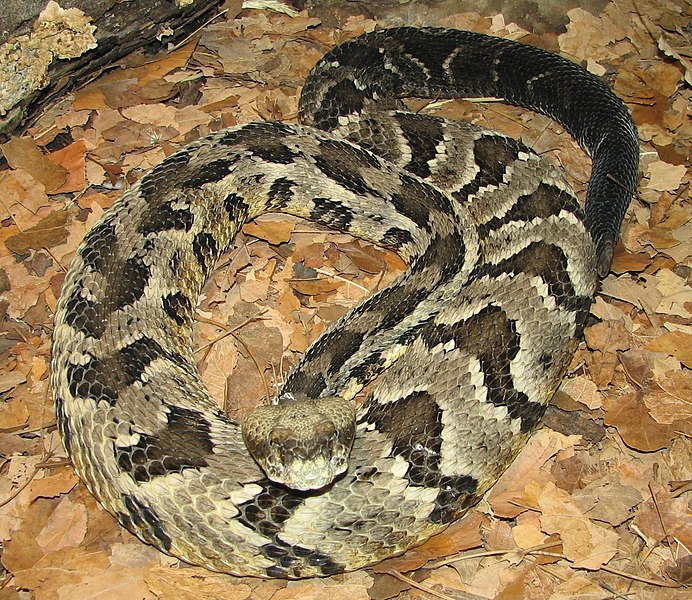
The site also contains timber rattlesnakes
Photo by Trisha M. Shears


Somewhere in the process last April 2012 he contacted me because I operate a school for prospectors teaching the fundamentals of prospecting that I try to tailor to the individual.  The owner already knew how to pan for gold, what he was really curious about was what he had on his property.  We made a trip to the site where we looked the site over and discovered plenty of evidence of prior mining activity with many prospecting pits and several hundred feet of trenching.  This activity covered several acres of the property.  From prior experience I know what this kind of work costs in money and labor.

In the past I had some involvement with Robert J. Altamura who worked for the Connecticut Geological and Natural History Survey when he prepared a map of the Bedrock Mines and Quarries of Connecticut.  Since I had a copy of the map and its accompanying booklet I checked and the site wasn’t on the map.  With that I contacted Margaret Thomas the state geologist and told her I’d found an unlisted mine.

Another creepy-crawler found on the property is the copperhead
Photo by Trisha M. Shears


Because the owner was a contractor he had some construction equipment including a backhoe that he used to explore the old mine.  He called me on the phone one morning in early May to tell me he had dug into what turned out to be an apparent mineshaft and had discovered many old bottles and other artifacts.  I told him to stop digging and I’d contact the state archeologist.  The state archaeologist told me he couldn’t come until May 24.

In the meantime I also contacted the Yale Peabody Museum who put me in touch with their mineral collection manager.  A bit later I contacted the geology department chairman at Hofstra University a personal friend to tell him what we had discovered.  Ultimately both the mineral manager and the chairman of the department agreed to come to the site on May 24.

What happened on the 24th was the meeting of a blue ribbon panel consisting of one archaeologist, three geologists and two engineers.  The net result of the meeting was we couldn’t determine what they had been mining.

The mine contains the following minerals: amphibolite, beryl, corundum, ilmenite, kyanite magnetite, pyrites talc and other minerals that are yet to be identified.  We also found one small speck of gold.

My own theory of this is:

The digging probably happened in the 1850’s after somebody came back from the California Gold Rush and decided there was gold on this property and went looking for it.  The debris filling the mineshaft has been dated to the post Civil War Era by the state archaeologist.  The mineshaft yielded what appears to be a cast iron ladle that could be used in assay work.

This tale is going to be continued!