Total Pageviews

Showing posts with label platinum group metals. Show all posts

Tuesday, May 15, 2012

Gold Occurrences in Paraguay

Map of Paraguay   - CIA

Paraguay is the next area in South America slated for heavy mineral exploration including gold.  Already more then 15 permits have been awarded for the exploration of gold in the country.  Concessions for gold exploration have already been awarded in the southern department of Guaira where several gold nuggets have been already found in the process of exploration.  In addition there are several other interesting areas that are yet to be explored.

In addition to the gold mining prospects there has also been considerable interest in diamonds and platinum group metals combined with nickel.  Most of the companies involved in exploration are still in the prospecting stage.  One of the companies involved in diamond exploration is Toronto-based Rex Diamond (TSX-RXD) that recently asked the government for a six month extension of its license.

The undersecretary also indicated that there are other mid-sized mining companies looking for gold and diamonds throughout the country.  Many of these companies are looking to develop small scale mining operations on their finds.  Meanwhile the Paraguayan Congress is working to overhaul the country’s mining code that will give the authorities and mining industry a greater measure of security for investors and clarify many aspects of the mining code.

Although there has been no recent volcanism in Paraguay there are at least two ancient volcanic provinces in the country to provide heat engines for the depositation of gold.  These are the Alto Paraguay Department where 240 million year old alkaline volcanic rocks underlie younger sediments.  At one point these rocks were explored for their potential uranium and phosphate deposits.

The other area of volcanism is found in a narrow strip along the Parana River these tholetic basalts that belong to the Parana Traps makes up most of the bedrock and underlies younger sedimentary rocks.  These traps also are host to the famous amethyst geodes found in Paraguay and Uruguay.  These volcanics were erupted in the Early Cretaceous as the opening of the South Atlantic Ocean and created minor outcrops seen today in a graben structure seen between Asuncion and Villarrica in the Amambay Department.  Cretaceous volcanism was also responsible for small sodic alkaline intrusions found in the Misiones Department of southern Paraguay.

The rivers that drain suspected gold bearing areas can contain much placer gold that in many cases is of viable commercial mines, but the same placer gold can be used to trace hard-rock gold deposits.  Gold can be found in areas that have undergone volcanism whether it is recent of something that has happened in the geologic past.


Sunday, May 22, 2011

Aqua Regia takes a Back Seat to a new Organic Process for Dissolving Gold and other Precious Metals

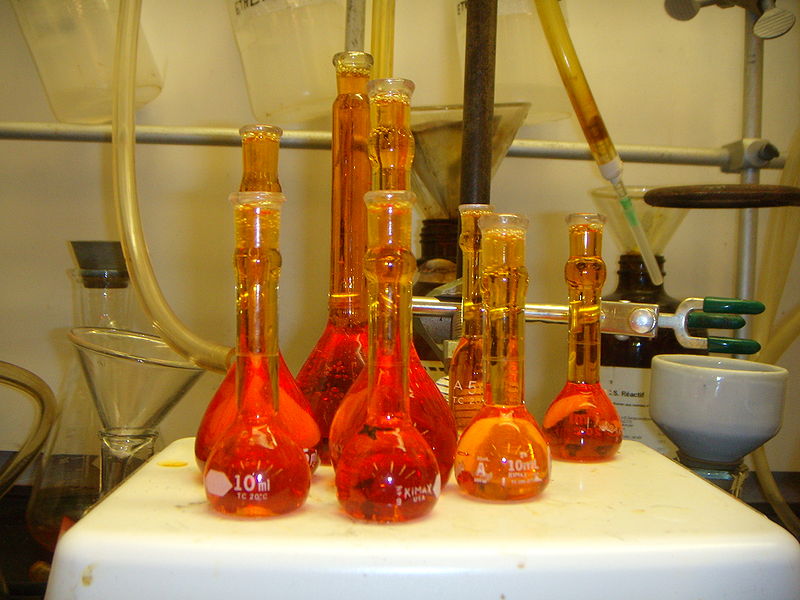
Solution of aqua regia in a laboratory
Photo by Thejohnier


Aqua Regia one of the few chemicals capable of dissolving gold and platinum group metals (PGMs) that was invented about 800 AD by the Arabic alchemist Gebar that was described in western literature in the 13 century by Paul of Taranto sometimes described as the “Pseudo Gebar.”  For centuries Aqua Regia reigned supreme until the development of organic solvents for gold were developed at the laboratory of Wei Lin and collogues at the Georgia Institute of Technology in the early 21st century. 

Aqua Regia is composed of one part of fuming nitric acid and three parts of hydrochloric acid that was used with a solution of tin chloride for the reaction forming the Purple of Cassius the only definitive test for gold until the invention of the Atomic Absorption Spectrometer in the 20th century.  Aqua Regia was also used in the gold refining process, but the same chemicals also dissolved PGMs making it difficult to remove PGMs from gold.  Lin’s new chemistry is capable of selectively removing the errant PGMs from gold by varying the constituents of the solution.

The new solution is based on the reaction of thionl chloride (SOCl2) and the organic solvent pyrazine.  Further experiments disclosed that by substituting other organic solvents such as N-N dimethylformamide (DMF), imidazole and pyrazine.  The gold can be recovered by calcining the resulting mixture.

Gold dust precipitated from aqua regia.
Photo by Greenhorn 1


A mixture of SOCl2 and DMS dissolves gold but doesn’t affect the PGMs making it possible to obtain 99.999 caret pure gold that is bullion grade.  By changing the recipe you can dissolve the PGMs without dissolving the gold.  This part of the process will make it easier to recover PGMs from catalytic converters then previous methods, and fuel cells in the future.

Even though the process can’t efficiently compete with conventional aqua regia at the present time Lin feels it will have uses beyond just dissolving gold and PGMs in the use of making nanostructures of the noble metals as well as recycling nano-coatings,  

Researches are ongoing with this technology, and it is expected that over the following years that advances in the technology will occur as well as new uses for the technology.  One of the major stumbling blocks that has to be overcome is the effects on the environment that is presented by this new technology.