Total Pageviews

Showing posts with label Maritime Provinces. Show all posts

Tuesday, August 16, 2011

Gold Occurrences in New Brunswick


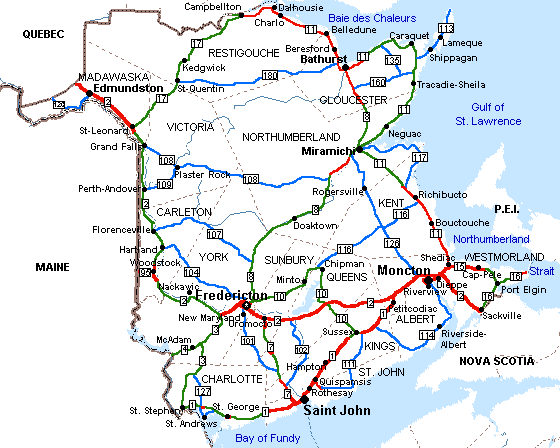
Road Map of New Brunswick


Because New Brunswick shares an extremely complex geological past with the New England States further south combined with government policy to develop their mineral resources the province has many mines in both the Bathurst camp in northeastern New Brunswick and at the Mt. Pleasant Camp producing a wide variety of metals ranging from the base metals of copper, lead and zinc to the precious metals of gold and silver finishing with rare metals such as indium. At Mt. Pleasant with sizeable amounts of indium occur with deposits of tin, tungsten and molybdenum. The province also exports sizeable amounts of cadmium, bismuth and antimony to a worldwide market.  In the southwest portion of the province there is extensive exploration for gold ongoing along the Clarence Stream.

By virtue of its diverse geological history New Brunswick has several different ways in which gold can occur.  In northern New Brunswick gold is found in the form of epigenetic formations in quartz veins following major faults and shear zones.  It is also found in gossens caused by the oxidation of volcanogenic massive sulfide (VMS) deposits of metals including pyrite and other iron sulfides. 

One of the largest faults found in North America passes through Newfoundland, Nova Scotia and Quebec just Missing New Brunswick by passing just to the north of the province.  This fault continues south through New England finally vanishing into the Atlantic Ocean south of Staten Island, New York.  Through its length it has several different names starting in New York it is called Cameron’s Line through Connecticut.  At the Connecticut/Massachusetts Border it is renamed the Whitcomb Summit Fault through Vermont where it passes along the west shore of Lake Memphramagog where it enters Quebec where it is renamed the Brampton/Baie Verte Fault.  When the continents divided during the Jurassic its northern end passed through the British Isles, and finally it went into the western edge of Norway where it finally vanishes.  This fault in reality is where North America collided with an island arc that was far out in the Iapetus Ocean that preceded the Atlantic Ocean.  In Greek Iapetus was the father of Atlantis for whom the Atlantic Ocean is named..

Like all suture zones its companion fault is interpreted to be a subduction zone with many metallogenic features that are remnants of the ancient ocean floor.  Most of the mineral deposits are found on the oceanic side of the fault where there are many VMS deposits and altered oceanic crust containing gold and other metals.  The altered oceanic crust is greenstone that is suspected to be the source rock for gold deposits.  The Abitibi Gold Belt of Quebec and Ontario has a similar history, but is much older.

There are two major gold producing areas in New Brunswick when this in the northern part of the province and is related to the Bathurst mining district. The other is along the bay in Fundy in the southern part of the province that is called the Annidale Belt. New Brunswick is located at the northern end of the Appalachian Orogen and shares its convoluted geology with the rest of the Appalachian Oregen.  The convoluted geology found in northern New Brunswick can be traced all the way to Staten Island NY.

Another place where placer gold has been found is in the Carboniferous rocks found in central New Brunswick that laps over into the province from Nova Scotia.  One of the places where you might find gold is in the later conglomerates that are products of erosion that washed down from older mountains.

Thursday, August 4, 2011

Gold Occurrences in Newfoundland

Gold from the Nugget Pond Mine in Betts Cove on the Baie Verte Peninsula of Newfoundland.
Photo by Rob Lavinsky


Gold was originally discovered in Newfoundland in the 1870s when there was a flurry of gold mining and prospecting in the Canadian Maritime provinces and Newfoundland.  This activity died down after a few mines were opened and closed again.  My great grandfather was one of those caught up in this early gold rush, but at least he mined enough gold for my great grandmother’s wedding ring.  It was this same gold rush that led to his leaving Canada for the United States as it was discovered he was poaching gold from Crown Lands; he decamped from Canada rather suddenly.

Most of the gold occurrences in Newfoundland are found in the central part of the island, and at latest count there were over 200 mines or prospects.  This is significant because the Baie Verte fault that marks a suture zone where gold is deposited.  The Baie Verte fault cuts across the island from north to south as the dividing line between continental rocks to the west and oceanic rocks to the east already has active gold mines along the strike of the fault.  This fault has been interpreted as a subduction zone that is dipping toward the west. The fault is one of the major faults that were in the super-continent of Pangaea. It extends from Staten Island, New York northwards with several name changes to Newfoundland.  It is also found in Europe from Ireland across Scotland finally cropping out in western Norway.

Gold is only one of the metals associated with this fault where others include copper and other heavy metals.  There have been several important mines found in the area controlled by the fault including the asbestos mines around Thetford Mines, Quebec and numerous gold occurrences.  

Mings Bight was where the first gold was discovered in the 1870s that were followed ca. 1903 by some short-lived mines.  By 1935 there were only 26 recorded instances of gold being found in Newfoundland.  It wasn’t until 1976 when significant gold mineralization was found near Cape Ray on the south coast.  In 1984 another deposit was found at Hope Brook.

A surge in prospecting followed the Hope Brook discovery that lasted until 1990.  The prospecting was focused on some dismembered ultramafic belts that were analogies of the mother lode deposits of California.   Then the search broadened until it included most of central Newfoundland.  The low price of gold during the 1990s virtually stopped exploration until it started to pick-up in 2002 and remains very active.

The island of Newfoundland has produced more then 64 tonnes of gold with previously discovered, and new deposits being explored promising a rich future for gold prospecting in Newfoundland. Gold exploration waned as the gold price fell in the late 1990s but began to accelerate in 2002-03 in conjunction with the strong rebound in the price. As of late 2004,with the price continuing to rise, exploration is very active.
Previously discovered deposits and prospects are all being re-investigated and several promising new grassroots discoveries have been made.

The Province has produced over 64 tonnes of gold, about half of which has been derived as a by-product of base-metal mining.