Total Pageviews

Showing posts with label New England. Show all posts

Tuesday, August 16, 2011

Gold Occurrences in New Brunswick


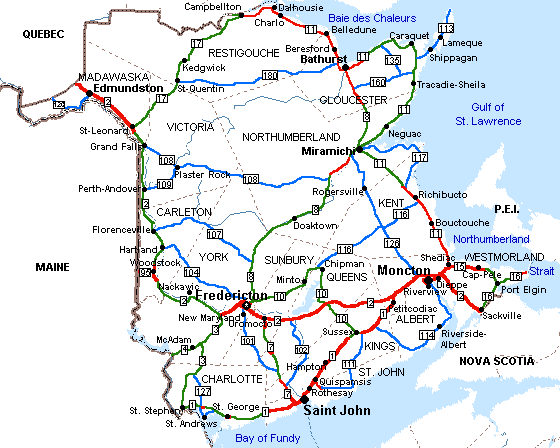
Road Map of New Brunswick


Because New Brunswick shares an extremely complex geological past with the New England States further south combined with government policy to develop their mineral resources the province has many mines in both the Bathurst camp in northeastern New Brunswick and at the Mt. Pleasant Camp producing a wide variety of metals ranging from the base metals of copper, lead and zinc to the precious metals of gold and silver finishing with rare metals such as indium. At Mt. Pleasant with sizeable amounts of indium occur with deposits of tin, tungsten and molybdenum. The province also exports sizeable amounts of cadmium, bismuth and antimony to a worldwide market.  In the southwest portion of the province there is extensive exploration for gold ongoing along the Clarence Stream.

By virtue of its diverse geological history New Brunswick has several different ways in which gold can occur.  In northern New Brunswick gold is found in the form of epigenetic formations in quartz veins following major faults and shear zones.  It is also found in gossens caused by the oxidation of volcanogenic massive sulfide (VMS) deposits of metals including pyrite and other iron sulfides. 

One of the largest faults found in North America passes through Newfoundland, Nova Scotia and Quebec just Missing New Brunswick by passing just to the north of the province.  This fault continues south through New England finally vanishing into the Atlantic Ocean south of Staten Island, New York.  Through its length it has several different names starting in New York it is called Cameron’s Line through Connecticut.  At the Connecticut/Massachusetts Border it is renamed the Whitcomb Summit Fault through Vermont where it passes along the west shore of Lake Memphramagog where it enters Quebec where it is renamed the Brampton/Baie Verte Fault.  When the continents divided during the Jurassic its northern end passed through the British Isles, and finally it went into the western edge of Norway where it finally vanishes.  This fault in reality is where North America collided with an island arc that was far out in the Iapetus Ocean that preceded the Atlantic Ocean.  In Greek Iapetus was the father of Atlantis for whom the Atlantic Ocean is named..

Like all suture zones its companion fault is interpreted to be a subduction zone with many metallogenic features that are remnants of the ancient ocean floor.  Most of the mineral deposits are found on the oceanic side of the fault where there are many VMS deposits and altered oceanic crust containing gold and other metals.  The altered oceanic crust is greenstone that is suspected to be the source rock for gold deposits.  The Abitibi Gold Belt of Quebec and Ontario has a similar history, but is much older.

There are two major gold producing areas in New Brunswick when this in the northern part of the province and is related to the Bathurst mining district. The other is along the bay in Fundy in the southern part of the province that is called the Annidale Belt. New Brunswick is located at the northern end of the Appalachian Orogen and shares its convoluted geology with the rest of the Appalachian Oregen.  The convoluted geology found in northern New Brunswick can be traced all the way to Staten Island NY.

Another place where placer gold has been found is in the Carboniferous rocks found in central New Brunswick that laps over into the province from Nova Scotia.  One of the places where you might find gold is in the later conglomerates that are products of erosion that washed down from older mountains.

Saturday, April 2, 2011

Nancy Twinkie sees Red:

Nancy was busy with her career s a TV Newscaster so for several weeks after the water snake episode we didn’t see each other.  There was a mine in West Cummington that produced rhodonite belonging to an old time miner named Anson Betts that had operated the mine during the 1920s for flux t the steel mill in Worcester, Massachusetts.  This steel mill belonged to US Steel where they made steel to address the New England Market.

At the time I had negotiated a lease for the mine and was in the process of pumping out the water when Nancy told me over the phone she had the following weekend free, and wondered if we could go prospecting again, so when I told her about the mine she got really curious.  The following Saturday morning I picked her up at home with the back end of my pickup truck filled with mining gear, and off we went up into the Berkshires to West Cummington. 

Before we went to the mine we stopped at the old farmhouse Anson Betts called home with his wife.  Anson was ninety-eight years old, but was as spry as a man that was forty years younger, so when he met Nancy he was on his best behavior.  Mrs. Betts brought us coffee that we drank with Anson before we repaired to the mine.

Anson as a young electro-chemist invented a way of electroliticaly refining the lead ores at Trail, British Columbia that is still used today as the Betts Process.  Several weeks later I was sitting in as a guest at a class in economic geology at Yale in New Haven, Connecticut where the professor just happened to be teaching a class about lead ore, and kept mentioning that the late Anson Betts was a graduate of Yale in 1894.  I finally raised my hand to advise the professor that Anson Betts wasn’t late, and we had coffee with him Saturday morning. 

After leaving the Betts house we went down to the lower mine next to the Plainfield Rd.  This was the mine I had leased because it had nice raspberry pink rhodonite even though it was covered with a black layer of manganese dioxide that is known as pyroluisite.  The mine itself was a small open-pit mine that was only about 50 feet deep and had been excavated into the side of a hill for about 100 feet.  Most of the rock we could see was covered with a film of pyroluisite with only a few splotches of ping showing through where some rock hounds had been at work.

While I was tending to the pump Nancy went rummaging around in the back of my truck where she found a sledge-hammer that weighed 8 pounds.  With a hammer that size you can do some serious damage, and Nancy walked up to an outcrop in the mine, and gave it a mighty whack with the hammer.  Nothing happened, but I should imagine Nancy’s teeth were probably rattling.

Some of the largest deposits of rhodonite in the world are in the Ural Mountains where it was mined as a gemstone and for making decorative items suck as the columns in a church or it was also used as a sargophus for Czar Alexander II.  The miners also used chunks of rhodonite as anvils for forging steel.  Its tough!