Total Pageviews

Showing posts with label snakes. Show all posts

Thursday, August 9, 2012

Some Handy Gear for the Prospector

Hardrock miner
Photo by Norbert Schnitzler


There are several items that over the years we have found to be handy added to our exploration kit.  Probably one of the handiest and incidentally the heaviest is a steel anvil 3 inches in diameter by 1 inch thick.  This is used for a simple test for gold.  Gold is malleable and can be flattened with repeated blows with a hammer.  So-called fools gold is brittle breaking up into several fragments, and if reduced to powder turns black.  Gold will retain its true color everything else turns black or in the case of mica turns white.

A hat to shield your punkin head from the hot sun is one of the most valuable things you can have during a prospecting expedition.  A hat also keeps the rain off your head if it starts raining. A simple bill cap will help, but a broad brimmed hat like the cowboy’s wear is even better.  The best one is a hard hat to protect your head from falling objects.

Gloves are another thing you shouldn’t be without because after a day of shoveling or hammering you are likely to find that one of the things you’ve got is a good set of blisters among other things.  The best work gloves for the prospector are leather work gloves.

If you are hunting for gold anywhere there are snakes, and there are always plenty of snakes wherever there is gold you need a pair of snake proof boots.  A rattlesnake can strike so hard that even with snake boots you can still be bruised through your boots.  A snake bite can ruin your day.  If you are messing around in streams one of the most handiest things you can have is a pair of rubber boots, preferably hip boots.

One of the handiest things you can have on a prospecting expedition is a good jeweler’s 10X loup.  Why a 10X because it has a depth of field that is deep enough to bring things into focus.  Loupes larger then a magnification of 10x have a much shorter depth od field to render them virtually useless.  In the same vein a pad and pencil also comes in handy for making notes.  A surveyor’s pad works best because they have water-proof paper.  You could also include a ball point pen.

The really most handy things to have is a good handheld GPS unit.  You can set it at your base station so you will always be able to return.  It is also handy for finding other places where you have been.  Another use for one of these is using it for laying out claims.

Friday, November 11, 2011

The Benefits of prospecting during Cold Weather

A snowy owl in flight during cold weather, one of the best times for prospecting.


The greatest benefit of prospecting during cold weather is there aren't any black flies around to gnaw on your bones. There are also many other benefits, probably the second most important is there aren't any mosquitoes around either. These two critters can make prospecting during the warmer month’s sheer hell. Another critter that is missing during the cold months is snakes. Many snakes are harmless, but the onesyou are apt to encounter while prospecting may not all be. It is the venomous snakes like copperheads, coral snakes, cottonmouths and rattlesnakes that can raise hob within any prospecting expedition.  For the most part even bears go into hibernation during the coldest months of the year. 

That leaves some other critters that might remotely be a bother, but only members of the deer family and the mountain lion are truly dangerous.  Usually deer try to avoid contact with humans, but during rutting season in the late fall male deer have been known to attack humans.  I once had a late fall encounter with a bull moose, a member of the deer family that could have been dangerous, but the moose didn’t like the smell of my companion that I’d been after for two weeks to take a bath.  The other dangerous animal is the mountain lion; they look upon humans as lunch.  Most mountain lions are confined to really wild areas in the western United States or the Florida Everglades.  They are very rare, but I observed one in Connecticut about thirty years ago.  According to the Department of Environmental Protection in Connecticut there weren’t any mountain lions in the state.  This spring one was killed on the Merritt Parkway, and another was observed by a canine control officer in northern Connecticut.

The perfect thing to go prospecting in during the winter.  Vehicles like this are used extensively for prospecting in Canada and other cold places.  This is a prototype that was built in Montana during the 1970s.
Photo by Gyre


The greatest benefit of cold weather prospecting is you can see so much further when the trees are bare.  One of the greatest problems facing a prospector is being able to find bedrock.  No leaves or other vegetation make it so much easier.  If you are panning for gold in a stream you can still do so just by wearing rubber gloves.  When I was prospecting in the cold weather I used to wear the bright red gloves that were covered with rubber, and were insulated.  They kept the cold water out, and the heat in.

It’s also much easier to get around in the bush or muskeg when the ground is frozen; in fact in some places where you want to prospect can only be approached during cold weather.  You don’t want to get into muskeg during warm weather, you’ll still be there.

Even if you are not out prospecting it is still a good time to plan your next expedition by studying the literature about the area where you intend prospecting, and laying your plans.  Remember there are plenty of other minerals worth looking for besides gold.

Monday, January 17, 2011

Wild Animals and the Gold Prospector

Most gold prospecting takes place in the wilds meaning that you are likely to encounter wild animals as you are prospecting.  Most wild animals will go out of the way to avoid you, but always keep in mind that any wild animal is not your friend.  The truth is any large animal can be dangerous, and many of them look at you as something for lunch.  Other animals have venomous bites including some kinds of snakes and lizards.

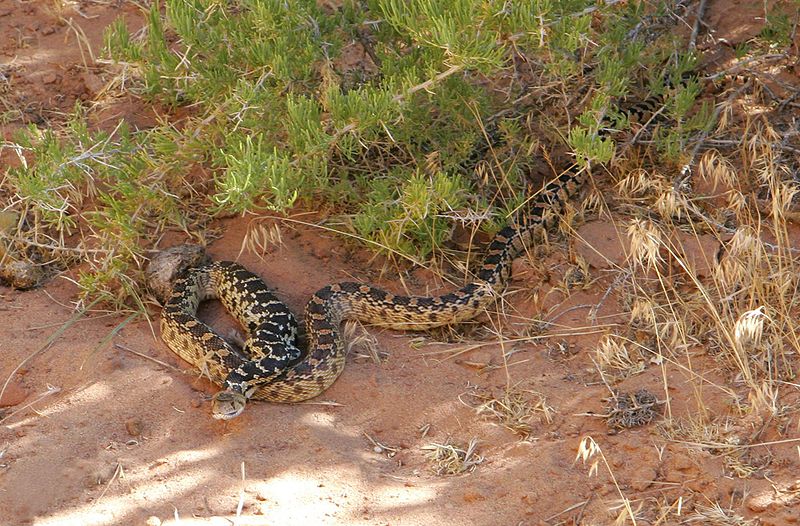
A rattle snake in his natural habitat. 

The encounter Nancy Twinkie had with a large water snake gave her a good scare, but under the circumstances had that snake been venomous that encounter could have resulted in a tragedy.  If a snake bite doesn’t kill you they are extremely painful, disfiguring and take a long time to heal.

You are apt to encounter venomous snakes near bodies of water, rocky places or any other place that offers concealment like old mines.  Years ago we had a lease on a mine in the central Berkshires of Massachusetts that had so many venomous snakes (rattlesnakes) that before you could do any work in the mine first you had to clear the snakes.  On another occasion we were prospecting in an old mine dump when my partner encountered a whole den of venomous snakes.  He wasn’t bit, but he sure moved fast!

A whitetail buck during rutting season.
Photo by Clinton and Charles Robertson

Snakes aren’t the only dangerous animal you are likely to meet in the wilds.  One of the most dangerous is any member of the deer family.  The members of the deer family are not the noble animal depicted in fiction, in reality they can be outright dangerous especially during the rutting season when the bucks will charge anything that moves.  The bull moose, a member of the deer family, have even known to charge locomotives during the rutting season.

A bull moose during rutting season.

One of the most dangerous situations we ever faced in the wilds is a pack of feral dogs.  These are somebody’s pet dogs that have gone wild.  Because they are familiar with people they do not fear man, and believe me a pack of these dogs can be absolutely dangerous. 

Feral Dogs.

When I was an active field geologist we had two encounters with bears, one of these encounters was with a family of four bears a female, a yearling and two cubs.  You don’t want anything to do with a female bear with cubs.  The other encounter was being stalked by a polar bear.  Polar bears look upon humans as some sort of seal their natural food, and this one was thinking about lunch.  We were forced to kill the bear when he charged us.

A polar bear similar to the one that stalked us while prospecting in the Arctic.

The strangest encounter you can have with an animal is with a large bird.  One morning I was walking my dog in a swampy area when I came around a clump of bushes and had en eyeball to eyeball encounter with a great blue heron.  These birds have a long sharp bill that they use to catch fish or to defend them selves usually aiming at their attacker’s eyes.

A great blue heron
photo by Ken Thomas

Wild animals aren’t your friends, but by exercising due caution you can usually keep most of them away by being noisy, and even whistling.  Some people even go to wearing bells to ward off most animals.  Probably the best thing to do if there are large carnivorous animals in an area is simply to avoid going into the locality. 

A mountain lion there are several reports of fatalities every year from these big cats in the United States

When going into any unfamiliar area the best policy is to exercise due diligence!