Total Pageviews

Showing posts with label lode gold. Show all posts

Monday, May 7, 2012

How to sample a lode gold deposit


_Pieces of drill cores
Photo by Constantino Figini 


Once you have discovered a promising outcrop of lode gold the next step is to sample the deposit.  This can be done in several different ways, but sometimes the old tried and true methods are the best.  The simplest way is to chisel a channel right across the outcrop of ore in which you are interested.  This is a lot of hard work but is well worth the effort.  The chiseling is done with a one inch (25 mm) stone chisel and a four pound hammer (2 kg), a short handled striking hammer works best for this.  The chips are saved in a cloth sample bag for later assaying.

Another situation you may come across is several outcrops of potential ore around your site that is in this case too much to sample the outcrops singly in a first sampling program on the site.  In this case you can go around the site and simply chip off a small sample from each outcrop, then have it assayed.  This isn’t the best method for sampling channeling is, but at least it will give some idea of what you have discovered.  Be sure you keep the samples random, and don’t favor what looks like hi-grade ore because this will skew the results of your sampling.

If you want to be sure about the accuracy of your samples send them to three different assayers then average the readings so you will come up with an average reading instead of a single assay.  This has been found to be more accurate.

After the preliminary sampling has been done, and your site has been proved to hold gold it is time to go onto more sampling to find out how much gold your site really holds, and if it is large enough to develop a mine.  It can take a lot of money to develop a hard rock gold mine, sometimes more then a billion dollars.  You should also keep in mind that only about one in a hundred gold discoveries are eventually developed into a paying gold mine.  They call it lode gold because it takes a load of money to develop it into a mine.

Drilling the orebody is the accepted method of proving the size of a gold deposit that is commercially viable.  This is done using a diamond core drill that gives you a solid core sample to examine.  Core drilling rigs come in several sizes with the smallest ones a drilling rig that can be back-packed.  There are several companies that make these drills that are capable of going at least 15 meters into solid rock.  Even larger rigs are available capable of drilling more then 1,200 feet into bedrock.

A back-pack rig is within the scope of something a prospector can carry into the bush with him, but larger rigs are best handled by specialized drilling companies.  The samples these take are cylinders or stone bearing the ore.  The first thing that happens when a core is retrieved is to split it in half lengthwise so the prospector retains half of the core with the remainder being shipped off to an assayer.  A series of core drill cores are used to delimit the actual size of an orebody by moving the drill rig further to the initial hole until the last hole bored is beyond the last hole bearing payable ore.  Many of these drilling programs encompass drilling kilometers of core drill holes.

Tuesday, March 20, 2012

Gold Occurrences in Ecuador


Coat of Arms of Wcuador

Ecuador is nestled between Colombia and Peru, but has seen nowhere the amount of exploration the other two countries have, a statement that is especially true of Peru.  According to some of the giants of the gold mining industry like Barrick and Newmont Ecuador is the prime place for exploration.  This is where the gold discoveries are going to be made, not in Peru where they are already mining gold.  Even though Colombia and Peru contain some really big deposits of gold Ecuador just hasn’t seen the level of exploration that has gone on in these other countries.

A great deal of gold has been found over the ages in south-eastern Ecuador including the gold used by the Incas from Pizzaro in the early 1500s.  This was enough gold to fill a room, but the Spaniards still executed the last of the Inca emperors.  The gold found here is epithermal in nature with drilling results by Aurelian Resources indicating a multi-million ounce deposit at their Fruta Del Norte project.

Today there are several exploration companies that are uncovering the enormous potential of this little explored region of South America.  Many of these exploration companies are working within a few kilometers from where Aurelian has its Fruta Del Norte property.  Many of these companies are exploring deposits that could potentially yield many ounces of gold.

Chimborazo one of the many volcanoes found in Ecuador that have epithermal gold deposits associated with them.
Photo by David Torres Costales


The majority of these companies are from Canada that are talking among themselves about arranging joint ventures.  The country of Ecuador is clearly open for business with all indications they have a government that is open for business and are prepared to act in a responsible manner.

Most of the Canadian and other companies are concentrating on the potential of developing lode gold deposits although there is plenty of room for placer deposits along the rivers and streams of Ecuador.  A great many of the deposits in this district are along tributaries of the Amazon River.

The potential for finding gemstones in this part of the world is also high it is just across the border in Colombia where some of the largest emerald mines in the world are located.  Years ago your author while exploring another of the tributaries of the Amazon discovered several sandbars that were littered with gem grade topaz that also contained placer gold.

Tuesday, January 10, 2012

Gold Occurrences in El Salvador


Coat of Arms of El Salvador


There are several volcanoes located in El Salvador with most of them found in the western part of the country and have all erupted during the Holocene.  It takes volcanic activity to create gold deposits, and that is exactly what has happened in El Salvador.  The heat from the volcanoes has driven the gold out in concentric circles around the volcanoes and is deposited when the temperature of the water drops below 300o C to about 200o C.  Quartz is also deposited at about the same range of temperature so they are often deposited at the same time.

Most of the lode gold found in El Salvador and Central America in general are in the form of epithermal deposits associated with the many volcanoes in the region.  These volcanoes are products of the subduction zone just off the west coast of Central America.  Many of these deposits grade to copper with depth making it possible that the largest copper deposits can also be found in the area.

Although there are little references to placer gold in the country it is reported to be found in most rivers and streams flowing from the interior as placer deposits in the bottom of the valleys.  Like other placer deposits it is found associated with the gravel deposits associated with flowing water.

First there was a gold rush in El Salvador that quickly was followed by the lawyers.  Although gold in plenty has been found in the country its large scale mining is being opposed by community groups, locals and environmentalists.  It seems their concern is mainly the distribution of wealth between the miners and the local population.  As we speak this is a battle moving its way through the courts!

Pacific Rim Mining has a project named El Dorado that is 65 km east of the capital of San Salvador that is presently in an advanced stage of exploration indicating there is 1.4 million ounces of proven resources available and a potential of much more that is the target for the present exploration program.

Mining and exploration is governed by the 1996 law that was last amended in 2001.
This law is administered by the Ministry of Economy’s Department of Hydrocarbons and Mines governs the granting of exploration license as well as exploitation concessions.  This allows the applicant the right to produce and sell valuable products recovered from natural resources within the area of the concession.  An Environmental Impact Study (EIS) has to be approved by the Salvadoran Ministry of Environment and Natural Resources as well as satisfying a number of other conditions.  Once it is granted the law requires that mine construction be started within the next twelve months in accordance with the conditions on the final permit.

Monday, June 13, 2011

The Hurdles You Face in opening a New Gold Mine

So, you have been lucky enough to find a good strike of lode gold!

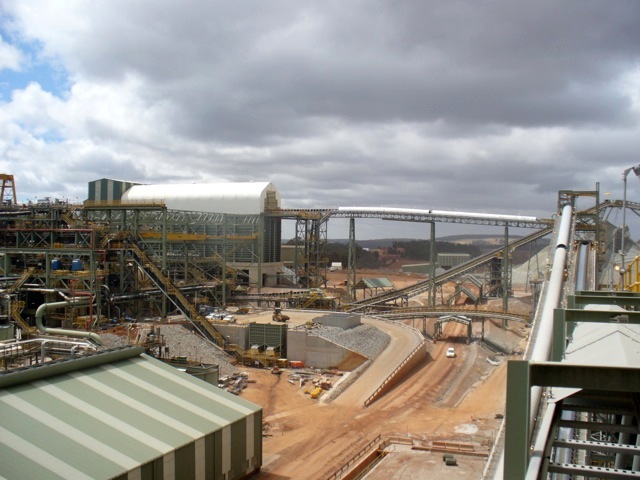
This will give you an idea of the scale of operations found at a working gold mine.  This is the Buddington Gold Mine in Australia.
Photo by Calistemon
That is only the first step in a long journey that is required to change a gold strike into a producing mine. It has been estimated by members of the mining community than in the United States this is a process that can take as long as seven years or more just for getting the necessary permits to mine. There are permits required by several different governmental agencies including the Environmental Protection Agency (EPA) and the Army Corps of Engineers. There are also several other permits that are required at the state and local level that can involve not only the Planning and Zoning Commission (P&Z) in your town, but if you are going to use explosives in your mining operations you are required to have a blasting permit from the town Fire Marshal. In some jurisdictions mining is not permitted under any circumstances.

Even with the permits all in place there is a considerable amount of construction activity that has to be accomplished before you ever get the mine into production. Part of the permitting process also includes a set of plans showing how you were going to open your mine, how work on the mine is going to progress, and how you were going to close the mine. All of this work is expensive at has to be performed by an engineer or landscape architect. It is only providing a basic set of plans that complicates the procedure of opening a mine, it is also some modifications to these plans that are required by several different permitting organizations. Probably the toughest of all is your local planning and zoning commission.

Now that you have your permits all in place after several years then you have to go through the necessary steps required to open your mine, and bring the mind into production. This is going to require all the equipment that is found in a crushed stone quarry and then some. Some of the basic Clement you are going to require is a jaw crusher, a secondary crusher and a set of conveyor belts to move the crushed stone to stockpiles.

A stone crushing plant in operation.
Photo by Richard Law


Depending on the method used to extract gold from its ore will require additional equipment like a giant ball mill to further reduce the ore into a powder. This powder is further refined in a process called floatation where it is mixed with water, and a detergent that forms bubbles that remove the gangue minerals from the gold. These processing steps ultimately lead to a smelter where the gold is cast into bars. The final step of reducing the gold to .999 Fine is done by a special refinery that most miners contract for from an outside source.

A ball mill is the device shown in the background of this photo.


The cost of taking a prospect to a producing mine often exceeds $1 billion or more. That is the reason why only about one in 300 prospects ever get that far, and are developed into a producing nine. For the most part mining lode gold is a major industrial operation that is usually beyond the capabilities of the single person although it has been done in the past and will shortly be done in the future.


Wednesday, June 8, 2011

Gold Occurrences in New Mexico

A copper mine in El Chino that produces gold as a byproduct.
Photo by Eric Guinther


New Mexico may be billed as the Land of Enchantment, but it is also known for its gold deposits as well as other minerals. These gold deposits generally follow along the crest of the Sangre di Cristo and other mountain ranges of the Rocky Mountains. This gold bearing belt cuts across the center of the state from the Colorado border south to the Mexican border. In this area it is possible to find both placer and lode gold. In much of this area gold is produced as a byproduct of mining other metals particularly copper.

Gold was originally discovered in New Mexico by the Spaniards in 1828, but there is evidence that the Native Americans they have found the gold deposits even earlier. This goal is mainly contained in a gold belt that cuts diagonally across the state from northeast to southwest that ranges from 50 to 100 miles wide. The gold and other metal deposits are closely associated with volcanic rocks found in the same area that can range from quartz monzonite to granodiorite intrusives. Most of these volcanics were produced during the Cretaceous or tertiery times.

There is a fine brochure produced by the New Mexico Bureau of mines and mineral resources that outlines the process of prospecting for gold for both amateur and professional prospectors. Many of the principles of prospecting can be used in other places as well as New Mexico.

There is no longer history of mining in New Mexico a place that had many good mines in the past, but today most of the gold produced in New Mexico is a byproduct of the copper mining industry.

The state also contains extensive placer deposits that have been washed down the mountains in dry washes and streams whenever a flash flood strikes. One authority states that the placer gold found that New Mexico has hardly been scratched because it is so dry that conventional panning methods don't work. To compound this does so-called dry panning methods don't work either because throughout the area the matrix containing the gold is damp and doesn't take kindly to conventional mining methods. Another factor limiting the hunt for placer gold is a layer of concrete subsoil called caliche but also limits the production of gold.

To find placer gold it is best to hunt in areas that have already produced gold. One of the places of interest is where deposits of gravel have come down from the mountains in arroyos, but these he posits are often naturally cemented together forming a stone like deposit that has to be treated like hard rock. Also the placer gold state is found between 3000 and 8000 feet. The higher elevations of least produce enough water for conventional placer mining.

Thursday, May 26, 2011

Gold Occurrences in Colorado

The Argo Gold Mine and Mill in Colorado
Photo by Dustin Moore


Whatever you may say about gold it sure attracts people's attention in a hurry so it was with the Colorado Gold Rush. The gold miners were egged on by the cries of, “Pike’s Peak or bust.” Rumors of gold date back to 1807 when the Mountain Man Zebulon Pike heard rumors of gold in the South Platte River. By 1859 rich deposits of gold were discovered in the mountains west of Denver when the miners abandoned the plains. The first placer mines were around Denver sparking the first Goldrush in 1858.  Gold was found in the following plains counties Adams, Arapahoe, Douglas, Denver, Elbert  and Jefferson. Small amount of placer gold is still produced from Sand & Gravel banks around Denver as a byproduct of gravel washing operations by the aggregate producers.

The district around Central City and Blackhawk was another important gold mining district that produced enough gold to bankroll the modern city of Denver with several hardrock mines being in the district.  At one time the author had dibs on part of the Bates - Hunter mine in Blackhawk. This is officially called the Central City – Idaho Springs District. 

The Teller House in Central City Colorado. Central City was the site of several goldmines during the 19th Century.
Photo by Hustvedt


Gold was originally discovered in this area on January 5, 1859, by a former California prospector named George A. Johnson during the Pike's Peak gold rush. He made his discovery at Chicago Creek where it empties into Clear Creek; this marked the first significant Gold strike that was made in Colorado. Jackson who originally came from Missouri was able to conceal his strike for several months until he paid for some supplies with gold dust then the word was out. What had attracted Jackson in the first place were the large number of hot springs that belched columns of steam into the air. Jackson's discovery eventually led to a gold rush.

 The presence of hot springs in the area is an indication that hydrothermal water sent shed themselves of their gold content into the surrounding rocks. The same hot springs gave the settlement a new name that was to be known as Idaho Springs. On May 5, 1859 another miner named John Gregory discovered a gold bearing vein but was later called the Gregory Lode between Black Hawk and Central City that was called Gregory Gulch. Within two months of this discovery several other gold bearing veins were also unearthed. These discoveries gave rise to the establishment of other mining towns in the area including Nevadaville and Russell Gulch.

This is Pike's Peak that gave rise to the cries of Pike's Peak or Bust during the Colorado Gold Rush


For a few years hardrock mining prevailed in the district until the miners exhausted the free milling gold that was prevalent in the shallower parts of the deposits. This Friday of gold or worked fine for the amalgamation process, but the miners could not recover any gold once they reached the sulfide ore at a deeper depth.

It wasn't until the invention of an effective smelter for the sulfide ore by Nathaniel P. Hill in 1868. This was an achievement that allowed hard rock mining to continue in the district where several other smelters were also built. It is estimated that by 1959 this district produced about 6,300,000 troy ounces of gold mainly from sulfide veins that were found in gneiss and granodiorite.

The early miners made their discoveries at the northeast end of the Colorado Mineral Belt, but it wasn't too long before they started heading southwest across the mountains from Idaho Springs the miners traced the Colorado mineral belt west along Clear Creek, then over the mountain passes to South Park and from there to head waters of the Blue River.

This was the Breckenridge district where the miners first discovered gold in the 1880s, By following the placer gold to its sources at the miners discovered that were veins in the hills containing gold. The miners even recovered some placer gold from the gravel benches to the north of the Blue River. Although gold production Peter now during the late 1800s, but was revived by gold dredging in 1908 along the Blue River. During its lifetime the Breckenridge district produced about 1 million troy ounces of gold. Today the gold mines around Breckenridge are all closed, but there are a few that remain open for tourists.

As early as 1859 prospectors had already found rich placer deposits on the west side of South Park in the valleys on the east side of the Mosquito Range in the principle districts of Fairplay and Alma.  These deposits were located at the headwaters of the South Platte River with others in the Tarryall District alongside Tarryall Creek. Later they found lode gold deposits in the mountains above Alma.  Some of these deposits were worked with floating dredges until 1952.  These gold miners left behind them the gravel ridges seen today. It has been estimated that production from these operations recovered about 67,000 troy ounces of gold. Altogether the Alma-Fairplay district produced about 1.55 million troy ounces of gold with over two=thirds coming from lode deposits.

The discovery of placer gold at Oro City in 1860 opened the pages on the colorful history of the Leadville District.  The placer deposits were exhausted within four years, but the discovery of lode gold in 1868 that later lead to the discovery of large silver deposits in 1877.  It was also in 1877 that the city of Leadville was founded.

The gold and silver deposits at Leadville were deposited in a paleo-karst environment where the rich ores were deposited in ancient river valleys that were later covered by volcanic deposits. The ore here acted as a replacement of limestone that is a common association for gold.  The ore was in the form of lead/silver sulfides with gold being produced as a byproduct.  It has been estimated that there were about 3.2 million troy ounces of gold produced from the Leadville District.

In 1870 gold was discovered by prospectors along the Wrightman Fork of the Alamosa River and a year later they found lode gold in veins where full scale production commenced in 1875 once they had build a mill.  In this district gold production continued until 1906, but became sporadic after that until all production ceased in 1990.  There were about 520,000 troy ounces produced in the life of this district.

At the southwest end of the Colorado gold belt gold is found in Telluride District where the gold is associated with several Tertiary volcanic calderas including the remains of the largest eruption ever discovered “La Garita.” Here the deposits are found associated with intrusives in the older sedimentary rocks as well as chimneys and veins in the volcanic rocks themselves. It is estimated that this district has produced about 6.8 million troy ounces of gold while it was productive. The same district also produced sizable amounts of silver, lead and copper during the same period.

The Cripple Creek district has produced the most gold in Colorado was not discovered until 1891.  After the discovery the towns of Cripple Creek and Victor were settled to take care of the needs of the mines as well as the miners. Altogether this district has produced more then 21 million troy ounces of gold. 

The Cripple Creek and Victor Gold Mining Co. was formed in 1979 with the idea of starting gold production in the district by working mine tailings from the old mines. In the period when they were active from 1979 to 1986 they produced around 150,000 troy ounces of gold.

In an exclusive interview with Jim Burnell of the Colorado Geological survey it was revealed that there are several hard rock deposits of gold that are ramping-up to resume production.  There has also been a considerable amount of activity from the small scale miners that don’t have to report their findings to the state.  According to Mr. Burnell there have been several exploration companies that have expressed an interest in Colorado gold, but for proprietary reasons they don’t want to have their names revealed.

To a limited extent gold mining is still going on in a large scale in Colorado, but the difficulties in permitting a large scale mine today make it extremely difficult to open a new mine. Several mining companies have tried opening some of the older mines that are grandfathered.

Wednesday, May 4, 2011

What to do if you find a Lode Gold Deposit

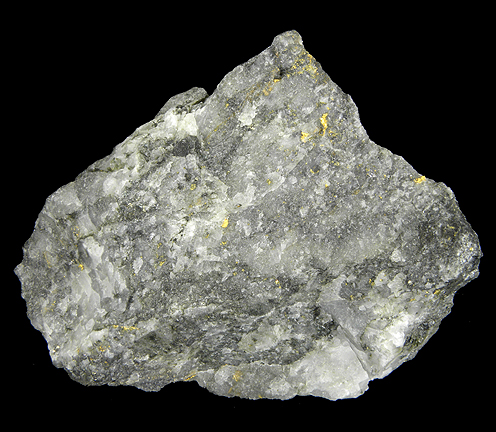
A view of an undeveloped lode gold deposit.  The gold is in the white veins in the photo.
Photo by Eric Jones


The first thing you have too do after finding a potential deposit of lode gold is to be sure that it legally is yours either by ownership of the land, by a legal claim or by working out a deal with the rightful owner of the land.  The best type of deal is when you are the owner of the land where the deposit has been found.  In some jurisdictions where it is permitted is the mineral claim whereby you come into ownership of the mineral rights by expending a certain amount of money on the claim per year for several years until it finally becomes a patented claim that in effects gives you the ownership of the claim.  If it is on private property that does not belong to you, and you can’t file a claim then you will have to work out some kind of agreement with the lawful landowner.

Most lode gold deposits are found in quartz veins that commonly called “Bull Quartz” by miners that are usually emplaced in a fault zone that might consist of one large vein or a whole series of quartz veins holding gold, or both.  It should be kept in mind that all showings of gold are not developed into gold mines in fact very few of them are.  During the 19th century this situation was called “Gamblers Ruin” that was the title of a book about mine appraisal.  The chances of developing your find into a working mine are about 1 in 300.

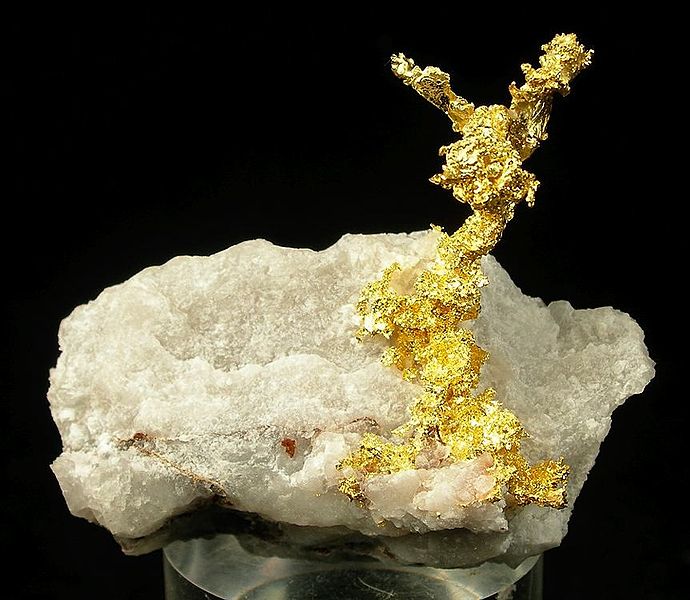
Gold in Quartz
Photo by Rob Lavinsky


If there is gold present you can find it in a brook adjacent to the suspected deposit.  This is done by panning in the brook a few feet on either side of the deposit, and another sample from the brook right at the point where the deposit is, or as close as you can get.  Another way for detecting gold deposits is by using a metal detector some of them can be set specifically for gold.  In some places you can rent a metal detector.  There are times when the gold in quartz is visible to the naked eye or with a magnifying glass.

An important step in developing a find into a mine is finding out if it actually contains gold and other valuable minerals this is done by taking a representative sample across the exposure by chiseling a line right across the exposure using a hammer and chisel.  This is hard work, but is necessary to get some kind of idea about what you have.  The rock chips are all saved and submitted to a licensed assayer for analysis.  This determines if you have discovered anything worth further exploratory work by determining how much gold is present per ton.  Remember gold showing as little as a few grams per ton is a payable deposit under the present price for gold.  You have a bonanza deposit when you measure the amount of gold present in troy ounces of gold per ton.

Another view of lode gold.
Photo by Rob Lavinsky


Once you have established that there is indeed gold present it is time to call for a diamond drilling program because there is nothing more convincing to bankers and other members of the financial world that is more convincing them a set of core samples.  The truth is you are pretty much on the hook for the first core sample that is taken at the point of discovery.  Further cores are taken by offsetting from the original discovery site by a predetermined distance in initial investigations this is usually 50 meters in each direction around the point of initial discovery.  It is not unusual for a drilling program to consist of several thousand meters of core drilling.

Core drilling also determines whether or not a find can be developed into a commercially viable mine, and there are any number of reasons why it isn’t.  One of the big finds we made during the 1960s was a deposit of copper that was drilled proving a resource worth $100,000,000 at the time.  It was never developed into a mine because It would have required the expenditure of $1,000,000,000 to get the ore out of the find.  In other words it wasn’t commercially viable, so no mine was developed.  The area was just too remote, and it still is.  We wound up calling this find the $100,000,000 nuisance.

Sunday, April 24, 2011

Gold Occurrences in Washington State

Although Washington State has never been noted as a major gold producer it has however produced over 2,000,000 ounces of gold. It has been reported that the state still possesses many unexploited virgin placers as well as lode gold where it is still possible for a prospector to make a profit. The state Department of Natural Resources, Geology and Earth Resources Division in Olympia has produced a bulletin titled, “Inventory of Washington” by Marshall T. Hunting that you will find invaluable in the search for gold.

Mt Olympus on the Olympic Peninsula of Washington.


Many of the counties of Washington were gold is already been found include Ashotin, Benton, Chelan, Clallam, Clark, Columbia, Cowlitz, Douglas, Ferry, Grant, Grays Harbor, Jefferson, King, Kittitas, Lewis, Lincoln, Okanogan, Pacific, Pend Oreille, Pierce, Skagit, Skamania, Snohomish, Stevens, Whatcom, Whitman and Yakima. In many of these counties the discoveries include both placer and lode gold.

In the state of Washington the major gold producing areas are pretty well limited to the northeast corner where the gold is found in the Okanogan Highlands that expense offered from British Columbia, and contains the second largest gold mine in the United States, the Cannon Mine that produced most of the lode gold found that Washington. A far greater amount of gold has been produced from placer deposits far exceeding the amount of lode gold that has been recovered.

The state of Washington is actually composed of several different so-called suspect terranes that have been plastered onto the West Coast of the United States so the bedrock back of the state resembles a patchwork quilt. Some of the best places to recover gold is in aureoles around volcanoes that are found in the state in abundance. The driving force behind all of this volcanic activity is the “Juan de Fuca” plate that is being thrust under the state of Washington creating a range of mountains to the west of Puget Sound that are called the Olympic Mountains. It is the same plate that further inland is creating the Cascade Range that includes several volcanoes including Mount Rainier, and Mount Saint Helens.

The southwest corner of Washington is covered by the Columbia Plateau basalts that are over 3000 feet thick. The basalt flows were in place during several different episodes possessing a magma that was quite runny. It is beneath these flows that they have discovered natural gas, and there is a good possibility that gold may be found in the older rocks under the basalt covered. At the present time however we just don't have the ability to prospect for the gold because it is buried so deep under the basalt.

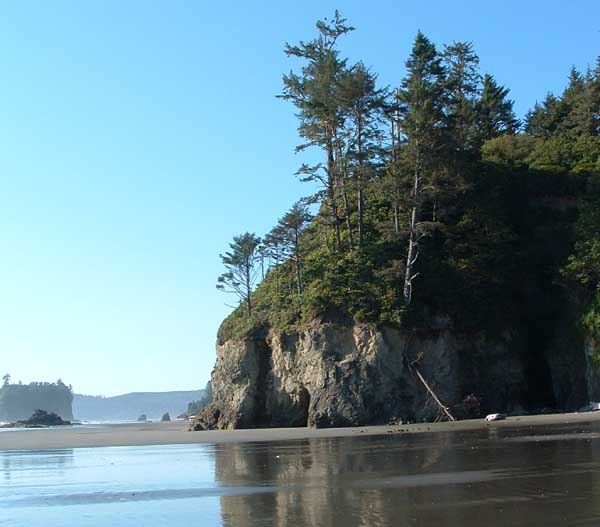
A typical beach on the Olympic Peninsula where gold may be found.
Photo by John Hunter


There are many reports of gold being found in the rivers that drain the Olympic Peninsula as well as the beaches facing the Pacific Ocean where fine gold has been found in the beach sands, and has produced many profitable claims. It would be advisable to check the regulations imposed on gold mining along the state beaches before you start mining. Most of the gold found on the speeches is very fine, but periodically is renewed by the action of storm waves making for a practically never ending supply.

Monday, March 28, 2011

On the Nature of Placer Gold

Gold is found in all the rivers of the world in sizes ranging from nuggets that can weigh several pounds to tiny flakes that are the size of a grain of flour. There is a size range between nuggets and flour gold that are called “pickers” because they can be picked up between the thumb and forefinger.

Although placer gold forms as particles weathered from existing bedrock that are concentrated into viable deposits by the action of running water in rivers or beaches, or by wind. In rivers gold is commonly found in places where there is a sudden decrease in the velocity of water causing the gold to fall out of the current. Gold has a specific gravity slightly higher than 19 when it is pure. It is this high specific gravity that causes gold to be carried down through a layer of sand and gravel to come to rest on the surface of the bedrock under the river. It is because of this fact that gold is rarely visible in a river. Gold is also found in aeolian deposits where the wind has blown away for lighter components of sand.

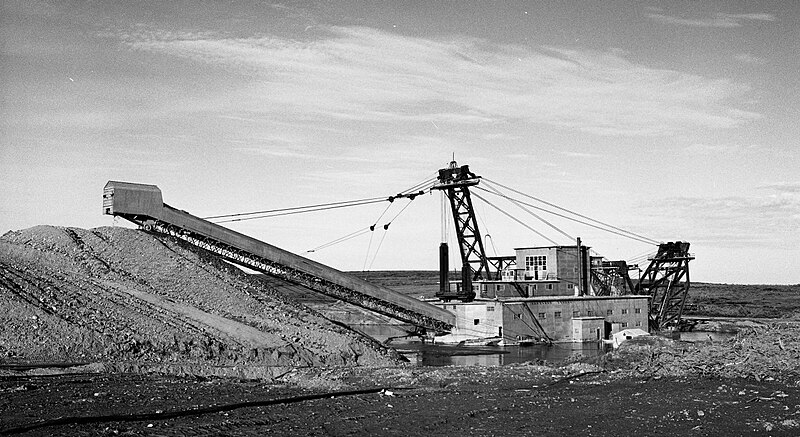
This is gold dredge No. 3 in Nome, Alaska the largest dredge in the world for mining placer gold.

Another type of placer deposit is formed in areas that have not been glaciated that are called saprolites. These deposits can be several hundred feet deep, and are composed of bedrock that has been subjected to a warm moist climate that has changed the rock into a mixture of clay and quartz leaving behind gold and a host of other insoluble minerals. In this case the gold is scattered throughout the entire depth of the deposit.

In all placer deposits gold is mostly found in the sand portion of the deposit gold nuggets are found in the gravel portion. Before the invention of metal detectors a great deal of gold was lost in the tailings pile because the miners classified the material they were working into sand. The gold nuggets were often discarded with the mine tailings, but are now being recovered by modern miners equipped with metal detectors.

Placer gold in a gold pan.
By alaskagold 
Although it is usually possible to recognize gold in placer deposits by its color. There are times when there is a thin film of metal oxide; usually iron or manganese that forms on its surface. Gold then takes on the appearance of the other black sands in the gold pan making it virtually impossible to recognize. This problem can be solved by treating the concentrate with vinegar or muriatic acid that dissolves the covering of metal oxides.

An old time prospector panning for gold.
By Tony Oliver

There is another type of gold that we are all familiar with these are the tiny specks that show up when we are finishing a pan of gold. These specks are so small that they float on the surface of water by surface tension and are called "floaters" by prospectors.  We normally lose them over the edge of the gold pan. This can be prevented by a single drop of dishwashing detergent added to the pan that causes these tiny specks to sink to the bottom where they can be recovered in the course of a regular cleanup.

Saturday, March 26, 2011

Learn how to Prospect for Gold

Panning for Gold


We are going to teach a class on prospecting for placer and lode gold at the Log House Restaurant on US Route 44 in Barkhamsted, Connecticut on May 21, 2011 starting at 9:00 AM and lasting until 3:00 PM.  This class will give you information about both placer and lode gold prospecting methods.  Emphasis will be on placer gold although a great deal of information will also be taught concerning lode gold in NW Connecticut that has some of the most complicated geology in the world.

In addition to the classroom studies we will spend part of our time in the field examining some of the situations and places where gold can be found.  We will also teach you some of the tricks of the trade. 

Each participant in the class will receive a Garrett Gravity Trap Gold Panning Kit, Model #1651-300 as part of his tuition fee.  This is a $29.95 value.

Please make all checks payable to John Carter.  Payments can be made by check or money order or by credit card via PayPal at: geotekllc@gmail.com 

Address:

John Carter
11 Meeting House Rd.
Suite 21a
Barkhamsted, CT 06063
Tel:  860-469-4804
Cell: 860-605-0475

About your instructor:

John Carter has been an avid prospector since childhood having prospected extensively in the gold bearing areas of Canada notably in the Abitibi Gold Province of Quebec and Ontario.  He also has prospected for placer deposits throughout New England and Maritime Canada.  John holds a degree in geology and has been a guest lecturer at the New School in New York, and Northwestern Connecticut Community College in Winsted, CT.  John has also been an army drill sergeant, so watch your step or he will write your name down.  He underwent 8 levels of instruction in the Army Instructors School, and is rated an expert in instruction. 

About the area:

Northwestern Connecticut contains some of the most complicated geology in the world, and although the gold deposits are sparse they are enough for you too see what gold looks like.  The paucity of placer deposits in the area may have been caused by the last period of glaciation having swept most of the potential gold and carried it further south to Long Island.  There has been at least one gold rush in East Litchfield when they were building the railroad bridge across Spruce Brook in 1849.  We had our own 49ers, but gold has also been found in Leadmine Brook in Thomaston, and along the Naugatuck River from Winchester South.  Gold is also found in the Farmington and Housatonic Rivers and their tributaries. 

Lode gold in the area:

Lode gold has also been found in the general area of Northwestern Connecticut by John Carter in East Litchfield during the construction of Rt. 8.  The fact that there are few reports of lode gold here is more apt to be related to lack of looking rather then lack of gold. Finding lode gold is much more difficult then finding placer gold.

Registration Form

Cutoff Here

Name: ________________________________

Address 1: _____________________________

Address 2. _____________________________

City: __________________________________

State: ___________ Zip: ___________

Tel: _________________

E-mail: _________________________

Please enclose registration fee or E-mail registration form to geotekllc@gmail.com

Tuesday, March 22, 2011

Gold Occurrences in Illinois

You might not exactly figure that you could find gold on the waterfront of Chicago or along the many beaches that are found on the shores of Lake Michigan, but that may be a very likely place to look. The USGS reports that there is no minable gold from Illinois even though the same glaciers that brought gold down from the Abitibi region in Canada no doubt affected the state of Illinois to as far south as the Ohio River. There are some old reports that mention lode gold being found in the state that might be credible.

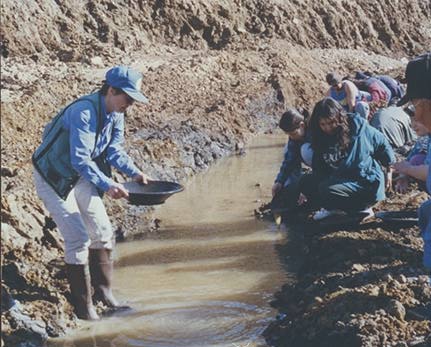
Gold panning in a small stream.
Photo by Sylvia Duckworth


There are some reports mentioning that there was a small amount of gold found from quartz geodes that were discovered while digging a shaft in the dolomite of Stephenson County. This is located in the upper Mississippi Valley lead and zinc mining area. There were also reports into Peoria Star-Journal that are dated August 6, 1975 that a small amount of gold was recovered from a mine shaft dug in Bald Knob a large hill in Union County.

Mostly gold found in Illinois came from the Abitibi Gold Belt and to the north in Canada. This gold bearing region extends from Wawa, Ontario to Val D’or, Québec and is one of the largest gold bearing regions on earth that since gold was originally discovered in 1909 has produced over 160,000,000 ounces of gold. This not only brought down into Illinois placer gold that is found in the rivers and streams throughout the state, but also there are reports of boulders containing gold that is said to be 
worth as much as $25 per ton.

A $20 gold piece known as a Gold Eagle.


Placer gold has been reported from several localities in Illinois including:
1. The Sangamon River Valley in Macon County,
2. The Mississippi River Valley and a small tributary in Henderson County,
3. The Illinois River Valley in Fulton County,
4. The Spoon River Valley in Fulton County,
5. An outwash plain in McHenry County.
Most of gold found in Illinois is from the northern part of the state including Chicago where most of it is concentrated in the so-called terminal moraines that were left by the glaciers and are recognized by their stomach he appearance. The gold found their death and rebirth and concentrated by the action of flowing water in the rivers and streams that are found in that part of the state. The gold is found is usually just a few flakes or gold dust that are found in the sand and gravel deposits usually in the bed of a stream or river.

With this kind of gold deposits anyone processing a very large amount of sand and gravel may find that recovering gold can be profitable. This is not a job for a single prospector although he can usually find enough gold to show other people what it looks like, and have some bragging rights.

The operators of sand & gravel pits are in a different situation because they are processing large amounts of sand and gravel every day. They could include a sluice box in their processing spread to concentrate gold from sand. If they are washing sand in their normal course of processing they could very easily place a gold trap in their spreads. A feature of placer mining of this type depends on the fact that most placer gold that is found in Illinois occurs in the sand portion of aggregates. This eliminates the need for processing the gravel portion of the product.

Gold is not the only thing that the glaciers brought down from Canada also brought diamonds, rubies, sapphires and zircons. These gems have been found as reported in “Canadian Diamonds,” a special report published during the summer of 2008 by the Northern Miner. Some of these diamond deposits are found in classical kimberlite deposits. Other occurrences are found in ancient gravel deposits that have solidified as conglomerate. The final source is alluvial diamonds and other gems brought down from Canada by the glacier..

Friday, January 14, 2011

Gold Occurrences in Vermont

Did you ever know that Calvin Coolidge the 30th president of the United States as a young man was a gold miner in Plymouth, Vermont where he was born. Virtually all the rivers and streams on the east flank of the Green Mountains are gold bearing. This gold belt crosses the Connecticut River as part of the Ammonoosuc gold belt of New Hampshire and extends northwards into Québec. This is part of a larger gold belt found in the northern Appalachians that extends all the way from Staten Island, New York to Baie Verte on the north coast of Newfoundland. On the landward side there is a continuous thrust fault that goes by many names but is continuous from one end to the other.

In this case however we are only considering the gold bearing areas in the state of Vermont. These are found in the eastern flank of the Green Mountains in the so-called Iapetus Suture Zone an area that is bounded on its west side by large intrusions granite. On its Eastside it is bounded by the Connecticut River. Virtually anywhere in this zone It is possible to find both lode and the placer gold.

The Waits River one of the many goldbearing streams of Vermont.

Even though the idea of finding gold causes us to have dreams of fabulous wealth in Vermont although there is gold there is not enough that has been discovered so far to make anyone wealthy. Several years ago there were unproven rumors about someone finding a gold pocket in the Williams River that produced over $2800 worth of gold in one afternoon.

Aside from gold there are also many occurrences of sulfide minerals in Vermont lying within the Connecticut Valley -- Gaspé Synclinorium and the Bronson Hill Anticlorium as well as the Appalachian province of Stratabound massive sulfide minerals. There are also isolated occurrences that are associated with the Green Mountain Anticlinorium Tectonic Province.

While a great many of the soleplate minerals have been discovered in Vermont that include lead, zinc, copper, molybdenum and arsenopyrite, copper was the only sulfide mineral that was mined on a large scale. Most of these sulfides contain gold as a byproduct.

At the present time, other than gold, no other metallic minerals are being mined in Vermont at the present time. The copper sulfide ore was originally discovered in Orange County as early as 1793, but it took another four years in the early 1830s before was finally mined. Until the discovery of copper on the Keweenah Peninsula of Michigan in 1846 Vermont was the largest producer of copper in the United States.

To this day the Orange County Mining District is a scar on the landscape. The site of the mine is at present listed on CERCLIS the EPA's database showing potential hazardous waste sites that will eventually be remediated under the Superfund program.

The first reports of gold in Vermont surfaced in 1845 when the State Geologist C.B. Adam's in his First Annual Report on the Geology of Vermont reported finding gold in the town of Somerset, Vermont.

It was four years later when the California gold rush caused many Vermonters to search for gold in California. By the mid-1850s many of these gold seekers had returned home. One of these 49ers by the name of Capt. Abial Slayton had struck it rich on his California gold claim. When he returned to Vermont in 1855 he went on to discover gold in what was then Hull's Brook that has since been renamed Gold Brook in Stowe. At the time of his discovery Slayton set up a sluicing operation that employed several people. Although this gold discovery never produced the amount of gold be found in California it did produce enough so that in 1887 the builders of the Mount Mansfield Electric Railroad drove the last spike that was coated with some of Slayton's gold.

An old fashioned gold pan used by the 49ers.
Photo by Nate Culi


In 1854, a mine containing gold, silver, lead and copper was opened in Bridgewater, Vermont. In this mine called was found as small irregular grains in quartz. It was noted in 1867 by Dr. C. T. Jackson that the so-called great Appalachian gold belt passed through both Plymouth and Bridgewater.

By the early 1900s even though gold was present in Vermont it was determined that it didn't occur in commercial quantities. There had been gold bearing rocks discovered in Plymouth and Bridgewater that were mined only it cost more to mind the metal than it was worth. By that time it was determined that it is useless to spend time and money trying to find a fortune in gold mining in Vermont.

It was the placer deposits that were found in the Plymouth area around 1855 that Calvin Coolidge later worked for gold when he was a young man. Even though there are plenty of indications that no one will get rich mining gold in Vermont, gold hunters are still out there looking for gold during the summer months when many people converge on the gold bearing streams in the state trying to recover “free gold” from stream gravels found in the beds of rivers and streams throughout the state.

Friday, December 24, 2010

Gold Occurrences in Maine

This article explains some of the gold occurrences found in Maine where gold can be had from three different sources as placer gold, lode gold where it occurs in quartz veins and as a trace element associated with metal sulfides especially pyrite where it occurs in thin films between individual pyrite crystals.

According to the Maine Geological Survey placer gold has been found in the following streams:

Sream
Township
County
Swift River and its tributaries
Byron area
Oxford, Franklin
Sandy River
Madrid to New Sharon
Franklin
South Branch-Penobscot River
Sandy Bay; Bald Mtn; Prentiss
Somerset
Gold Brook
Bowman
Oxford
Gold Brook
Chain of Ponds; Kibby
Franklin
Gold Brook
Chase Stream
Somerset
Gold Brook
T5 R6; Appleton Township
Somerset
Nile Brook
Dallas; Rangeley
Franklin
Kibby Stream
Kibby
Franklin
St. Croix River
Baileyville
Washington

This is the kind of mountain stream where you can expect to find gold.
This list is by no means conclusive because virtually any other stream in the vicinity of those listed can also contain gold. The bed load of the streams eventually reaches the Atlantic Ocean where the litterol current carries in parallel to the coastline depositing its load of gold onto the sand and gravel beaches of Maine. As a teenager the author did some prospecting along these beaches discovering that the gold that was present was mainly flowered gold. The most gold was discovered near the mouths of the rivers running into the ocean. 

Ogunquit Beach, Maine where as a teenager we panned for gold.  Notice the small stream entering the ocean on the left side of the picture it was here where we had our most luck panning.

Because gold is 19 times denser than water another place that might be profitable to look is in the lower reaches of sand and gravel deposits where the deep deposits are at rest on bedrock or a bed of clay. Another factor that has to be taken into consideration is stream migration. Since the time of the glacier melting around 12,000 years ago the stream channel may have migrated several hundred feet to the West of its original position. To the practiced eye this can be readily seen by an area of flat terrain with the higher banks on the west side of the stream.  This is a situation that not only exists in Maine, but is a worldwide phenomenon where ever you have flowing water.

Gold on Quartz   Photo by Rob Lavinsky

Placer gold is that the only variety of gold found in the state of Maine.  Maine also has lode gold where gold is found in quartz veins. Even more complicated is gold deposits found as trace elements in base metal sulfides where gold is found as an impurity that must be recovered when the metal ore is smelted.  Finally gold is often associated with iron pyrite where it is a thin film between the crystal faces of pyrite.

You can purchase all kinds of supplies and equipment through our associate Amazon.com needed for operating a placer gold mining site.  By using the Amazon Searchbox you can access both new and used equipment.