Total Pageviews

Showing posts with label glaciers. Show all posts

Friday, June 24, 2011

Gold Occurrences in Missouri

The only part of Missouri where gold is found is in the counties bordering the Missouri River where gold was brought down from Canada by the glaciers.  The gold was left behind when the last glacier melted about 12,000 years ago.  Whatever gold is found is extremely, what miners call flour gold that won’t support a commercial operation, but is a lot of fun to find anyways.

This is gold found in terminal moraines that formed where the glacier was continuously melting in one place that are recognized by their hummocky appearance and many sand & gravel deposits. The Gold deposits are often accompanied by diamonds that are more likely to be found in payable amounts throughout the areas where glaciers once trod.  Diamonds are another example of the many riches brought down from Canada by the glaciers.

Gold is found as panable deposits along the sand bars that line the Chariton River and its tributaries.  It has also been found at Kirksville in Adair County in sand and gravel deposits. In Macon County there are two areas containing gold one of these is near the town of Elmer where gold is found in Murray Gulch.  Around the town of Gifford gold has been discovered in glacial deposits.

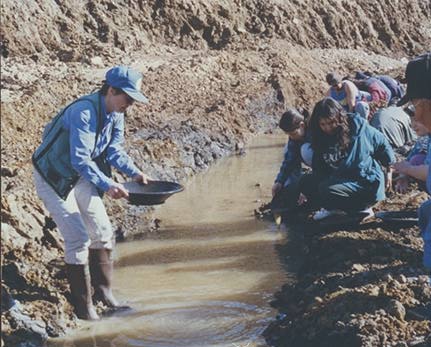
A group being taught how to pan for gold. 
The advice given by many geologists is not to spend too much time looking for gold in Missouri because you will be wasting your time.  That doesn’t mean that Missouri is bereft of minerals because there are mineral deposits scattered throughout the state.  The area around Joplin used to be the scene of extensive deposits of lead and zinc.  These mines are now closed, but there are plenty of mineral specimens to collect in the area.

Thursday, March 24, 2011

Gold Occurrences in Wisconsin

There is gold to be found in Wisconsin in the forms of placer deposits in just about any county in the state that were brought here by the many glaciers that have come down from the gold bearing regions of Canada. It should be remembered by prospectors that Wisconsin is divided geologically into two different parts that are nearly equal in size. In the southern part of Wisconsin the basement rocks are buried under a deep deposit of sedimentary rocks that in some places can be miles deep. The northern part of the state is a continuation of the Canadian Shield.

Bedrock map of the Lake Superior region.

Gold found in the northern part of Wisconsin comes from both small lode deposits as well as widespread placer deposits. The placer gold is found in just about any stream or river in the state as well as the beaches along the southern shores of Lake Superior. The deposits lode gold all discovered in several places up to this point none of them found were economically viable. There are several mines in the northern part of the state that are producing both iron and other base metals. Geologically there is no reason why gold should not be associated with these deposits. Just across the border in Michigan there is working gold mining that is produced gold for many years. Of interest are the copper mines that are found in the northern part of the state where the operators of these mines were well aware of the presence of gold, but for economic reasons they just didn't raise the issue.

Throughout the whole state of Wisconsin there are glacial deposits of placer gold brought down from Canada that by being reworked by running water for placer deposits. These deposits are found in the rivers and streams wherever there is a sudden change of velocity in the running water, or on beaches of the many lakes in the state where the gold is concentrated by wave action. Gold of this nature is usually found in fine grains and what is termed flour gold that forces the prospector to become very skillful in the use of the gold pan recover this gold.

Glacial Deposits
Photo by Richard Webb

The gold isn't the only thing the glaciers brought down from Canada; they also brought down several gemstones including diamond, ruby, sapphire and zircon. Weight for weight the stones are actually worth more than gold with the exception of zircon. Deposits of these gemstones are often found in placer gold deposits because there are also concentrated by the action of flowing water. Like gold the glaciers scattered these gemstones across the whole state.

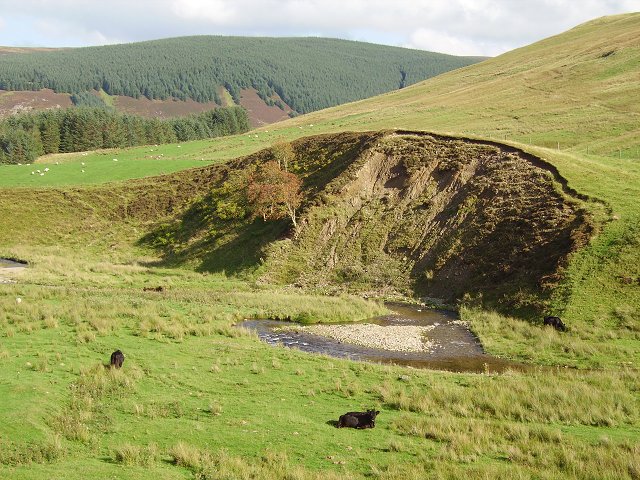
A glacier.
Photo by Kristan Hutchison

Anyone in Wisconsin is allowed to do what is termed recreational gold panning without having to have a license as long as the stream banks and bottoms are not harmed or large amounts of silt and other waste products is not released into the waters of the State. Any gold you find belongs to the person that holds the mineral rights on the property where you found it. You must get permission from the property owner before you do any panning by reaching some sort of agreement with the holder of any mineral rights before you start gold recovery. 

Tuesday, March 22, 2011

Gold Occurrences in Illinois

You might not exactly figure that you could find gold on the waterfront of Chicago or along the many beaches that are found on the shores of Lake Michigan, but that may be a very likely place to look. The USGS reports that there is no minable gold from Illinois even though the same glaciers that brought gold down from the Abitibi region in Canada no doubt affected the state of Illinois to as far south as the Ohio River. There are some old reports that mention lode gold being found in the state that might be credible.

Gold panning in a small stream.
Photo by Sylvia Duckworth


There are some reports mentioning that there was a small amount of gold found from quartz geodes that were discovered while digging a shaft in the dolomite of Stephenson County. This is located in the upper Mississippi Valley lead and zinc mining area. There were also reports into Peoria Star-Journal that are dated August 6, 1975 that a small amount of gold was recovered from a mine shaft dug in Bald Knob a large hill in Union County.

Mostly gold found in Illinois came from the Abitibi Gold Belt and to the north in Canada. This gold bearing region extends from Wawa, Ontario to Val D’or, Québec and is one of the largest gold bearing regions on earth that since gold was originally discovered in 1909 has produced over 160,000,000 ounces of gold. This not only brought down into Illinois placer gold that is found in the rivers and streams throughout the state, but also there are reports of boulders containing gold that is said to be 
worth as much as $25 per ton.

A $20 gold piece known as a Gold Eagle.


Placer gold has been reported from several localities in Illinois including:
1. The Sangamon River Valley in Macon County,
2. The Mississippi River Valley and a small tributary in Henderson County,
3. The Illinois River Valley in Fulton County,
4. The Spoon River Valley in Fulton County,
5. An outwash plain in McHenry County.
Most of gold found in Illinois is from the northern part of the state including Chicago where most of it is concentrated in the so-called terminal moraines that were left by the glaciers and are recognized by their stomach he appearance. The gold found their death and rebirth and concentrated by the action of flowing water in the rivers and streams that are found in that part of the state. The gold is found is usually just a few flakes or gold dust that are found in the sand and gravel deposits usually in the bed of a stream or river.

With this kind of gold deposits anyone processing a very large amount of sand and gravel may find that recovering gold can be profitable. This is not a job for a single prospector although he can usually find enough gold to show other people what it looks like, and have some bragging rights.

The operators of sand & gravel pits are in a different situation because they are processing large amounts of sand and gravel every day. They could include a sluice box in their processing spread to concentrate gold from sand. If they are washing sand in their normal course of processing they could very easily place a gold trap in their spreads. A feature of placer mining of this type depends on the fact that most placer gold that is found in Illinois occurs in the sand portion of aggregates. This eliminates the need for processing the gravel portion of the product.

Gold is not the only thing that the glaciers brought down from Canada also brought diamonds, rubies, sapphires and zircons. These gems have been found as reported in “Canadian Diamonds,” a special report published during the summer of 2008 by the Northern Miner. Some of these diamond deposits are found in classical kimberlite deposits. Other occurrences are found in ancient gravel deposits that have solidified as conglomerate. The final source is alluvial diamonds and other gems brought down from Canada by the glacier..