This is about the gold mining and prospecting industry. Tell your friends about us! You can find our blog at http://goldminingandprospecting.blogspot.com We've been working on our new book about East Coast Gold that should be ready by October. If you want to reserve a hard copy go to geotekllc@gmail.com
Total Pageviews
Showing posts with label lode deposits. Show all posts
Sunday, October 23, 2011
Gold Occurrences in Saskatchewan
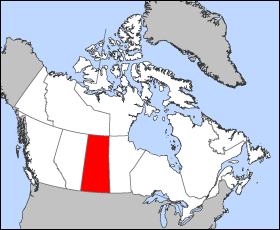
Many of the people living in Saskatchewan don’t realize that the province is the largest producer of Uranium in Canada but also has or had some world class gold deposits that are found in the northern part of the province. The starting point for all this mining activity is the city of Saskatoon where many of these mining companies are headquartered. The potential of the province where the surface geology has barely been scratched is vast with many mineral deposits yet to be found.
Rumors of gold being found by trappers on the North Saskatchewan River started filtering out in 1859. These rumors claimed there were one ounce and larger nuggets being found were prevalent during the building of North Battleford. Flour gold can still be recovered by panning the river from Churchill west to Edmonton Alberta and beyond. Some stories even tell of seeing businessmen with their pants rolled up panning gold from the river during lunch hour around Edmonton Alberta.
Gold was first discovered in Saskatchewan near Prince Albert in 1859 in the North Saskatchewan River. The province began producing gold in small quantities in the early 1900s from placer deposits along the North Saskatchewan River and its tributaries. Today there five gold mines have been brought into production since 1987 with additional production coming from base metal mines mainly from around Flin Flon. There are an additional 200 gold occurrences in the province that are not being worked presently.
During the 1980 although gold had been produced since the early 1900s marked the first time that there had been a significant gold exploration program had been used in the province. Most of these occurrences are in the Precambrian shield area except for some small placer deposits draining off the Canadian Shield.
According to the Saskatchewan Geological Survey (SGS) there are still large areas in the Province that haven’t been explored especially in the Canadian Shield. To search for Saskatchewan occurrences of gold, use the Saskatchewan Mineral Deposits Index searchable database, or the Geological Atlas of Saskatchewan. Or open the Mineral Resource Map of Saskatchewan.http://upload.wikimedia.org/wikipedia/commons/2/2b/Saskatchewan-map.png
It has been pointed out to me by one of my Canadian prospectors whose mother was born in Battleford, SK that they mined placer gold along the Saskatchewan River flowing between Battleford and North Battleford. Some of the miners reported they were able to recover as much as an ounce a day.
Thursday, March 24, 2011
Gold Occurrences in Wisconsin
There is gold to be found in Wisconsin in the forms of placer deposits in just about any county in the state that were brought here by the many glaciers that have come down from the gold bearing regions of Canada. It should be remembered by prospectors that Wisconsin is divided geologically into two different parts that are nearly equal in size. In the southern part of Wisconsin the basement rocks are buried under a deep deposit of sedimentary rocks that in some places can be miles deep. The northern part of the state is a continuation of the Canadian Shield .
| Bedrock map of the Lake Superior region. |
Gold found in the northern part of Wisconsin comes from both small lode deposits as well as widespread placer deposits. The placer gold is found in just about any stream or river in the state as well as the beaches along the southern shores of Lake Superior . The deposits lode gold all discovered in several places up to this point none of them found were economically viable. There are several mines in the northern part of the state that are producing both iron and other base metals. Geologically there is no reason why gold should not be associated with these deposits. Just across the border in Michigan there is working gold mining that is produced gold for many years. Of interest are the copper mines that are found in the northern part of the state where the operators of these mines were well aware of the presence of gold, but for economic reasons they just didn't raise the issue.
Throughout the whole state of Wisconsin there are glacial deposits of placer gold brought down from Canada that by being reworked by running water for placer deposits. These deposits are found in the rivers and streams wherever there is a sudden change of velocity in the running water, or on beaches of the many lakes in the state where the gold is concentrated by wave action. Gold of this nature is usually found in fine grains and what is termed flour gold that forces the prospector to become very skillful in the use of the gold pan recover this gold.
![]() |
| Glacial Deposits Photo by Richard Webb |
The gold isn't the only thing the glaciers brought down from Canada ; they also brought down several gemstones including diamond, ruby, sapphire and zircon. Weight for weight the stones are actually worth more than gold with the exception of zircon. Deposits of these gemstones are often found in placer gold deposits because there are also concentrated by the action of flowing water. Like gold the glaciers scattered these gemstones across the whole state.
| A glacier. Photo by Kristan Hutchison |
Anyone in Wisconsin is allowed to do what is termed recreational gold panning without having to have a license as long as the stream banks and bottoms are not harmed or large amounts of silt and other waste products is not released into the waters of the State. Any gold you find belongs to the person that holds the mineral rights on the property where you found it. You must get permission from the property owner before you do any panning by reaching some sort of agreement with the holder of any mineral rights before you start gold recovery.
Wednesday, February 9, 2011
Gold Occurrences in New Jersey
The first mention of gold in New Jersey dates back to 1829 when gold was reported from the general area around Franklin. The report failed to mention whether this was lode or placer gold, but from the geological history of that area it could have been either. One of the features in New Jersey shares in common with all the other states of the northeastern United States is the possibility of placer gold being brought down from the Abitibi Gold Belt in Canada .
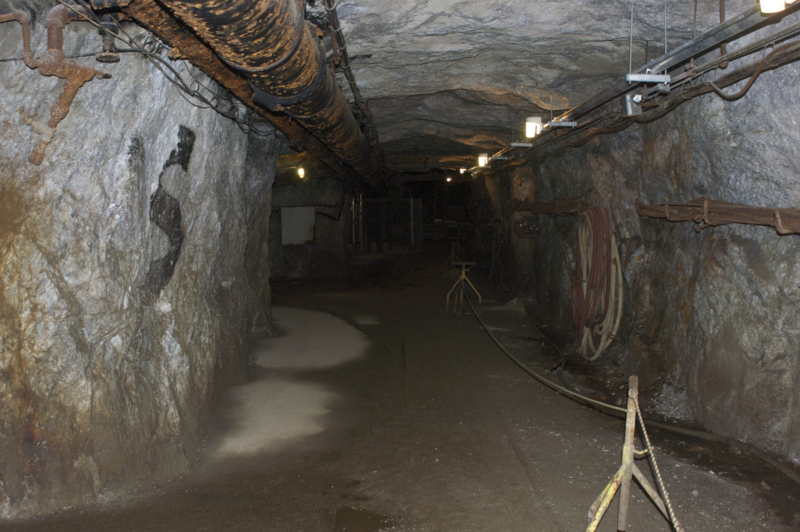
| An adit in the Sterling Hill Museum at Sterling Hill, NJ |
Gold has been reported in the ancient rocks of Grenvellian age from Sussex County associated with the iron deposits. It has also been reported from the Schwangunk conglomerate from extreme western Sussex County in the vicinity of High Point , New Jersey . The stone here is a conglomerate composed of quartz pebbles that is identical to the conglomerates of the Schwangunk Mountains of New York State .
There have been reports of so-called gold mines in the past one notable example was in the Schuler Mine that showed some gold in quartz. Many of the reported gold mines in Bergin County during the 19th century were actually scams.
Although gold appears to be sparse in New Jersey there is otherwise a very rich history of mining for several other commodities including copper and silver in the Newark Basin basalts and sandstone. In the mid-19th century there were several mines producing copper and byproduct silver in this area of New Jersey .
Sunday, November 28, 2010
Trace Minerals found with Gold
Forward:
There are many minerals that are found in nature with gold, one of the most common found in placer deposits is small grains of magnetite. This and other minerals have been used to find gold that can be recovered by the use of the pan. Other minerals have been used in locating gold in lode deposits. It seems that gold is often found with other metal bearing minerals including iron. These are called indicator minerals.
Placer deposits are made from the products of erosion if they can withstand the rigors of the weathering process. Very few minerals are hard and tough enough to survive whole and remain recognizable when they have been reduced to the size of sand grains, around 2 mm in diameter. The most abundant mineral found in sand is quartz, SiO2 also known as silica.
Quartz grains along with other minerals having a hardness of 7 or more on the Mohs Scale of Hardness make up what are called black sands or stream heavies in placer deposits. Gold is another mineral found in the same environment that doesn’t depend on its hardness to survive in such an environment instead quite the opposite is true. The ability of gold to survive is its softness and malleability allowing it to survive in placer deposits.
Most of the indicator minerals for gold are . . .
Quartz | Magnetite (Magnetic) | Hematite |
Garnet | Beryl | Corundum |
Feldspar (Sometimes) | Kyanite | Sillimanite |
Topaz | Tourmaline | Mica (Small flakes) |
Diamonds | Monazite | Zircon |
There are others in the list, but these are the most likely to be encountered.
Lode gold is found in solid rock that is often discovered by tracing placer gold back to its source often using the indicator minerals found associated with gold in the gold train, a scattering of gold found away from its source rock. The further away gold is from its source the smaller the particles become and the more widespread the individual particles of gold become.
Most gold is found in quartz veins where it has been deposited from hydrothermal waters into the older quartz veins. Much gold has been found in iron pyrite as a contaminant, and ever rarer it is sometimes discovered a “telluride” where it is combined with the element tellurium.
Many of the same minerals as found in sand can also be found in occurances of lode gold, but there are several other minerals that are just too soft to survive the rigors of weathering, they include . . .
Apatite | Calcite | Biotite Mica |
Sphalarite | Chlorite | |
Feldspar | Staurolite | Arsenopyrite |
Amphobolite | Garnet | Iron Pyrite |
Pentlandite | Argentite | Granular Magnetite |
These are the most common minerals associated with lode gold; there are others.
Subscribe to:
Posts (Atom)