Total Pageviews

Showing posts with label geological history. Show all posts

Thursday, April 28, 2011

Gold Producing Metallogenic Provinces and Epochs (MPE)

There are many metallogenic provinces and epochs (MPE) that can be traced through the formations of various rocks including those particular places and times when gold was deposited. There are at least eight of these episodes that can be found in the Appalachian Mountains of southern Québec. These MPE's can range all the way from the Grenville orogeny that occurred around 1.2 million years ago, and can be traced to different types of orogenies and mineralization to the end of the Permian era. 

A map of selected worldwide ore deposits of metals.
By KVDP


The different MPE's can be directly related to specific orogeny like the Grenvillian or any other orogenic event that has happened in the history of the world. An MPE can be found anywhere on the face of the earth. That means you had better know the geological history of the area where you are prospecting, and remember that some orogenic events left more gold behind them than others.

MPE's are usually associated with a suture zone where one tectonic plate has collided with another. In the case of an oceanic plate colliding with the continental plate the oceanic plate is subducted beneath the continental plate, and about 20 km inside account metal plate there should be a line of granitic intrusions.

The subduction zone acts as a giant heat engine melting the material that has been dragged downward by subduction causing it to become heated to the point the material is melted.  The subducted material is also saturated with water that lowers the melting point of the material, and supplies the water that at depths of kilometers beneath the surface of the earth becomes super heated water that is capable of dissolving many minerals that when they reach the right environment through the action of the superheated hydrothermal fluid are deposited as ore.

A subduction zone.
By A.J. Stern


Searching around in the area that has been intruded one is apt to find gold in the aura of contact metamorphism that is associated with the granitic intrusions. In this case gold is often associated with scheelite, an ore of tungsten in the form of tungsten carbonate. This occurrence is often found where the granite has intruded through an older layer of carbonate rocks such as limestone or dolomite where it forms a skarn..

On the oceanic side of the subduction zone are found many metal sulfide deposits where this whole deposits are usually found in small amounts, but there can also be some really huge deposits of sulfide that are formed this way. These are the result of sulfide deposits that are laid down by black smokers found on spreading centers located on the bottom of the ocean. These deposits are laid down very much like plums in a pudding at the scattered across the bottom of the ocean.
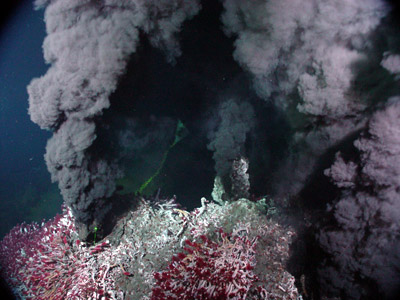
A black smoker at a spreading center at the bottom of the ocean. NOAA


As these deposits are carried away from the spreading center by the action of more magma being injected they cover the ocean bottom with spots where they are eventually subducted beneath a continental plate where they are often reactivated to form secondary mineral deposits sometimes in quantities large enough to form ore deposits.

MPE's are where ore deposits are typically found, and in many cases are considered to be the primary source of mineralization, and they eventually break down to form detrital mineral deposits.

Wednesday, February 9, 2011

Gold Occurrences in New Jersey

The first mention of gold in New Jersey dates back to 1829 when gold was reported from the general area around Franklin. The report failed to mention whether this was lode or placer gold, but from the geological history of that area it could have been either. One of the features in New Jersey shares in common with all the other states of the northeastern United States is the possibility of placer gold being brought down from the Abitibi Gold Belt in Canada.
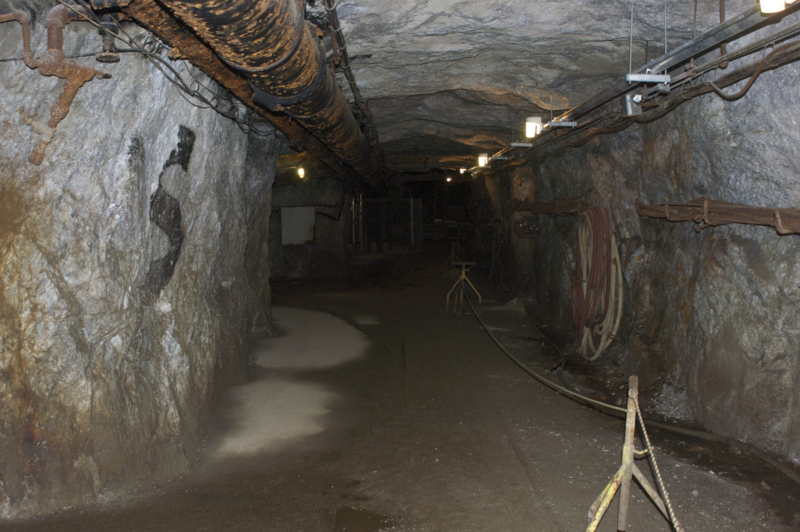
An adit in the Sterling Hill Museum at Sterling Hill, NJ

Gold has been reported in the ancient rocks of Grenvellian age from Sussex County associated with the iron deposits.  It has also been reported from the Schwangunk conglomerate from extreme western Sussex County in the vicinity of High Point, New Jersey.  The stone here is a conglomerate composed of quartz pebbles that is identical to the conglomerates of the Schwangunk Mountains of New York State.

Sussex County is also the home to some very rich zinc deposits at Franklin and Sterling Hill.  Although no gold was apparently found at these localities gold is often associated with zinc as a byproduct of the smelting process.  These zinc ores are contained in Precambrian marble with iron and manganese ores at times creating minerals containing both iron, manganese and zinc.  There have even been reports of corundum crystals being found in the same marble.

There have been reports of so-called gold mines in the past one notable example was in the Schuler Mine that showed some gold in quartz.  Many of the reported gold mines in Bergin County during the 19th century were actually scams. 

Southern New Jersey is covered with outwash composed of sand & gravel from the last glacier that came as far south as Staten Island where terminal moraines can be observed half way down the island.  There is a possibility that a small amount of gold may be present in the gravel topping the hills of Ocean County that was brought down from Canada by the glacier..

Although gold appears to be sparse in New Jersey there is otherwise a very rich history of mining for several other commodities including copper and silver in the Newark Basin basalts and sandstone. In the mid-19th century there were several mines producing copper and byproduct silver in this area of New Jersey

Tuesday, February 8, 2011

Gold occurrences in Finland

The adit of a mine in Finland


One of the last places in the world you would expect gold is Finland, but it does have a very diverse geological history that has led to the creation of many different types of gold deposits of a variety of ages and different styles of mineralization. In the past any gold produced in Finland occurred as a byproduct from the mining of various Volcanogenic Massive Sulfides (VMS). It is only within the past decade that this situation has changed because of the closure of some of the baseball to mines, and the beginning of production from some of the recently discovered gold only deposits.

The gold deposits occurred during several distinct episodes of the crustal evolution of Finland. Gold deposits began in Finland during the Archean word forms and greenstone belts with low-grade copper, cobalt and nickel massive sulfides were formed. The same geologic setting created low grade ranging from 0.1 to1.0 ppm of gold but it is in very large deposits. Another type of gold deposit is found in the Tampere schist belt in southern Finland that is host to the Kutemajarvi gold deposits that in the period ranging from 1994 to 2003 produced 13 tons of gold from 1.4 million tons of ore. This mine was reopened in June 2007 by Dragon Mining that now operates under the name of “Orivesi Mine.”

The gold deposits in Finland are mainly associated with the Baltic Shield, but in the northern part of the country they are found in the greenstone belts of central Lapland where there are very few deposits having atypical mineralization.  Many of these deposits contain a significant enrichment of copper, cobalt, nickel and in some deposits uranium.  The areas having the largest potential for gold are to be found in the Paleoproterozoic greenstone belt located in eastern Finland and Lapland.  In the western Central Lapland greenstone belt there is the possibility of finding iron oxide, copper and gold deposits.  These systems are found in the western part of the Central Lapland greenstone belt.

In Central Lapland the greenstone belt is found in the northern part of the Fennoscandian Shield.  The mineral deposits found in this area are mainly sulfides and sulfoansenides in nature that also have gold values.  In this they resemble BHP Billiton’s deposits at Olympic Dam Mine located in Australia.