Total Pageviews

Showing posts with label beaches. Show all posts

Sunday, April 24, 2011

Gold Occurrences in Washington State

Although Washington State has never been noted as a major gold producer it has however produced over 2,000,000 ounces of gold. It has been reported that the state still possesses many unexploited virgin placers as well as lode gold where it is still possible for a prospector to make a profit. The state Department of Natural Resources, Geology and Earth Resources Division in Olympia has produced a bulletin titled, “Inventory of Washington” by Marshall T. Hunting that you will find invaluable in the search for gold.

Mt Olympus on the Olympic Peninsula of Washington.


Many of the counties of Washington were gold is already been found include Ashotin, Benton, Chelan, Clallam, Clark, Columbia, Cowlitz, Douglas, Ferry, Grant, Grays Harbor, Jefferson, King, Kittitas, Lewis, Lincoln, Okanogan, Pacific, Pend Oreille, Pierce, Skagit, Skamania, Snohomish, Stevens, Whatcom, Whitman and Yakima. In many of these counties the discoveries include both placer and lode gold.

In the state of Washington the major gold producing areas are pretty well limited to the northeast corner where the gold is found in the Okanogan Highlands that expense offered from British Columbia, and contains the second largest gold mine in the United States, the Cannon Mine that produced most of the lode gold found that Washington. A far greater amount of gold has been produced from placer deposits far exceeding the amount of lode gold that has been recovered.

The state of Washington is actually composed of several different so-called suspect terranes that have been plastered onto the West Coast of the United States so the bedrock back of the state resembles a patchwork quilt. Some of the best places to recover gold is in aureoles around volcanoes that are found in the state in abundance. The driving force behind all of this volcanic activity is the “Juan de Fuca” plate that is being thrust under the state of Washington creating a range of mountains to the west of Puget Sound that are called the Olympic Mountains. It is the same plate that further inland is creating the Cascade Range that includes several volcanoes including Mount Rainier, and Mount Saint Helens.

The southwest corner of Washington is covered by the Columbia Plateau basalts that are over 3000 feet thick. The basalt flows were in place during several different episodes possessing a magma that was quite runny. It is beneath these flows that they have discovered natural gas, and there is a good possibility that gold may be found in the older rocks under the basalt covered. At the present time however we just don't have the ability to prospect for the gold because it is buried so deep under the basalt.

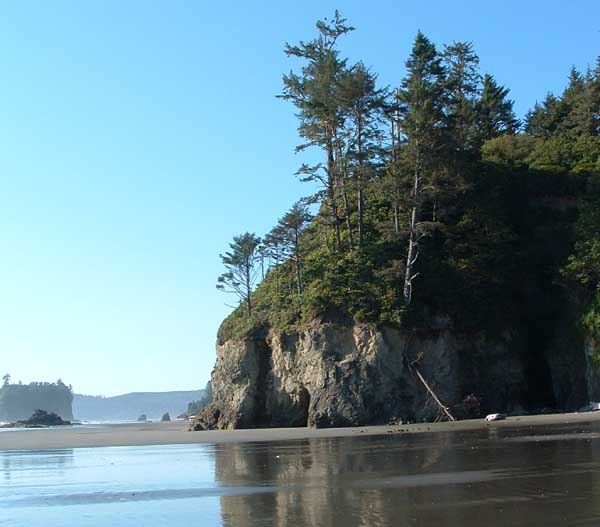
A typical beach on the Olympic Peninsula where gold may be found.
Photo by John Hunter


There are many reports of gold being found in the rivers that drain the Olympic Peninsula as well as the beaches facing the Pacific Ocean where fine gold has been found in the beach sands, and has produced many profitable claims. It would be advisable to check the regulations imposed on gold mining along the state beaches before you start mining. Most of the gold found on the speeches is very fine, but periodically is renewed by the action of storm waves making for a practically never ending supply.

Tuesday, March 22, 2011

Gold Occurrences in Illinois

You might not exactly figure that you could find gold on the waterfront of Chicago or along the many beaches that are found on the shores of Lake Michigan, but that may be a very likely place to look. The USGS reports that there is no minable gold from Illinois even though the same glaciers that brought gold down from the Abitibi region in Canada no doubt affected the state of Illinois to as far south as the Ohio River. There are some old reports that mention lode gold being found in the state that might be credible.

Gold panning in a small stream.
Photo by Sylvia Duckworth


There are some reports mentioning that there was a small amount of gold found from quartz geodes that were discovered while digging a shaft in the dolomite of Stephenson County. This is located in the upper Mississippi Valley lead and zinc mining area. There were also reports into Peoria Star-Journal that are dated August 6, 1975 that a small amount of gold was recovered from a mine shaft dug in Bald Knob a large hill in Union County.

Mostly gold found in Illinois came from the Abitibi Gold Belt and to the north in Canada. This gold bearing region extends from Wawa, Ontario to Val D’or, Québec and is one of the largest gold bearing regions on earth that since gold was originally discovered in 1909 has produced over 160,000,000 ounces of gold. This not only brought down into Illinois placer gold that is found in the rivers and streams throughout the state, but also there are reports of boulders containing gold that is said to be 
worth as much as $25 per ton.

A $20 gold piece known as a Gold Eagle.


Placer gold has been reported from several localities in Illinois including:
1. The Sangamon River Valley in Macon County,
2. The Mississippi River Valley and a small tributary in Henderson County,
3. The Illinois River Valley in Fulton County,
4. The Spoon River Valley in Fulton County,
5. An outwash plain in McHenry County.
Most of gold found in Illinois is from the northern part of the state including Chicago where most of it is concentrated in the so-called terminal moraines that were left by the glaciers and are recognized by their stomach he appearance. The gold found their death and rebirth and concentrated by the action of flowing water in the rivers and streams that are found in that part of the state. The gold is found is usually just a few flakes or gold dust that are found in the sand and gravel deposits usually in the bed of a stream or river.

With this kind of gold deposits anyone processing a very large amount of sand and gravel may find that recovering gold can be profitable. This is not a job for a single prospector although he can usually find enough gold to show other people what it looks like, and have some bragging rights.

The operators of sand & gravel pits are in a different situation because they are processing large amounts of sand and gravel every day. They could include a sluice box in their processing spread to concentrate gold from sand. If they are washing sand in their normal course of processing they could very easily place a gold trap in their spreads. A feature of placer mining of this type depends on the fact that most placer gold that is found in Illinois occurs in the sand portion of aggregates. This eliminates the need for processing the gravel portion of the product.

Gold is not the only thing that the glaciers brought down from Canada also brought diamonds, rubies, sapphires and zircons. These gems have been found as reported in “Canadian Diamonds,” a special report published during the summer of 2008 by the Northern Miner. Some of these diamond deposits are found in classical kimberlite deposits. Other occurrences are found in ancient gravel deposits that have solidified as conglomerate. The final source is alluvial diamonds and other gems brought down from Canada by the glacier..

Tuesday, November 23, 2010

A Tool for Prospecting: The Gold Cube

Introduction to the Gold Cube:

The shores of Lake Superior contain gold in the form of small flat flakes that are hard to recover this is what Mike Pung while on a prospecting trip discovered in July 2009 while mining gold from the beaches of Lake Superior.  Instead of complaining Mike decided to do something about that gold.  From this trip to Lake Superior Mike invented a new way to recover virtually 90% of the placer gold in the world called the “Gold Cube.”

Mike’s invention is not a stand alone device, but is used with other gold mining equipment such as a high-banker or sluice box.  The final cleanup from the Gold Cube is a common gold pan.  The Gold Cube is used for the clean-up at the end of a gold mining expedition or used at home to process gold bearing sand at your leisure you have brought back from your last gold mining expedition.  The Gold Cube is made from a series of nesting trays that are 5 x 12 x 15 inches that are stacked in a zigzag fashion usually three segments high.  The Gold Cube is designed to work in about 90% of all gold bearing sands in the world.        

How it was invented:

When most people think of prospectors their minds turn right away to California during the 1849 gold rush, but they have plenty of modern compatriots these are people that hold another job, but go gold prospecting or mining during their time off. 

One of these gold miners was Mike Pung while prospecting for gold along the shores of Lake Superior in Upper Michigan.  Like all small scale gold miners Mike doesn’t want to say where, because it would quickly attract other miners possibly starting a gold rush like the one in Hemlo, Ontario a few years ago that is across Lake Superior on its opposite side.

The gold that is found on the beaches of Lake Superior was brought there by the great continental glaciers having their origin in Ontario where one of the great gold provinces of the world is located, the Abitibi Gold Province.  This is where most of the placer gold found in the northern mid-western states had its origin.

While working with a high-banker and a sluice box Mike had a bright idea to make the  gold miners life easier.  The result was the invention of the Gold Cube that was dreamed-up during a prospecting trip in July, 2009. 

What it does:

The Gold Cube is not a panacea for gold mining it is just one of many tools that have been developed over the years making the gold miner’s life easier.  As a tool the Gold Cube has been designed to recover a kind of gold that occurs as small flat flakes one of the most common kinds of placer gold in the world accounting for about 90% of all the placer gold in the world.  It will allow the miner to process about 1,000 pounds of gold bearing sand per hour with a very rate of gold recovery. 

How it works:

The gold cube has three stackable components made from low density polyethylene (LDPE) whose decks are permanently covered with a type of fabric used for making conveyor belts.  This particular fabric is one of the most effective gold traps in use.  The whole unit weighs about 20 pounds making it completely portable with three sections that are stackable in a zigzag configuration.  The top section has a built in hose connection using from 800 to 1,100 gallons per hour making completely usable in the field for cleanup mining operations.

Once the unit is setup with water running the gold bearing sand is fed into the Gold Cube one scoop at a time.  The running water carries the sand down through the zigzags trapping the gold on the fabric covered decks on the way down.  The unit has a further trick for the recovery of gold before the sand and water slurry can reach the next section a baffle on the bottom of section forces the mixture to rise up before it can reach the next segment.  This has a space in its bottom where gold can settle, and the lighter sand is carried on to the next segment.  The assembled Gold Cube will process about 1,000 pounds of gold bearing sand at 8 mesh size per hour.  

After the gold sand has been run the Gold Cube is disassembled and the individual segments are washed out in a tub of water.  What little is left in the bottom of the tub is mainly gold with some other heavy minerals that can be separated with a conventional gold prospectors pan.

How to get a Gold Cube:

Gold Cubes can be bought directly from their website goldcube.net The website has an excellent video showing the Gold Cube in action as well as many other sites of interest to placer gold miners.