Total Pageviews

Showing posts with label uranium minerals. Show all posts

Friday, April 22, 2011

Gold, Uranium and Carbon in Detrital Deposits

One of the common associations with gold in detrital deposits is the association of gold with uranium and carbon. This holds true in the Witwatersrand and all the other gold deposits of a detrital nature.  For many years the origin of the carbon was hotly debated with the most recent evidence holding that it is from primitive life forms that lived in the distant past in the Archean


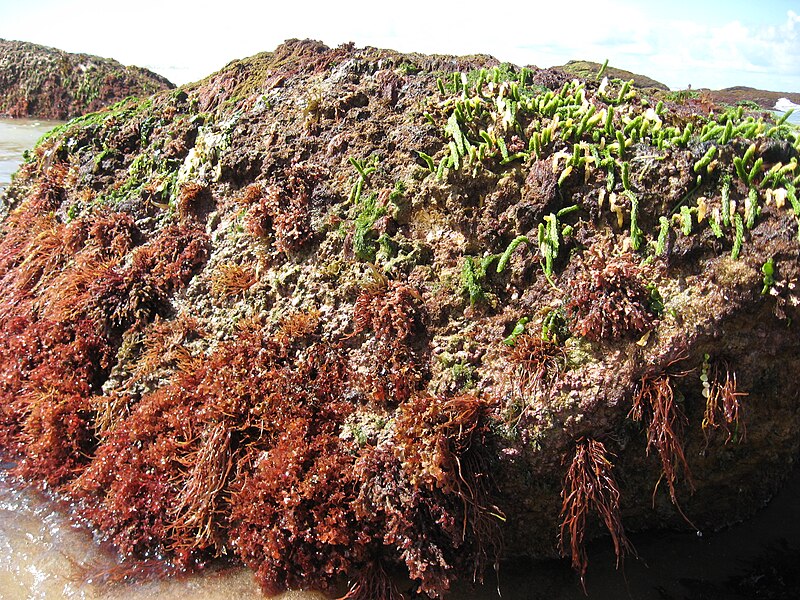
Algae exposed at the intertidal zone similar to the ancient algae that trapped gold.  Even today this kind of mat could be a good place to search for gold.
Photo by Leonardo de Jorge


It has been posited that these algae formed great mats similar to stromatolites that acted as a trap for the gold particles and uranium minerals in the same manner that modern mats of algae work to snare gold particles in a modern environment.  It is common practice to use an artificial mat of the same nature in a sluice box to entrap gold.

Although the deposits can be several thousand feet deep now, but at the time of depositation they were relatively shallow at the bottom of running water that was only a few tens of meters deep subsequent Earth processes have buried them to their present depth. 


An angular uncomformity with a basel layer of conglomerate that would be a good place to look for gold.   The best place is right at the uncomfority.
Photo by Lamprus


At the time many of these gold bearing deposits were at the bottom of a braided stream channel that by being deposited in this manner explains the stringers of gold found in such a deposit.  These stringers of gold are common in detrital gold deposits.  Sometimes there is a layer of carbon that is as thin as a pencil line that is so rich in gold and other minerals that they are mineable. In many detrital deposits the slim lines occur at a regular frequency to the extent that the entire deposit is mined so that I can undergo further ore dressing to free the gold so it can undergo even further treatment usually by being leached with a solution of cyanide.

Even today if you encounter a mat of algae in the bottom of the stream or river is a good place to search for gold that has been caught in the mat by the action of running water.

Monday, April 18, 2011

Detrital Gold Deposits

Maybe you have heard of the Witwatersrand in South Africa if you haven't yet is the world's largest deposits of gold that since its discovery in 1886 has produced over 40% of the total gold supply ever mined in the world. This makes it the most glaring example of a detrital gold deposit in the world. The type of rock hosting this vast deposit is conglomerate that until about a year ago the source of its gold was unknown. By working with an isotope of iridium a team of geologists was able to pinpoint the source of this gold In eroded highlands delayed to the north.

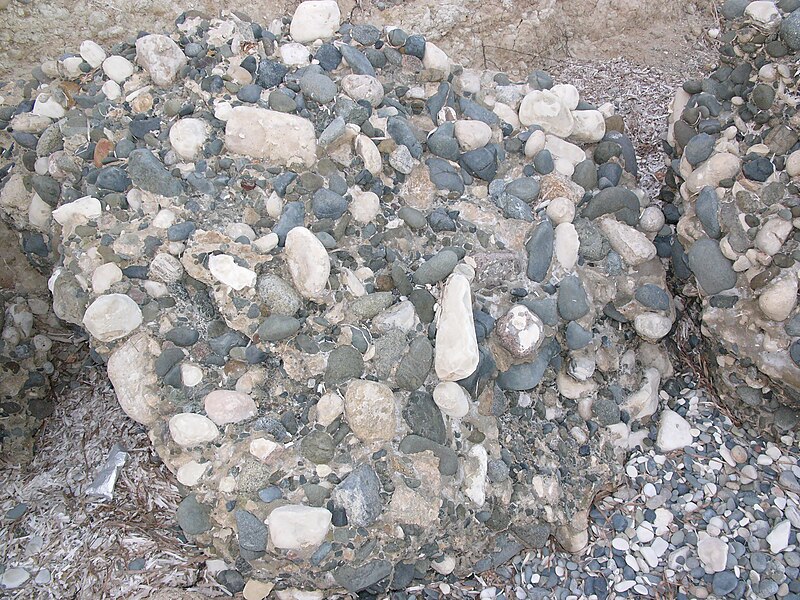
Conglomerate the gold in this rock is usually found in the cement holding the pebbles together.
Photo by Hannes Grobe

The Witwatersrand is not the only deposit of conglomerate in the world that contains gold. In the area around Timmins Ontario there are also mines that produce gold from ancient conglomerates of Archean age between 2.8 M2 .6 billion years old. It is not only gold that these ancient conglomerates are apt to contain a common Association in rocks of this type are uranium mineralization. This is been taken advantage of at Elliot Lake, Ontario where some of the largest uranium mines in the world are found. The same deposits also contain significant amounts of rare earth elements to the point that the mining company Pele Mountain Resources (TSX-V ~ GEM) headquartered in Toronto, Ontario. At their Eco Ridge Mine in Elliot Lake, Ontario they are actively searching for both uranium minerals and rare earth minerals. The conglomerate at the Eco Ridge Mine also contains some gold.

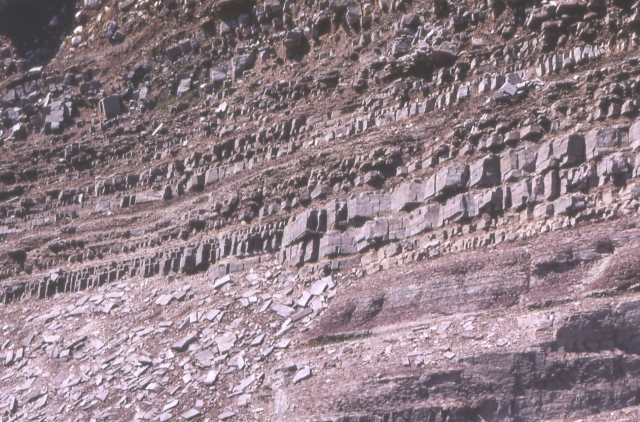
Sandstone in a red bed that has been cemented and stained by iron oxide.
Photo by Anne Burgess

Ancient conglomerates are not the only place where gold can be found in sedimentary rocks as detrital gold is also found in many types of sandstone as small grains, and can even be found in fine-grained shale as microscopic particles that are too small to be seen with the naked eye. This kind of gold was never recovered until recently when Newmont Mining developed the gold deposits of the Carlin Trend in northern Nevada.

A closeup of the Marcellus Shale found in the eastern United States.  Aside from holding a vast amount of natural gas the Marcellus Shale sometimes contains gold in very fine specs that are invisible to the naked eye.
Photo by Lvklock

Most of those miners that are working with placer gold deposits in the rivers and streams of the world or along the beaches are also dealing with a type of detrital gold deposit in the form of specs of gold to have been eroded from hard rock and have been swept down river by the action of running water to where we can find them in the gravel deposits of the stream bed.

Conglomerate is nothing other than stream gravel that has become fossilized over time; just about any time you find conglomerate when you are prospecting it is a good idea to have a very careful look at the deposit. This also applies to sandstone and shale since they are also sedimentary rocks that have been produced by the action of running water.