Total Pageviews

Showing posts with label bedrock. Show all posts

Sunday, March 13, 2011

Gold Occurrences in Ohio

Gold does occur in Ohio in the glacial drift that covers the state where it has been brought down from Canada by two separate episodes glaciation the Wisconsinan and the Illinoian in the past 300,000 years. There is no lode gold in Ohio because the crystalline bedrock of the state is buried beneath thousands of feet of sedimentary rocks. Since the crystalline basement rocks are an extension of the Canadian Shield it is safe to assume that there is gold bearing mineralization under the overlying sedimentary rock as there is in the Abitibi gold belt to the north in Canada.

Glacial Deposits in Ohio
By Ohio Geological Survey


All the gold that is found in Ohio is placer gold that was brought down from the Abitibi region of Ontario during the last two ice ages that is widely distributed all the way from Lake Erie all the way to the Ohio River. The placer gold deposits in the state cover about two thirds of its area and even they are covered by younger lake bottom and wind borne deposits. Just about any river or stream in Ohio has the capability of carrying placer gold. Although gold is not plentiful in Ohio there is enough to attract the interest of many part-time gold miners and prospectors.

The discovery of gold in Ohio probably dates back to the return home of some California gold miners that started exploring the local rivers and streams for placer gold, and found some. The most plentiful gold in Ohio is found in the deposits that were laid down in front of glaciers in areas that are called terminal moraines. Just about any flowing water in this area will have gold bearing sands.

The glacial map of Ohio narrows down the most likely places to find gold in the state so study the map carefully. This map is available from the Ohio Geological Survey in a much more readable scale than is possible on the computer. They also publish a paper called GeoFacts No, 9 that is titled “Gold in Ohio” that should be read by any goldseekers that want to find gold in Ohio. and the Illinoian in the past 300,000 years. There is no lode gold in Ohio because the crystalline bedrock of the state is buried beneath thousands of feet of sedimentary rocks. Since the crystalline basement rocks are a seller and extension of the Canadian Shield it is safe to assume that there is gold bearing mineralization under the overlying sedimentary rock as there is in the Abitibi gold belt to the north in Canada.

All the gold that is found in Ohio is placer gold that was brought down from the Abitibi region of Ontario during the last two ice ages that is widely distributed all the way from Lake Erie's all to the Ohio River. The placer gold deposits in the state cover about two thirds of its area and even they are covered by a younger lake bottom and wind borne in deposits. It just about any river or stream in Ohio has the capability of carrying placer gold. Although gold is not plentiful in Ohio there is enough to attract the interest of many part-time gold miners and prospectors.

The discovery of gold in Ohio probably dates back to the return home of some California gold miners that started exploring the local rivers and streams for placer gold, and found some. The most plentiful golden Ohio was found in the positives that were laid down in front of the glaciers in areas that are called terminal moraines. Just about any flowing water in this area will have gold bearing sands.

The glacial map of Ohio narrows down the most likely places to find gold in the state so study the map carefully. This map is available from the Ohio Geological Survey in a much more readable scale than is possible on the computer. They also publish a paper called GeoFacts No, 9 that is titled “Gold in Ohio” that should be read by any goldseekers that want to find gold in Ohio.

Wednesday, December 15, 2010

Hard Rock Prospecting


Prospecting in hard rock is much different the prospecting in the bed of a stream all though valuable minerals are often found by tracing a trail of specific minerals up a stream until you reach a point where the minerals vanish. When you have reached this point you start looking at the bedrock to see where it had weathered from. Hard rock prospecting is much more complicated than finding placer deposits; it is also much more observational. In this case gold and the other valuable minerals are encased in rock of one sort or another. This enclosing rock is called by the German name “Gangue” a useless rock enclosing the valuable minerals that you are looking for. While quartz is the most common gangue mineral there are plenty of others like calcium carbonate, barite, fluorite and list goes on.

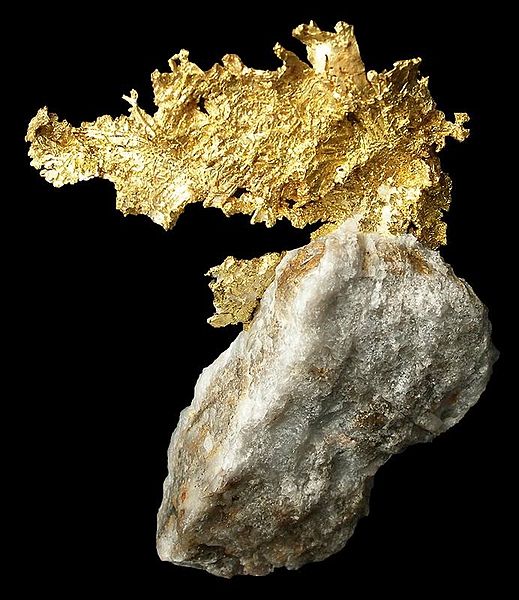
Gold on Quartz     Rob Lavinsky Photo

In many respects hard rock prospecting is a science of whys, why is that rock discolored, why is that water discolored, why is that vegetation stunted are only a few of the many things prospectors look for in the field. A good prospector will examine every outcrop of rock in the area where he is prospecting looking for signs that it might contain a valuable mineral deposit. The basic tools they uses for finding minerals in the hard rock are a geologists pick, and a magnifying glass usually a loupe having 10X. magnification.

The most common indicator of a valuable mineral because it looks exactly like rust, because it is rust, iron oxide that is called a gossen. Just like many other words used in mining and prospecting is derived from German in this case the word gossen means “iron hat.” This is caused by the weathering of iron bearing minerals usually pyrite, but pyrite often contains other metals in what is called a solid solution series. Because they are so obvious finding a gossen nowadays is virtually impossible.

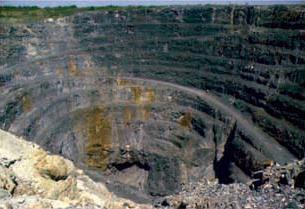
Iron Staining (gossen) on the wall of Kidd Creek Mine Timmins, Ontario   NOAA

The most sought after metal and prospecting is gold, and the old saying goes, “Gold is where you find it.” Although it is usually found in quartz veins and stringers throughout any rock that is been affected by hydrothermal activity gold can also be found in many many other types of rocks. The world's largest gold deposits are found in the Witwatersrand in South Africa. For over a century the source of the gold has been debated, but it has been recently discovered the gold deposits in the Witwatersrand come out of fossil remnants of an ancient mountain range.

When he is in the field the prospector is always looking for rocks that are discolored by the action of hot water, rocks that are deformed, faults in the rock that are often the channel for mineral bearing hot water. When he finally finds an area that looks promising the very first thing he does is to collect several grab samples across the width of the presumed mineral deposit for later analysis in a lab. If the results are promising he will go back and chisel a channel right across the vain in several different places. The samples from each vain are kept separate and are also sent to a lab for analysis.

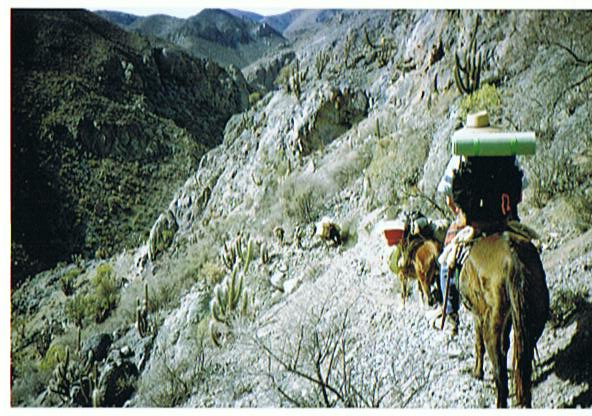
Prospectors in northern Chile

Sometimes it is virtually impossible to find any outcrops of rock in this case the prospector has to dig down through the overlaying soil until he reaches bedrock where he may find some viable mineralization by observing some of the indicators that are visible above the soil.

Although hard rock prospecting can be a one-man job more often it is left up to a team of explorers each of whom has his own specialty that is generally led by a geologist or geophysicist. An exploration team like this is capable of finding deposits of gold and other metals in many places that are beyond the capabilities of the single prospector.

Copper Ore   Hannes Grobe

One of the things the prospector always has to keep in mind is the odds are stacked against them because for every showing of ore only one in about 300 will prove to be viable for constructing a mine. There was a book published in the late 1900s titled, "Gamblers Ruin" a how to book about nine evaluation.although this particular book has been long out of print there are several good books on the subject that are still available with many of them up to date.