Total Pageviews

Showing posts with label fools gold. Show all posts

Tuesday, January 4, 2011

Australian Gold

Gold is been found and mined in all the states of Australia including the Northern Territories. Although gold was originally discovered in New South Wales most of the gold produced today is found in the southwest corner of Western Australia. A long strip of gold bearing rocks is found along the coast in both New South Wales and Victoria that extends into Tasmania. The largest mining activity for gold in Australia is located in Western Australia. There are smaller gold producing areas that are almost like plums in a plum pudding scattered across the interior of Australia as can be seen on a resource map produced by the Geological Survey of Australia.

Front End Loader working in an Australian gold mine.

The largest gold nugget that was ever discovered was found in Australia in 1869. This was the Welcome Stranger nugget. This was the name given the largest alluvial gold nugget that was ever discovered on Earth. The nugget weighed in at 2,283 ounces, 6dwts and 9 grains. It was found to measure 61 cm (24 inches) by 31 cm (12.2 inches). It was discovered at Moliagul, Victoria by John Deason and Richard Oates on February 5, 1869 about 9 miles northwest of the town of Dunolly. They named this huge nugget the Welcome Stranger.

This wasn't the only large mass of gold discovered in Australia a somewhat smaller one was found by twenty-four miners working in a mine shaft in Ballarat during 1858. This was the largest gold nugget found at the time until the discovery of the Welcome Stranger in 1869. This earlier gold nugget was called the "Welcome Nugget."

An example of crystallized gold the Providence Nugget from Australia.

The official discovery of gold in the West really a start of a gold rush in 1851 when a prospector named Edward Hammond Hargraves claimed he had discovered payable gold near Bathurst, New South Wales at a place for Hargraves called Ophir. It was six months later that gold was discovered in Victoria. Even though gold had been discovered as early as 1841 by others including Rev. WB Clarke in 1841. Clarke reported his find to the then governor of New South Wales George Gipps. Gipps told Clark to put his discovery away advising Clark that “We shall both have our throats cut!” At the time Australia had a convict society and the last thing the authorities wanted was the discovery of gold. Later the governments of both New South Wales and Victoria rewarded Clarke for his contributions to the gold industry of Australia, however the financial rewards didn't compare to those that were awarded Hargraves.

Monday, January 3, 2011

Nancy Twinkie Strikes it Rich

Nancy Twinkie Strikes it Rich:

After near freezing to death in the bottom of the Satan’s Kingdom gorge looking for gold on the coldest day of the winter with Nancy Twinkie I came home and put my gold panning gear away until warm weather.  I honestly thought I had seen the last of Nancy and the whole collection of the camera crew from NBC.  I was wrong! 

For those that didn’t read the first of this series Nancy Twinkie and the Frozen Pan of Gold, Nancy Twinkie is a cute little blond TV Newscaster.

Several months passed the snow melted away, the birds returned and the next thing I knew summer had arrived.  Now in mid-summer the world of news practically comes to a standstill because not much is happening.  With this happy thought I was sitting at my desk one morning when the phone rang – it was Nancy Twinkie who wanted to do another story about gold panning now that the weather had improved.  So, we set up an appointment for two days later in the same place under the Satan’s Kingdom Bridge.

Satan’s Kingdom is a gorge on the Farmington River in New Hartford, Connecticut where the stagecoach robbers used to wait to waylay the Hartford stage when the days of the Wild West were back East.

We all met at the coffee shop, from there we drove over to the river where the whole collection of TV people debarked from their cars, so help me this time it looked like a convoy.  This time the crew looked more like the 8th Army then a camera crew.  There must have been at least thirty of them; it looked like the whole studio came this time except the janitor.

During the summer the Satan’s Kingdom Gorge becomes the haunt of a pack of nature lovers and tree huggers who go floating down through the gorge riding on old inner tubes; this lot is called tubers, and there must have been a couple of hundred of them milling around or floating down the river.  It became immediately obvious there were more people in Satan’s Kingdom then there needed too be.

We poked through the masses to our place under the bridge next to the river where I filled one of my gold pans with about twenty pounds of river sand and gravel.  As I started to work the pan down to see if there was any gold Nancy Twinkie asked me how hard it was to pan for gold, so I told her after I finished this pan full I’d teach her how to pan for gold.  I worked the pan down to just a swirl of black sand, and sure enough there were a few small colors of gold showing at the end of the swirl.  Nancy became real interested then.  Little did I realize she was beginning to suffer from a case of gold fever!

If you have never had gold fever it is one of the more serious illnesses you can catch.  Your breathing becomes labored, your eyes pop out, nothing will cure your sickness except finding more gold. Not even black flies!

I taught Nancy Twinkie how to use a gold pan, and where to look for gold.  By the time we had finished there was a whole crowd that gathered around us watching.  We had spent several hours panning for gold, and I’ll be huckleberried if Nancy didn’t find more gold then I did.  By that time she was thoroughly hooked on gold panning, so as we left I gave her one of my new plastic gold pans, and wished her luck.

Since I wasn’t married, I casually asked her if she would like to join me for a day of panning in the Berkshires the following Saturday.  She accepted, and I was in trouble, just how much I didn’t know until later!

Saturday, January 1, 2011

Gold Deposits of India

Although India is by far the greatest importer of gold in the world it has a very poor gold mining industry. There are however, some gold mines that are active including the Kolar Goldfields in Karnataka, the Dona block in Andra Pradesh, the Bansawar district in Rajasthan and Madhya Pradesh.

The Champion Reef Mine in the Kolar Gold Field of India
It has been estimated by the Geological Survey of India (GSI) that there are more then 20,000 metric tons of gold spread across several states of India causing the Indian government to askthere the GSI to explore for additional reserves that can be tapped in Andhra Pradesh, Karnataka, Madhya Pradesh, West Bengal, Rajasthan, Bihar and Chhattisgarh.

The Indian government is concerned over its dependence on imports of gold into the country where India has been the top importer of gold in the world for several years. This concern was increased by the recent economic downturn when the price of gold shot up to $1,000 per ounce in the international markets, and is recently traded for over $1,400 per ounce in US dollars.

This is prompted the Indian government to give the GSI three years in which to explore the possibilities of being able to tap the estimated 14,000 tonnes of gold they presently have which should be increased to 20,000 tonnes in the next three years. As well as gold the Indian government also wants the GSI to explore for diamonds.

The Hope Diamond originally from Golconda, India

There are several overseas companies that are in talks with the Indian government for gold mining and exploration including Indogold, Anglo-American Gold Mining, Monarch Gold Mining, De Beers India Ltd., Rio Tinto Exploration Ltd and BHP minerals.

At the present time the Indian government is using all the initiatives it has to expedite the efforts to unearth valuable minerals like gold and diamonds. Right now in India produces hardly 4/10 of 1% of the Golden consumes despite having about 9% of all the gold reserves in the world within its borders.

Under Indian law presently foreign companies rarely invest in India because they cannot sell the data they map and can only use it if they open the mines themselves. The new mining policy however, is expected to open the mining sector to foreign investment. Under the new rules that have been suggested to approvals for most minerals must be made of about a year or will be automatically referred to a tribunal.

At present international gold companies are looking to form joint ventures with gold exploration firms in India enabling them to launch new exploration projects. It is in southern India in the Deccan region where it's been assumed as a result of some surveying or largest deposits of gold might be found.


Friday, December 31, 2010

How to Build a Simple Magnetometer for finding Gold

The earth is nothing more then a giant magnet as attested by its magnetic poles that attract a magnetic needle to magnetic North and South. The same phenomenon of magnetic attraction can be used to detect magnetic minerals even as small as what are termed micro-mounts, or for that matter large masses of magnetic mineral like magnetite below the surface of the earth. Although gold itself is not magnetic that often occurs in the company of different minerals that are; one example is granular magnetite.

This deceptively simple magnetometer can be used both at home or in the field. Its materials are also simple consisting of a very few parts that are obtainable anywhere. The core of this magnetometer is nothing more complicated than an ordinary soda straw with a small magnet glued on one end. There is a needle shoved through the straw at approximately its balance point with the magnet attached. The needle rests on two parallel sides are far enough apart to allow the straw to present up and down.

The best kind of magnet that you can use as a so-called rare earth magnet that is far more powerful than an ordinary magnet. Small maintenance of this type can be found in auto parts stores, sources say are part of an automobile alternator they can also be found in your local junkyard. The best kind of soda straw to use is one that has a flexible joint near its upper end, so you can bend the straw to get it perfectly balanced.

At home your magnetometer is used to detect magnetic minerals that is accomplished by passing the near the magnetic tip to see if the magnet is attracted. If it is you know immediately whether or not the mineral is magnetic, conversely if the magnet is not attracted to the specimen then it is not magnetic. This is important because many minerals look alike and the magnetometer test is one step in identifying the mineral.

In the field; all you have to do is walk a straight line while watching the straw, if the magnet is attracted to a magnetic mass in the ground the straw will move up or down. This is also important because many different mineral deposits are magnetic and have other minerals that are associated with them including gold. A simple method of measuring the amount of dip is by placing a quadrant next to the straw allowing you to measure the amount of dip the straw undergoes.

A simple magnetometer of the type described can be seen by following this URL:


Monday, December 27, 2010

Equipment Needed for Gold Panning

How to use a gold pan is something that is easily learned, but requires some practice.  The gold pan as we know it was invented by some Yankee tin-knocker during the California gold rush of 1849. Prior to that just about any water-tight container was used; one of the most common was a shallow wooden box.  The author has even used a plastic food container as a gold pan in a pinch.

A gold pan in use.
As illustrated by the assortment of gold pans and gold pan sets illustrated in the Amazon search box at the bottom of this Blog it is possible to purchase many different varieties and configurations of gold pans. We personally prefer using a whole set consisting of a 14 inch classifier that is used to remove anything larger than 3/8 of an inch. What passes through the classifier goes into a 14 inch green plastic pan. This larger pan is used to work down the bulk of the gold bearing gravel. What is left in the pan is to concentrate consisting of mostly black sand and other stream heavies including gold. Although you can work down through the sand to its gold content it is more efficient to save the sand for later.   

A gold panning kit also includes a couple of other handy items; one of them is a small squeezable plastic bottle equipped with a plastic tube that is used to suck up small pieces of gold and gold dust in your pan. The other handy thing is a couple of small plastic vials that are used to keep the gold in you collect. Gold is placed into the vials from the suction bottle simply by squeezing it causing the gold to be expelled.


The other equipment that is required on a successful gold panning expedition is not directly related to gold panning, but they are things that you actually need. You will need a jeweler's loup with a 10 X. magnification, a long handled shovel and if the water is cold a pair of waterproof gloves. Since you are apt to be wandering around in the bit of a stream or other place with standing water it is a good idea to have a pair of rubber boots.

This is the basic equipment required for a successful gold panning expedition!


Friday, December 24, 2010

Gold Occurrences in Maine

This article explains some of the gold occurrences found in Maine where gold can be had from three different sources as placer gold, lode gold where it occurs in quartz veins and as a trace element associated with metal sulfides especially pyrite where it occurs in thin films between individual pyrite crystals.

According to the Maine Geological Survey placer gold has been found in the following streams:

Sream
Township
County
Swift River and its tributaries
Byron area
Oxford, Franklin
Sandy River
Madrid to New Sharon
Franklin
South Branch-Penobscot River
Sandy Bay; Bald Mtn; Prentiss
Somerset
Gold Brook
Bowman
Oxford
Gold Brook
Chain of Ponds; Kibby
Franklin
Gold Brook
Chase Stream
Somerset
Gold Brook
T5 R6; Appleton Township
Somerset
Nile Brook
Dallas; Rangeley
Franklin
Kibby Stream
Kibby
Franklin
St. Croix River
Baileyville
Washington

This is the kind of mountain stream where you can expect to find gold.
This list is by no means conclusive because virtually any other stream in the vicinity of those listed can also contain gold. The bed load of the streams eventually reaches the Atlantic Ocean where the litterol current carries in parallel to the coastline depositing its load of gold onto the sand and gravel beaches of Maine. As a teenager the author did some prospecting along these beaches discovering that the gold that was present was mainly flowered gold. The most gold was discovered near the mouths of the rivers running into the ocean. 

Ogunquit Beach, Maine where as a teenager we panned for gold.  Notice the small stream entering the ocean on the left side of the picture it was here where we had our most luck panning.

Because gold is 19 times denser than water another place that might be profitable to look is in the lower reaches of sand and gravel deposits where the deep deposits are at rest on bedrock or a bed of clay. Another factor that has to be taken into consideration is stream migration. Since the time of the glacier melting around 12,000 years ago the stream channel may have migrated several hundred feet to the West of its original position. To the practiced eye this can be readily seen by an area of flat terrain with the higher banks on the west side of the stream.  This is a situation that not only exists in Maine, but is a worldwide phenomenon where ever you have flowing water.

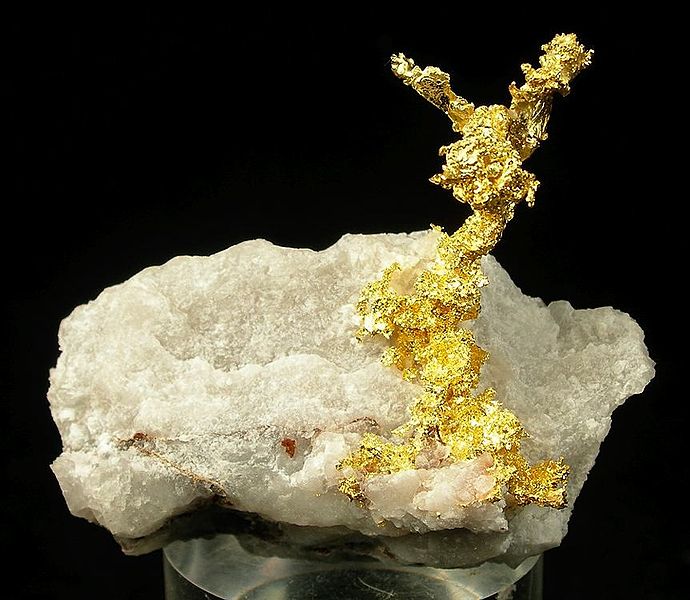
Gold on Quartz   Photo by Rob Lavinsky

Placer gold is that the only variety of gold found in the state of Maine.  Maine also has lode gold where gold is found in quartz veins. Even more complicated is gold deposits found as trace elements in base metal sulfides where gold is found as an impurity that must be recovered when the metal ore is smelted.  Finally gold is often associated with iron pyrite where it is a thin film between the crystal faces of pyrite.

You can purchase all kinds of supplies and equipment through our associate Amazon.com needed for operating a placer gold mining site.  By using the Amazon Searchbox you can access both new and used equipment. 

Saturday, December 18, 2010

Using the Purple of Cassius to Check For Gold in the Field

If you have ever gone to church and admired the beautiful stunning colors in the stained glass windows the red in those windows comes from ion sized gold particles disseminated through the glass as it was formed in a furnace.  The same physical characterstics are also seen in the Purple of Cassius.  It is this characteristic of gold that allows us to make a very accurate test for it while in the field.  This test was the standard test for goldsmiths for centuries until it was replaced in the 20th century by the atomic absorption spectrometer.

This is how they prospected for gold and other metals in 15th century Germany   Georgius Agricola


The Purple of Cassius was discovered in 1685 by Andeas Cassius, an alchemist who described it in the work De auro.  It was also described in a book published in the Italian City of Bologna as an artist’s color.  The alchemists of that day that quickly realized that it could be used as a sensitive test for gold.

Besides affording a sensitive test for gold the Purple of Cassius has found much use as an artist’s color. As noted earlier it is also used to produce red glass. The Purple of Cassius is also painted on glass before it is fired leaving the glass with a thin layer of fused-on gold.

When you are prospecting for gold in hard rock or any other place the purple of Cassius is the ideal test to take into the field because the various chemicals you need are capable of being carried in a small space without taking up too much room. It is also so sensitive that the prospector could get a rough idea of how rich the gold deposit is. This is determined by the color of the reaction that could range from a light pink to a dark purple. The darker the purple is the richer is the gold ore.

This is how they mined during the 15th century.   Georgius Agricola


Another advantage of using this test in the field is the ease with which you can mix these chemicals used to test with. There are several simple formulas for doing this but one of the most common is two parts of concentrated nitric acid in one part of concentrated hydrochloric acid. The result is a very powerful acid called “Aqua Regia” one of the few substances that will dissolve Gold.  The other ingredient used in the test is tin chloride solution you can either purchase it alone or you can make it yourself by dissolving the metal tin in some hydrochloric acid.

Beakers like those used in the Purple of Cassius test.


When you are dissolving gold in this acid mixture slosh the material being tested around in the acid to dissolve any gold that may be present.  In itself this is a sort of test as the aqua regia will turn yellow if there is any gold present. This is not too accurate though so don't depend on it as a test.

To perform the test fill a beaker with deionized water followed by a few drops of the gold bearing aqua regia into the water followed by a few drops of the tin chloride solution. The purple of Cassius will then precipitate out of the solution in a depending on the quantity of gold present the precipitation can range from a light pink to a deep purple color. Remember, the deeper purple color there is the more gold there is present.

Friday, December 10, 2010

Gold Deposits from Continental Glaciation in the American Midwest

Introduction:
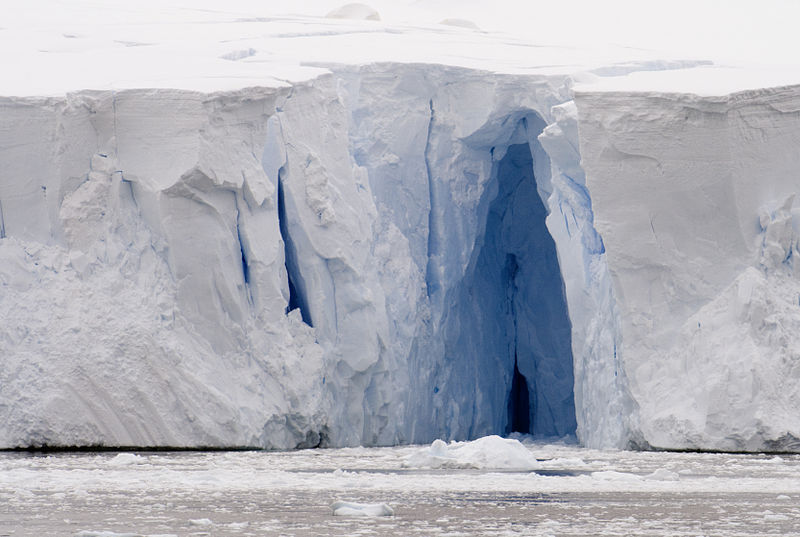
This is what a continental glacier looks like

During the past 1 million years there have been three episodes of continental glaciation that has covered the northern hemisphere with vast ice sheets more than two miles thick. Over much of the Midwest these continental glaciers southern boundaries are today marked by the Missouri and Ohio rivers. This is where the glaciers stopped advancing and is an area called a terminal moraine where for centuries all the material the glacier gathered on its way south was deposited in a similar fashion to the pile that forms under a conveyor belt.

The Abitibi:

To the north in Canada lies one of the great gold provinces in the world, the Abitibi, the second-largest gold producing region on earth. As the continental glacier advanced south it scoured the surface of the land in the Abitibi including many lode gold deposits and deposited them at the regions of terminal moraines accounting for the gold found in the northern Midwest of the United States north of the Missouri and Ohio Rivers. Most of the gold will be found just north of the Ohio River with lesser amounts spread across the states from western New York to Missouri.
A gold mine in the Abitibi Gold Belt, Canada

The glacier explains the presence of gold in the northern United States, and the absence of placer gold in Ontario. In its travel south from the Arctic it passed over an area of sedimentary rocks south of Hudson and James Bay with no gold leaving the soil covering the Abitibi region with no gold hence the absence of placer deposits.

Gold in the Midwest:
A terminal moraine in the foreground where the glacier stopped and just dumped its load.

A terminal moraine is characterized by a hummocky appearance of many small hills and valleys and large deposits of sand and gravel. Subsequent reworking of the material by streams in a terminal moraine has resulted in the concentration of gold in the channels of streams throughout the area. Most of the gold is concentrated in an area north of the Ohio River, and just to its north, however enough gold was dragged down from Canada that it can also be found in the sands along the Great Lakes and in thin deposits across the states.  .

Friday, December 3, 2010

Field Analysis while Prospecting for Gold

If you ever wanted instant analysis of a sample or ore while prospecting in a re,ote area the portable X-ray Fluorescence Meter is just what you want.  They are pretty pricey, but can be rented from various sources for around $500 per day.

These are a portable x-ray fluorescence meters in action by Niton analyzing copper wire in the field.


There are a number of companies manufacturing portable x-ray fluorescence meters used for identifying different elements in the field whether prospecting or any of a variety of other ways where specific analyses of any chemical element is required.  With one of these meters you can determine the composition of any mineral right in the field without having to take samples home that are later sent to a lab for analysis.

The meter also has many applications in the environmental field among them are identifying lead based paint and other contaminants in the field.  The device will identify all the heavy metals as well as other contaminants.  The EPA and other government bodies use the technology for protecting the public from dangerous substances because of its fast, nondestructive, fast and is capable of being hand-held. 

It is regularly used in the mining industry for field sampling in mineral exploration work in active mining to effectively trace ore shoots.  With this device it is possible to know what you are dealing with eliminating the need to send samples to an outside lab thereby saving time and costs.  

Another example of a hand-held portable x-ray fluorescence meter manufactured in China.
  

The best thing about these devices is they are all hand held about the size of an electric drill.  One of these units can be carried in a holster like a pistol, and in fact are pistol shaped.  The whole instrument ready to use only weighs around 11 pounds (5.5 kg).  They are capable of identifying up to 25 elements at a time that are displayed on a screen at the back of the device.  Not only does the device tell you what elements are present, but also indicates how abundant they are.

Monday, November 29, 2010

How Gold was recovered in the past

Gold was the first metal discovered by man as it is found in nature as a pure metal that is commonly found in the beds of streams as gold nuggets.  The earliest gold miners before the dawn of history limited their production to whatever gold nuggets they were able to find.

A flat stone like those used in early gold recovery
It didn't take the early miners long to discover that there was much finer gold particles in the sands of the streams as well as nuggets.  It didn't take nearly miners very long to discover they could recover this gold hidden in the sand that because of its weight would remain behind while the lighter sand particles could be washed away by running water.

A goldpan used during the California Goldrush

Man being the ingenious creature he is used a flat stone set at a slight angle to wash the sands leaving the particles of gold behind as the water took the lighter particles of sand.  Gold is 19 times heavier then water while most of the sand had a density of about three times of water.  This was an early demonstration of what is now called gravity separation, a method still in use.

Jason seizing the Golden Fleece
We are all familiar with the Greek Myth of “Jason and the Golden Fleece.  The dwellers living around the Black Sea used to put sheepskins in the bed of streams coming down from the mountains to catch any gold washed down from those same mountains.  This ancient mining method is still made use of in the bottoms of high-bankers and sluice boxes to catch gold particles.  However today they use indoor/outdoor carpet or old conveyor belts to entrap the gold.

In many countries they made use of a shallow wooden box to separate gold from sand, a practice still in use in some countries.  This was their form of a gold pan, and even today the use of square gold pans has made a big comeback.  They are touted to be the latest thing in gold recovery, but in reality they have been in use for centuries. 

The modern goldpan is a recent discovery that was first used by the 49ers during the California Goldrush.  The original goldpans were something knocked together by some nameless tinsmith that were used by the miners to pan for gold along the gold-bearing streams.


Saturday, November 27, 2010

Raymond A. Kukkee on the Association of Biotite and Gold

As the result of a question somebody asked that was engaged in diamond core drilling on a gold deposit in Canada about the association of biotite and gold prompted me to put the question up to a friend in Ontario.  Mr. Kukkee has been a professional prospector in Ontario for more then thirty years, this is his answer. . .

“As far as I have seen,  and from what I've stumbled across  putzing around in the bush,  I would have conclude that   biotite mica can certainly  associated  with gold,  ( or gold can be found with biotite mica).  I found some, so  the association is most certainly not impossible.   Any time you find thick bands of  biotite in situ  suggests there is high-grade shearing of the rock structures  at hand  --and those contact structures are the most likely targets for gold.  On the other hand you can see flecks  biotite in gneissic rocks at times which doesn't seem to mean much. 

Many people think biotite is only black, but  it can be  black, dark brown, and even green yet! )     It's got a lot of iron in 
it, the green cast  can be  from chromium,  and of course biotite mica  itself  is  a silicate.   Logically, iron and silicates  are often associated with gold.

In prospecting  field work,  and being a persistent type,  I always looked at it this way, gold is where you find it, and it's most likely to be found in contact areas.   Where there are contacts showing   slickensides and schistose rocks  which are often  associated with gold  ( and/or  perhaps sulphide mineralization with  shearing)  , there most certainly can be biotite  in those structures, so why not use the reverse association as well?  It's a good indicator.   

 I would guess that direct gold/biotite association is more likely  found where there is physical metamorphism caused by  shearing,  as opposed to gold solutions being injected into biotitic structures after-the-fact ?   Maybe in the long-term scheme of things-- D-2 and even D3 events ( is there such a thing as a D3?) ,  maybe  that  could happen too ?  
 
 One of my old  low-grade gold finds had a  band  or dike  of rotten biotite (maybe  a foot across)  between  silicate/quartz  gold-bearing rocks  and a structure, (I interpreted it as  foot rock)  that had sections full of garnet ( the garnet-bearing layers were metamorphic rock).  The adjacent  biotite-bearing rock did carry some gold. 
That's about all I know about gold and biotite, I've probably forgotten more than that I imagine..LOL


It's interesting that prospectors might  overlook biotite as a barren mineral , it's not really very  exciting stuff, but if you happened to  find a big enough  deposit,   the vermiculite industry would be interested in it. 
China exports vermiculite for up to about  200-$400  USD/metric tonne,  at least they were  a couple of years ago.  The key is to find the stuff without any asbestos content.   I wonder if the Chinese worry about that?   the expanded vermiculite/perlite/agricultural/construction  market is huge if you can find just  the right stuff.”

That's about it,  how's the weather down there?  It quieted down here, about -10 C,,,,stopped snowing, not bad for Nov. 27th.


Friday, November 26, 2010

Biotite as an Indicator Mineral for Gold

Introduction:

There are many minerals used for gold, but until recently I was unaware of the use of biotite as an indicator mineral for gold.  It seems however that under some circumstances that is exactly what role biotite plays.  In a minerologically diverse set of amphibolite schists coming from altered metavolcanics both amphibole and biotite in the gold bears veins.  It is felt by many geologists that any gold present has been leached out of the surrounding greenstone making it younger then the rock it is contained in, this is true of the Abitibi Gold Belt and other greenstone belts that are found throughout the Canadian Shield


Biotite is a common rock forming mineral found in abundance in both igneous and metamorphic rock. The mineral is a member of the cyclosilicate family of minerals characterized by perfect cleavage parallel to the C-axis that produces flakes or thin layers.  Its fracture is indistinct and uneven. 

  • Hardness = 2.5
  • Specific Gravity = 2.9 – 3.4+ a bit above average.
  • Streak = white
  • Associated minerals: quartz, feldspars, apatite, calcite, hornblende, garnets and schorl, (a black variety of  tourmaline.)
  • Other distinguishing features = its sheets can be bent and will flex back into shape, meaning its cleavage sheets are flexible.
  • Occurrences = worldwide in igneous and metamorphic rocks.
  • Color: = Black to brown shading into yellow with weathering.
  • Luster: Vitreous to Pearly.
  • Transparency = Transparent to translucent.
  • Crystal System = monoclinic; 2/m.
  • Crystal Habits = tabular to prismatic; many of its crystals are pinicoid termination forming books of mica like muscovite another member of the cyclosilicate family.  It is a lamellar to granular in appearance giving gneisses and schists their characteristic glitter.
  • Cleavage = Perfect in one direction.
  • Fracture = Not distinct and uneven due to its cleavage.

Gold Association:

Biotite is often found associated with lode gold deposits.  Because it contains iron it might be looked on where the biotite takes the place of granular magnetite where gold is often found.  It is well known that gold colors glass red so does it also affect biotite causing the presence of gold to increase the red hue found in some biotites. 

Tuesday, November 23, 2010

A Tool for Prospecting: The Gold Cube

Introduction to the Gold Cube:

The shores of Lake Superior contain gold in the form of small flat flakes that are hard to recover this is what Mike Pung while on a prospecting trip discovered in July 2009 while mining gold from the beaches of Lake Superior.  Instead of complaining Mike decided to do something about that gold.  From this trip to Lake Superior Mike invented a new way to recover virtually 90% of the placer gold in the world called the “Gold Cube.”

Mike’s invention is not a stand alone device, but is used with other gold mining equipment such as a high-banker or sluice box.  The final cleanup from the Gold Cube is a common gold pan.  The Gold Cube is used for the clean-up at the end of a gold mining expedition or used at home to process gold bearing sand at your leisure you have brought back from your last gold mining expedition.  The Gold Cube is made from a series of nesting trays that are 5 x 12 x 15 inches that are stacked in a zigzag fashion usually three segments high.  The Gold Cube is designed to work in about 90% of all gold bearing sands in the world.        

How it was invented:

When most people think of prospectors their minds turn right away to California during the 1849 gold rush, but they have plenty of modern compatriots these are people that hold another job, but go gold prospecting or mining during their time off. 

One of these gold miners was Mike Pung while prospecting for gold along the shores of Lake Superior in Upper Michigan.  Like all small scale gold miners Mike doesn’t want to say where, because it would quickly attract other miners possibly starting a gold rush like the one in Hemlo, Ontario a few years ago that is across Lake Superior on its opposite side.

The gold that is found on the beaches of Lake Superior was brought there by the great continental glaciers having their origin in Ontario where one of the great gold provinces of the world is located, the Abitibi Gold Province.  This is where most of the placer gold found in the northern mid-western states had its origin.

While working with a high-banker and a sluice box Mike had a bright idea to make the  gold miners life easier.  The result was the invention of the Gold Cube that was dreamed-up during a prospecting trip in July, 2009. 

What it does:

The Gold Cube is not a panacea for gold mining it is just one of many tools that have been developed over the years making the gold miner’s life easier.  As a tool the Gold Cube has been designed to recover a kind of gold that occurs as small flat flakes one of the most common kinds of placer gold in the world accounting for about 90% of all the placer gold in the world.  It will allow the miner to process about 1,000 pounds of gold bearing sand per hour with a very rate of gold recovery. 

How it works:

The gold cube has three stackable components made from low density polyethylene (LDPE) whose decks are permanently covered with a type of fabric used for making conveyor belts.  This particular fabric is one of the most effective gold traps in use.  The whole unit weighs about 20 pounds making it completely portable with three sections that are stackable in a zigzag configuration.  The top section has a built in hose connection using from 800 to 1,100 gallons per hour making completely usable in the field for cleanup mining operations.

Once the unit is setup with water running the gold bearing sand is fed into the Gold Cube one scoop at a time.  The running water carries the sand down through the zigzags trapping the gold on the fabric covered decks on the way down.  The unit has a further trick for the recovery of gold before the sand and water slurry can reach the next section a baffle on the bottom of section forces the mixture to rise up before it can reach the next segment.  This has a space in its bottom where gold can settle, and the lighter sand is carried on to the next segment.  The assembled Gold Cube will process about 1,000 pounds of gold bearing sand at 8 mesh size per hour.  

After the gold sand has been run the Gold Cube is disassembled and the individual segments are washed out in a tub of water.  What little is left in the bottom of the tub is mainly gold with some other heavy minerals that can be separated with a conventional gold prospectors pan.

How to get a Gold Cube:

Gold Cubes can be bought directly from their website goldcube.net The website has an excellent video showing the Gold Cube in action as well as many other sites of interest to placer gold miners.     


Sunday, July 18, 2010

The Carlin Trend in Nevada has invisible gold

One of the premier gold producing areas in the United States is the Carlin Trend of northern Nevada. This small area covering 6 by 35 kilometers produces more gold then any other area in the US. The gold here is found associated with pyrite crystals in sizes ranging from single ions to masses containing only a few atoms of gold. This kind of gold is invisible to the naked eye and is not detectable to an ordinary microscope but becomes visible under an electron microscope.

This was country that was heavily prospected during the nineteenth century by typical prospectors with a gold pan and donkey. Although some small amount of placer gold was found these prospectors had no idea of what they were walking over since they couldn’t see much gold there. The Carlin type gold deposit is a recent phenomenon that was discovered during the 1960s by Newmont Mining although gold deposits like this were just becoming to be known during the late 1920s.

Gold in this kind of deposit is found in limestone deposits disseminated throughout the whole deposit. The gold itself is actually found as single ions or small aggregates of gold atoms that can be seen only by the use of an electron microscope. When this type of deposit is mined it involves tearing down whole mountains. It is in a mine like this that are the home of giant machines like trucks capable of holding 350 tons of ore at once and shovels that can fill one of these trucks with three shovels full.

Getting the ore out of the mine is only the beginning of a long and arduous job because the next step in the process of producing gold is crushing all the ore into pieces that do not exceed one-quarter inch in size that is then trucked to an asphalt pad covering several acres that slopes in to the center to a drain that removes any gold charged liquid. This is called the heap leaching process.

The heap leaching process works on a simple principle that gold is dissolved in a solution of alkaline cyanide. It is this solution that drains into the center of the asphalt pad for recycling onto the heap of stone once again. The cyanide solution is sprinkled onto the top of the heap using sprinklers similar to lawn sprinklers. This solution makes several circuits through the heap dissolving a small amount of gold during each circuit.

After several months the cyanide solution is finally drawn off when it is charged with dissolved gold. The gold is usually recovered from the solution by being precipitated using powdered zinc. The precipitate falls out of solution collecting on the bottom of the vat as a black powder where it is removed for further processing. The cost of recovering gold using the heap leaching process is about $320 per ounce.

References:

Carlin type gold deposits, Steve Castor, Nevada ureau of mines and geology, http://www.smedg.org.au/oct01.html

Heap Leaching, Wikipedia, http://en.wikipedia.org/wiki/Heap_leaching


Friday, July 16, 2010

Telling gold from fools gold!

The problem of identifying real gold in the field to separate it from fools gold often arise. There are several minerals that mimic gold in appearance like iron pyrite and weathered biotite mica that both have a gold-like appearance.

The easiest field test for gold is simple its density is 19 grams per cubic centimeter that is far denser then any of its mimics. Some genius in antiquity developed the “touchstone” test for gold based on what color its streak is when left on a dark colored stone. In practice this is usually a piece of black slate. Gold will leave a gold-colored streak on this stone its mimics will not. For ages this was the definitive test for gold until it was replaced by the “Purple of Cassius” test during 1685 by Andreas Cassius.

Another ancient test used frequently was based on the fact gold is malleable. You can bend it, and it keeps its bend. You can also bend weathered biotite, but unlike gold it quickly snaps back into shape. The other method based on malleable gold is hammering it into a flat sheet all of those minerals that mmimic gold are brittle and will break-up into a powder if hammered.

The acid test works because gold is unaffected by all strong acids except aqua regia, all the other minerals that mimic gold are affected by acids and are dissolved. A possible exception to this is weathered biotite mica.

The Purple of Cassius’s history goes back to the fourteenth century where it was described as an artist’s pigment however Andreas Cassius gets the credit for its invention. The principle behind the purple of Cassius is the ability of Aqua Regia a two to one mixture of concentrated nitric and hydrochloric acids to dissolve gold.

Just by its dissolution in aqua regia gold produces a rough-and-ready test because the gold charged aqua regia assumes a golden-yellow color. This test is not accurate enough however to be definitive. The purple of Cassius is however. Until the invention of the modern science of spectrometry developed during the nineteenth and twentieth century’s the purple of Cassius was the recognized definitive test for gold.

The test works by adding a few drops of the gold charged aqua regia to 100 ml of clean water, then adding twice as many drops of a solution of tin chloride to the solution. The tin will cause the gold to precipitate from the solution forming a colloid that ranges in color from pink thru dark purple. The darker the color the more gold is present.

The science of “spectroscopy” has supplanted most of the chemical tests for gold in the laboratory, but not in the field where because the various manifestations of the spectroscope are just to bulky. Many of the old chemical tests for gold and other minerals are still being used.

References:

The creation of color in eighteenth century Europe, Gutenburg.org,
http://www.gutenberg-e.org/lowengard/C_Chap33.html

Acid test (Gold), Wikipedia, http://en.wikipedia.org/wiki/Acid_test_(gold)

Spectroscopy, Wikipedia, http://en.wikipedia.org/wiki/File:Light_dispersion_conceptual_waves.gif

Tuesday, July 13, 2010

Gold in quartz veins

Gold is often found associated with milky hydrothermal quartz that is called “bull quartz. Although gold has many other associations with base metals this is its association with iron pyrite (fool’s gold). Gold is found with many other metals and ores. One common association is with iron ore where it is often found in association with granular magnetite. This is a common occurrence in places like Nova Scotia and the Cornwall, Pennsylvania iron mines.

The common way gold in quartz is found is when hydrothermal water with both gold and quartz percolate up through the fissures in bedrock that is hot enough to hold both minerals dissolved in solution. Both minerals drop out of solution when the water cools. Quartz falls out of the solution first. The speed of the dissolution can be judged by the size of the quartz crystals. Basically, the larger the crystals the slower the hot fluids cooled. Gold is one of the last minerals that to come out solution. Gold is one of the last minerals the last minerals to be deposited out of solution.

There are several other minerals that are likely to fall out of the solution first, quartz is only the first of many. Other common minerals that are apt to be deposited ahead of gold are galena lead sulfide, sphalarite zinc sulfide and bornite a sulfide of copper and iron that is called peacock ore. Gold is usually found as an encrustation on other minerals that form in the spaces in the quartz matrix. Quartz containing gold is called by miner’s “bull quartz” a milky quartz having the crystal faces obscured in the body of the rock.

They are there none-the-less you just can’t see them with the naked eye however, they can be seen by using an X-ray Diffraction Spectrometer. These are usually called “Powder Cameras” by the geologists that use them. They work by mixing the powdered mineral with caladium, a mixture of acetone and nitrocellulose. They are then formed into small rods containing the powdered mineral that are placed in the X-ray beam. By photographing these rods with a special X-ray camera using a photographic plate that shows the resulting diffraction patterns of each mineral. Every mineral has a distinctive diffraction pattern that is used to identify it just like fingerprints.

Gold can be found in just about any rock, sometimes in specks that are too small to be seen with a conventional microscope. They are only seen with an electron microscope. These deposits are diffused into the rock and weren’t discovered until the 1970s. These deposits hold enough gold as tiny specks to be economically viable.

One such mine is the Carlin mine operated by Newmont Mining in northern Nevada. Another mine is one the author tried to get control of in Mexico years ago where the gold was diffused through marble as equally tiny specks. We discovered the deposit had the potential of producing several billion dollars worth of gold, except the owners were not willing to sell the property.

References:

Gold Reef Mining, Wikipedia, http://en.wikipedia.org/wiki/Quartz_reef_mining

Igneous Geology of the Carlin Trend, Michael W. Ressel, et al, Geoscience World, http://econgeol.geoscienceworld.org/cgi/content/abstract/101/2/347

gold,