Total Pageviews

Showing posts with label Abitibi. Show all posts

Thursday, July 5, 2012

Gold Deposits in Ancient Turbidites

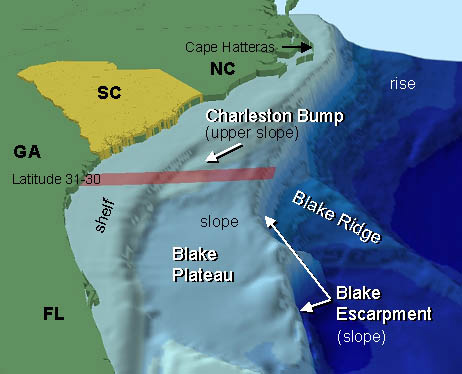
The southeastern coast of the United States - NOAA

The largest deposits of gold on Earth are found in ancient turbidites that include the Witwatersrand of South Africa and the Abitibi found in Canada in both Québec and Ontario. By definition a Turbidite is a landslide that occurs on a continental slope of a continental landmass where the erosion products of the continent eventually work their way to the abyssal plain at the bottom of the ocean that can be several kilometers deep.

Turbidites start at the edge of the continental shelf and can be caused by several different geological phenomena. They are deposited by a special type of water flow called a Turbidity Current that can be started by an earthquake, a powerful oceanic storm or in some cases just by the amount of material that collapses in on itself. The turbidity current contains not only water but suspended debris that causes it to flow out of town little slow but a speed that exceeds that of water itself because the current is also carrying suspended particles. Depending on the height of the slope the speed that it flows can reach as much as 70 km/h.

Once this flow reaches the bottom of the slope it quickly loses its forward speed and as it does drops off particles according to their density. It has such a high specific gravity of more than 19 gold is one of the first things that is dropped from a turbidity current. The finer particles and spread out over the abyssal plain of the ocean extending across the abyssal plain for hundreds of kilometers. In many cases at the edge of the flow the finer particles may only be a few millimeters thick, but over time this can actually be built into deposits of great thickness.

Mostly gold of the Turbidite deposit will say relatively close to the edge of the continent. Examples of these Turbidite flows are found in several places in the world one of the classic examples is the MegumaTerrane of Nova Scotia.

Some of the metals found in this environment include gold, silver, tungsten and antimony.  In western Connecticut the Rowe schist is an example of a metamorphosed turbidite.  This formation extends from northern Massachusetts almost to Long Island Sound in Connecticut.  Over the years reports of gold have been rumored about with this formation, but what is lacking is substantial proof i.e. no core drilling.

A capsule description of a turbidite deposit is gold-quartz veins, segregations, lodes, sheeted zones that are hosted by fractures, faults, openings in anticlines, synclines, along bedding planes in the turbidites and those that are associated with poorly sorted clastic sedimentary rocks.

These rocks are typically found close to the margins of continents or in back arc basins.  These rocks were typically deposited in submarine troughs, periarc basins, foreland basins and other remnant oceanic basins.  One feature that is typical of these rocks is multiple deformation events accompanied by metamorphism.  They show evidence of being thick sediment sequences displaying both deformation and are metamorphosed.  Although there can be some igneous rocks found in one of these deposits they tend to be quite rare and are usually present as pegmatites.  In some cases there are younger granitic intrusions associated with these rocks raising them to be raised to greenschist, but in some cases can reach amphibolite grade metamorphism.

The ore mineralogy of one of these deposits whether it is principle or subordinate includes native gold, pyrite, arsenopyrite, phyrottite, chalcopyrite, sphalerite, galena, molybdenite, bismuth, stilbite, bornite and other sulfosalt minerals. These minerals generally have a low sulfide content of less than 2.5%. The usual minerals found in association with these ore minerals are Quartz, carbonates, feldspar and chlorite.

When rocks of this type are discovered in glaciated terrains they may undergo deep weathering where alluvial recycling may produce rich placer deposits, such as in the Bendigo region of Australia.

There is several factors that control the ore deposits that are often found in fold crests, discordant veins and tension gashes. In some cases such as the in the Bendigo there is a relationship between ore deposits in the amount of graphite that is found in the country rock. The structural control is often extended to a district causing a scale alignment of deposits. Sometimes the veins appear confined to a specific stratigraphic interval that is often near to a change in stone type. Sometimes a more subtle relationship occurs lower deposits more closely related to the upper portion of the turbidite as of the magma district of Nova Scotia.

Because the low sulfide content, the majority of Quartz veins houses most geophysical methods of geophysical exploration to become ineffective it is often necessary to resort to the more usual prospecting techniques that are often accomplished with a gold pan by tracing the deposit.

In the deposit of this kind is not unusual to find deposits that range from a 50 g per tonne. Many of these are attractive targets for exploration as many of them are world class deposits.

Deposits of this type become incorporated into continental land masses with the death of an ocean by two continental masses colliding and the turbidite deposits are squished between the continents causing the turbidite to become incorporated into the mountain range that is a result of the collision. 

Tuesday, July 3, 2012

Gold Occurrences in Burkina Faso


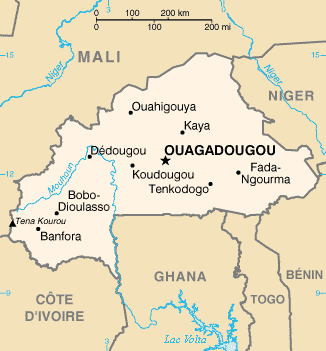
Map of Burkina Faso  -  CIA


In the past 40 years there has been a great deal of interest in gold mining in Burkina Faso. This is a country that is very geologically rich with the Poura region alone accounting for over 25 tonnes gold. As of 2003 the government brought about a new Mining act and immediately after there were more than 30 companies that have undertaken exploration projects in the country. They also created five new mines that are on the point of full production.

As demonstrated by the Abitibi region of Canada some of the richest gold mines in the world are located on greenstone belts.  In Burkina Faso greenstone belts cover about 3,000,000 km² of West Africa the Burkina Faso accounted for approximately 21% of these greenstone exposures. There are about 13 international mining companies that are active in this area now. .

As many as 13 international mining companies are working in the country mainly in the Greenstone belts. These belts account for over 21% of West Africa's Greenstone belt exposures that house on the world's most prolific gold mines. Some of these mines are capable of producing over 100 thousand ounces of gold per year. Much of this gold is produced by the heap leaching process and probably accounts to more than 1,000,000 ounces per year. Although some of these are producing mines, more of them are exploration projects that have been ongoing for some time.

All of the United Nations development program and Burkina Faso indicates that the early Proterozoic (Birrimian) Greenstone belts located at Boromo and Hound consists of steeply dipping volcanic and volcano-sedimentary units that have been intruded by the Eburnean granitoids there about 2 billion years old that have undergone incipient to low grade greenschist metamorphism. Many of the former gold prospects and mines are found in the Greenstone belts including the spell Poura vein gold deposit and the Dossi shear zone prospects. Much of gold that is discovered is associated with scheelite, calcium tungstate that is an ore for the metal tungsten.

Gold mining is one of the newest stories in Burkina Faso in recent years where the gold mining industry has been developing apparently inexhaustible resources.  There are many Australian companies that are already there searching for gold.  Many are finding it.

Most of the primary gold deposits are derived from metamorphic rocks that were developed from auriferous rocks that were eroded away long before the placer deposits bearing them were metamorphosed in the older volcanic and volcano=sedimentary rocks.  In this they are similar to the rocks found in the Witwatersrand district of South Africa and the Abitibi greenstone belts of Canada.

Friday, May 4, 2012

Gold Occurrences in Brazil


Coat of Arms of Brazil


Within its borders Brazil is the fifth largest country in the world; it touches upon all the countries in South America except Ecuador.  The country also has an astonishing variety of mineral deposits including iron, gold, gemstones, diamonds and oil.  There are literally hundreds of active mining companies found in Brazil.  Brazil also enjoys a rising economy and has a stable government with the future for mining being extremely bright.

The Amazonian shield covers much of the eastern portion of the South American continent and provides many of its gold mines.  Prospecting in the area is similar to prospecting in Canada’s Abitibi Gold Province in Ontario with a repeat of its greenstone belts with alternating gneiss’s.  There are also many deposits of turbidite hosted paleo-gold deposits similar to those found in the Witwatersrand in South Africa.  To the north of the Amazonian shield is the Guyana shield, to the south are the Rio Apa and Platian cratons and in the west is the Sao Francisco craton.  All of these areas are gold bearing.

Brazil covers 8.5 million square kilometers with 7,500 kilometers of coastline making it the largest country in South America, a size that dwarfs all its neighbors.  Its size is on continental size contains a vast resource base making it a prime target for attracting foreign investors and miners as well as Brazilian mining companies.  The country also has a long history of gold mining dating back into the 16th century.

It is estimated that less then 30% of the country has been adequately mapped so there is plenty of room for prospecting in both placer and lode gold deposits. Placer deposits can be found throughout Brazil except in the depths of the Amazon Basin, and there are plenty of gold deposits found in the Precambrian Shield areas that dot the country.

One of the biggest problems facing the Brazilian mining industry are the number of artisanal mining operations that keep popping up; there was a gold rush in the 1990s that centered on the Guyana shield that reportedly attracted over 90,000 miners to the area.  These miners for the most part disregarded good environmental practices resulting in large areas that were contaminated with mercury and other contaminants.

It has been found that artisanal mining is today the largest source of mercury release into the environment not only in Brazil but other countries too.  One of the sites mentioned that is the largest is in the Tapajos River Basin in the Amazon region of Brazil.  The Global Mercury Project (GMP) under the auspices of the United Nations is aiming to reduce this mercury contamination.

Brazil as a whole is mining friendly and enjoys a now stable government and a rapidly expanding economy that welcomes miners from around the world.  There are still vast amounts of the country that have not been explored, so one never knows what might be found just around the next bend of the river.

Thursday, March 31, 2011

The Abitibi Gold Province of Eastern Canada

During the course of writing the articles about the states in the American Midwest where gold occurrences are we made several references to the Abitibi Gold Belt in Canada located in the provinces of Québec and Ontario. This is what the Abitibi is about.

The Dome Mine in Timmins, Ontario one of the original gold mines of the Porcupine Gold Rush

We are taught about the great gold rushes that occurred in the Western United States during the latter part of the 19th century, but we know very little about the biggest Goldrush that ever occurred in North America. Know was that the California gold rush, nor was it the Klondike Gold Rush it was the Porcupine Goldrush that occurred about 600 miles north of New York City in Porcupine, Ontario. 

This Goldrush occurred in the Abitibi Gold belt that has proved to be one of the great gold bearing provinces on earth, and appears to be exceeded in size only by the Witwatersrand of South Africa.  The Abitibi is a continuous band of gneiss, granite and greenstone extending from Wawa, Ontario to Val d’Or, Québec that is the same goes is produced more gold than there is in Fort Knox. Since 1901 the gold mines of the Abitibi region of produced more than 170,000,000 ounces of gold; more than 68,000,000 ounces of them produced in the Township of Timmins, Ontario alone.

The Kidd Creek Mine in Timmins Ontario a leading producer of copper and zinc.  NOAA

During its history of his loss of more than 100 years they have a time he gold belt has produced over 100 gold mines, and from recent exploration it appears that the Abitibi is going to produce even more gold than it has in the past. Gold is not the only metal that is produced in the Abitibi Gold belt it has also been the scene of some very large base metal mines. It is in the same town of Timmins that the fabulous Kidd Creek Mine is located that kicked off a mining rush in early 1964 that today is producing copper and zinc along with other metals at a depth around 9500 feet making it one of the deepest mines in North America. It also produced the base metal mines around Rouyn-Noranda said gave birth to the Noranda Mining Company that during its day was one of the largest mining companies in the world.

Aside from its production of over 170,000,000 ounces of gold the Abitibi has also produced 35,000,000,000 pounds of zinc, 15,000,000,000 pounds of copper and 400,000,000 ounces of silver. In addition there are several minor metals that are also produced like germanium and indium. Even today they keep finding more mineral deposits in the Abitibi.


.

Tuesday, March 22, 2011

Gold Occurrences in Illinois

You might not exactly figure that you could find gold on the waterfront of Chicago or along the many beaches that are found on the shores of Lake Michigan, but that may be a very likely place to look. The USGS reports that there is no minable gold from Illinois even though the same glaciers that brought gold down from the Abitibi region in Canada no doubt affected the state of Illinois to as far south as the Ohio River. There are some old reports that mention lode gold being found in the state that might be credible.

Gold panning in a small stream.
Photo by Sylvia Duckworth


There are some reports mentioning that there was a small amount of gold found from quartz geodes that were discovered while digging a shaft in the dolomite of Stephenson County. This is located in the upper Mississippi Valley lead and zinc mining area. There were also reports into Peoria Star-Journal that are dated August 6, 1975 that a small amount of gold was recovered from a mine shaft dug in Bald Knob a large hill in Union County.

Mostly gold found in Illinois came from the Abitibi Gold Belt and to the north in Canada. This gold bearing region extends from Wawa, Ontario to Val D’or, Québec and is one of the largest gold bearing regions on earth that since gold was originally discovered in 1909 has produced over 160,000,000 ounces of gold. This not only brought down into Illinois placer gold that is found in the rivers and streams throughout the state, but also there are reports of boulders containing gold that is said to be 
worth as much as $25 per ton.

A $20 gold piece known as a Gold Eagle.


Placer gold has been reported from several localities in Illinois including:
1. The Sangamon River Valley in Macon County,
2. The Mississippi River Valley and a small tributary in Henderson County,
3. The Illinois River Valley in Fulton County,
4. The Spoon River Valley in Fulton County,
5. An outwash plain in McHenry County.
Most of gold found in Illinois is from the northern part of the state including Chicago where most of it is concentrated in the so-called terminal moraines that were left by the glaciers and are recognized by their stomach he appearance. The gold found their death and rebirth and concentrated by the action of flowing water in the rivers and streams that are found in that part of the state. The gold is found is usually just a few flakes or gold dust that are found in the sand and gravel deposits usually in the bed of a stream or river.

With this kind of gold deposits anyone processing a very large amount of sand and gravel may find that recovering gold can be profitable. This is not a job for a single prospector although he can usually find enough gold to show other people what it looks like, and have some bragging rights.

The operators of sand & gravel pits are in a different situation because they are processing large amounts of sand and gravel every day. They could include a sluice box in their processing spread to concentrate gold from sand. If they are washing sand in their normal course of processing they could very easily place a gold trap in their spreads. A feature of placer mining of this type depends on the fact that most placer gold that is found in Illinois occurs in the sand portion of aggregates. This eliminates the need for processing the gravel portion of the product.

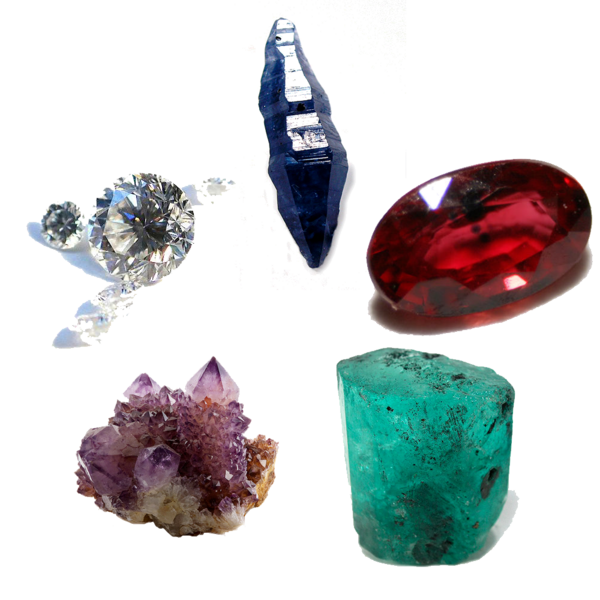
Gold is not the only thing that the glaciers brought down from Canada also brought diamonds, rubies, sapphires and zircons. These gems have been found as reported in “Canadian Diamonds,” a special report published during the summer of 2008 by the Northern Miner. Some of these diamond deposits are found in classical kimberlite deposits. Other occurrences are found in ancient gravel deposits that have solidified as conglomerate. The final source is alluvial diamonds and other gems brought down from Canada by the glacier..

Sunday, March 13, 2011

Gold Occurrences in Ohio

Gold does occur in Ohio in the glacial drift that covers the state where it has been brought down from Canada by two separate episodes glaciation the Wisconsinan and the Illinoian in the past 300,000 years. There is no lode gold in Ohio because the crystalline bedrock of the state is buried beneath thousands of feet of sedimentary rocks. Since the crystalline basement rocks are an extension of the Canadian Shield it is safe to assume that there is gold bearing mineralization under the overlying sedimentary rock as there is in the Abitibi gold belt to the north in Canada.

Glacial Deposits in Ohio
By Ohio Geological Survey


All the gold that is found in Ohio is placer gold that was brought down from the Abitibi region of Ontario during the last two ice ages that is widely distributed all the way from Lake Erie all the way to the Ohio River. The placer gold deposits in the state cover about two thirds of its area and even they are covered by younger lake bottom and wind borne deposits. Just about any river or stream in Ohio has the capability of carrying placer gold. Although gold is not plentiful in Ohio there is enough to attract the interest of many part-time gold miners and prospectors.

The discovery of gold in Ohio probably dates back to the return home of some California gold miners that started exploring the local rivers and streams for placer gold, and found some. The most plentiful gold in Ohio is found in the deposits that were laid down in front of glaciers in areas that are called terminal moraines. Just about any flowing water in this area will have gold bearing sands.

The glacial map of Ohio narrows down the most likely places to find gold in the state so study the map carefully. This map is available from the Ohio Geological Survey in a much more readable scale than is possible on the computer. They also publish a paper called GeoFacts No, 9 that is titled “Gold in Ohio” that should be read by any goldseekers that want to find gold in Ohio. and the Illinoian in the past 300,000 years. There is no lode gold in Ohio because the crystalline bedrock of the state is buried beneath thousands of feet of sedimentary rocks. Since the crystalline basement rocks are a seller and extension of the Canadian Shield it is safe to assume that there is gold bearing mineralization under the overlying sedimentary rock as there is in the Abitibi gold belt to the north in Canada.

All the gold that is found in Ohio is placer gold that was brought down from the Abitibi region of Ontario during the last two ice ages that is widely distributed all the way from Lake Erie's all to the Ohio River. The placer gold deposits in the state cover about two thirds of its area and even they are covered by a younger lake bottom and wind borne in deposits. It just about any river or stream in Ohio has the capability of carrying placer gold. Although gold is not plentiful in Ohio there is enough to attract the interest of many part-time gold miners and prospectors.

The discovery of gold in Ohio probably dates back to the return home of some California gold miners that started exploring the local rivers and streams for placer gold, and found some. The most plentiful golden Ohio was found in the positives that were laid down in front of the glaciers in areas that are called terminal moraines. Just about any flowing water in this area will have gold bearing sands.

The glacial map of Ohio narrows down the most likely places to find gold in the state so study the map carefully. This map is available from the Ohio Geological Survey in a much more readable scale than is possible on the computer. They also publish a paper called GeoFacts No, 9 that is titled “Gold in Ohio” that should be read by any goldseekers that want to find gold in Ohio.

Tuesday, February 15, 2011

Gold Occurrences in Madagascar

Although in the past Madagascar was a significant gold producer but because of its tumultuous political history for many years it remained in the doldrums. Today Madagascar is considered to be an up-and-coming place for mining now the political situation has become more stable. Today Madagascar has become a beacon for the mining and exploration industry that right now is largely undeveloped.

Madagascar is shown in red.

For those who don't know where Madagascar is, is approximately 400 km due east of the African mainland. It is separated from Africa by the Mozambique Channel.

Although the island has a vast potential for hosting valuable mineral deposits right now the country does not have a well-developed mining industry. As little as 30 years ago it was one of most geologically studied areas in the African region, but then the country underwent a period of political instability resulting in mineral exploration being put on the back burner. It wasn't until 1993 that the political instability vanished when the country returned to a liberal democratic form of government. It wasn't until recently however, that it began to regain some of the lost footing it once had in exploration and mining.

Although Madagascar is considered to be a part of the African Continent the island geologically is a micro-continent between Southern Africa and India. This becomes readily apparent when you start looking at the local geology and the flora and fauna. The geology of the island is more akin to that of Sri Lanka and India that is anything found in Africa.

Madagascar's primary gold deposits are similar to those of the Abitibi region of Canada than anything else. Like the Abitibi the gold is associated with greenstone belts, quartz reefs and veins, and is also found the fuse for the country rock in deposits similar to those of the Carlin Trend in Nevada.  There is a great deal of gold that is also associated with that volcanogenic massive sulfide (VMS) deposits similar to those that are found at the kidd Creek Mine in Timmins, Ontario or the Horne Mine in Rouyn-Noranda, Québec. Both of these mines are in the Abitibi Gold Belt of Canada.

Gold isn't the only thing found in Madagascar that is worth money.
Photo by Rob Lavinsky

Alluvial gold is also been recovered from both ancient and recent placer deposits as well as lateritic earth. Aside from the gold deposits found in Madagascar is also the home of many valuable gemstones including those of the ruby and sapphire family that are mined mainly by artisanal miners although in some cases a few of these mines have been mechanized.

Although the primary gold deposits found on the island predate the breakup of Gondwana one of the two continents that made up the supercontinent Pangaea. This is very important to remember because it makes the regional tectonics arrival into the emplacement of gold deposits. Madagascar's gold bearing rocks are all part of its suite of basement rocks. These rocks are divided into three different systems with the youngest being the Vohibory System, the middle is the Graphite System and the oldest is the Androyen System. Most of the gold however is found in the graphite system. There are also some interesting gold deposits in the Vohibory System.

Wednesday, February 9, 2011

Gold Occurrences in New Jersey

The first mention of gold in New Jersey dates back to 1829 when gold was reported from the general area around Franklin. The report failed to mention whether this was lode or placer gold, but from the geological history of that area it could have been either. One of the features in New Jersey shares in common with all the other states of the northeastern United States is the possibility of placer gold being brought down from the Abitibi Gold Belt in Canada.
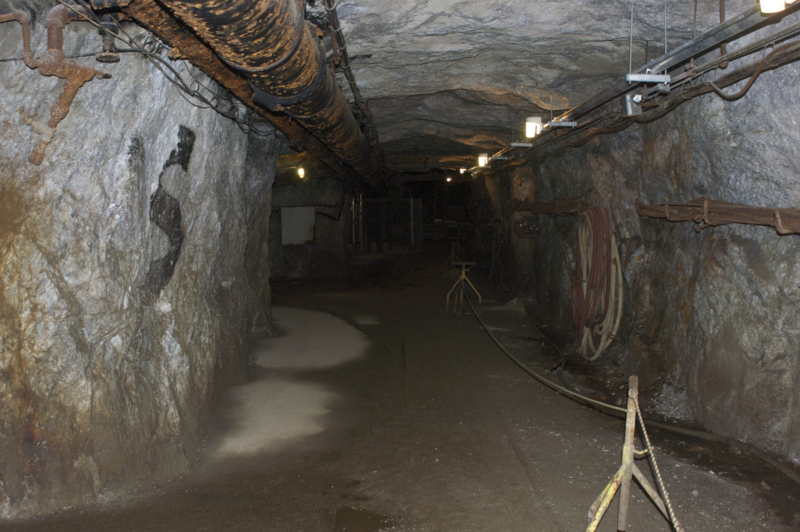
An adit in the Sterling Hill Museum at Sterling Hill, NJ

Gold has been reported in the ancient rocks of Grenvellian age from Sussex County associated with the iron deposits.  It has also been reported from the Schwangunk conglomerate from extreme western Sussex County in the vicinity of High Point, New Jersey.  The stone here is a conglomerate composed of quartz pebbles that is identical to the conglomerates of the Schwangunk Mountains of New York State.

Sussex County is also the home to some very rich zinc deposits at Franklin and Sterling Hill.  Although no gold was apparently found at these localities gold is often associated with zinc as a byproduct of the smelting process.  These zinc ores are contained in Precambrian marble with iron and manganese ores at times creating minerals containing both iron, manganese and zinc.  There have even been reports of corundum crystals being found in the same marble.

There have been reports of so-called gold mines in the past one notable example was in the Schuler Mine that showed some gold in quartz.  Many of the reported gold mines in Bergin County during the 19th century were actually scams. 

Southern New Jersey is covered with outwash composed of sand & gravel from the last glacier that came as far south as Staten Island where terminal moraines can be observed half way down the island.  There is a possibility that a small amount of gold may be present in the gravel topping the hills of Ocean County that was brought down from Canada by the glacier..

Although gold appears to be sparse in New Jersey there is otherwise a very rich history of mining for several other commodities including copper and silver in the Newark Basin basalts and sandstone. In the mid-19th century there were several mines producing copper and byproduct silver in this area of New Jersey

Friday, December 10, 2010

Gold Deposits from Continental Glaciation in the American Midwest

Introduction:
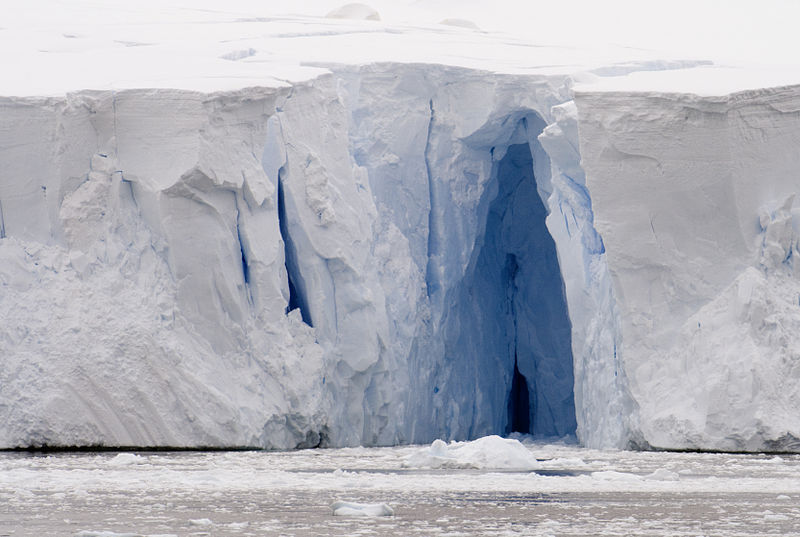
This is what a continental glacier looks like

During the past 1 million years there have been three episodes of continental glaciation that has covered the northern hemisphere with vast ice sheets more than two miles thick. Over much of the Midwest these continental glaciers southern boundaries are today marked by the Missouri and Ohio rivers. This is where the glaciers stopped advancing and is an area called a terminal moraine where for centuries all the material the glacier gathered on its way south was deposited in a similar fashion to the pile that forms under a conveyor belt.

The Abitibi:

To the north in Canada lies one of the great gold provinces in the world, the Abitibi, the second-largest gold producing region on earth. As the continental glacier advanced south it scoured the surface of the land in the Abitibi including many lode gold deposits and deposited them at the regions of terminal moraines accounting for the gold found in the northern Midwest of the United States north of the Missouri and Ohio Rivers. Most of the gold will be found just north of the Ohio River with lesser amounts spread across the states from western New York to Missouri.
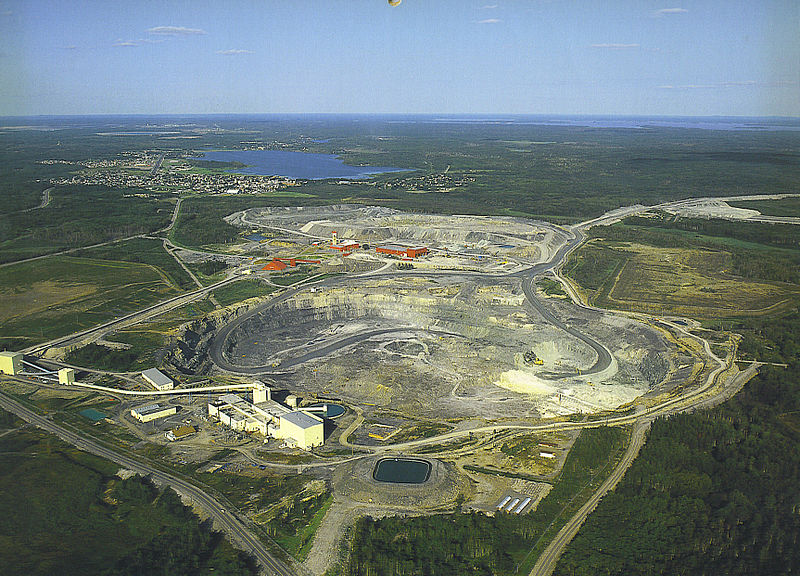
A gold mine in the Abitibi Gold Belt, Canada

The glacier explains the presence of gold in the northern United States, and the absence of placer gold in Ontario. In its travel south from the Arctic it passed over an area of sedimentary rocks south of Hudson and James Bay with no gold leaving the soil covering the Abitibi region with no gold hence the absence of placer deposits.

Gold in the Midwest:
A terminal moraine in the foreground where the glacier stopped and just dumped its load.

A terminal moraine is characterized by a hummocky appearance of many small hills and valleys and large deposits of sand and gravel. Subsequent reworking of the material by streams in a terminal moraine has resulted in the concentration of gold in the channels of streams throughout the area. Most of the gold is concentrated in an area north of the Ohio River, and just to its north, however enough gold was dragged down from Canada that it can also be found in the sands along the Great Lakes and in thin deposits across the states.  .