Total Pageviews

Showing posts with label United States. Show all posts

Thursday, August 4, 2011

Gold Occurrences in Newfoundland

Gold from the Nugget Pond Mine in Betts Cove on the Baie Verte Peninsula of Newfoundland.
Photo by Rob Lavinsky


Gold was originally discovered in Newfoundland in the 1870s when there was a flurry of gold mining and prospecting in the Canadian Maritime provinces and Newfoundland.  This activity died down after a few mines were opened and closed again.  My great grandfather was one of those caught up in this early gold rush, but at least he mined enough gold for my great grandmother’s wedding ring.  It was this same gold rush that led to his leaving Canada for the United States as it was discovered he was poaching gold from Crown Lands; he decamped from Canada rather suddenly.

Most of the gold occurrences in Newfoundland are found in the central part of the island, and at latest count there were over 200 mines or prospects.  This is significant because the Baie Verte fault that marks a suture zone where gold is deposited.  The Baie Verte fault cuts across the island from north to south as the dividing line between continental rocks to the west and oceanic rocks to the east already has active gold mines along the strike of the fault.  This fault has been interpreted as a subduction zone that is dipping toward the west. The fault is one of the major faults that were in the super-continent of Pangaea. It extends from Staten Island, New York northwards with several name changes to Newfoundland.  It is also found in Europe from Ireland across Scotland finally cropping out in western Norway.

Gold is only one of the metals associated with this fault where others include copper and other heavy metals.  There have been several important mines found in the area controlled by the fault including the asbestos mines around Thetford Mines, Quebec and numerous gold occurrences.  

Mings Bight was where the first gold was discovered in the 1870s that were followed ca. 1903 by some short-lived mines.  By 1935 there were only 26 recorded instances of gold being found in Newfoundland.  It wasn’t until 1976 when significant gold mineralization was found near Cape Ray on the south coast.  In 1984 another deposit was found at Hope Brook.

A surge in prospecting followed the Hope Brook discovery that lasted until 1990.  The prospecting was focused on some dismembered ultramafic belts that were analogies of the mother lode deposits of California.   Then the search broadened until it included most of central Newfoundland.  The low price of gold during the 1990s virtually stopped exploration until it started to pick-up in 2002 and remains very active.

The island of Newfoundland has produced more then 64 tonnes of gold with previously discovered, and new deposits being explored promising a rich future for gold prospecting in Newfoundland. Gold exploration waned as the gold price fell in the late 1990s but began to accelerate in 2002-03 in conjunction with the strong rebound in the price. As of late 2004,with the price continuing to rise, exploration is very active.
Previously discovered deposits and prospects are all being re-investigated and several promising new grassroots discoveries have been made.

The Province has produced over 64 tonnes of gold, about half of which has been derived as a by-product of base-metal mining.

Monday, April 18, 2011

Nancy Twinkie sees Green and finds Platinum

After a few prospecting and rock hounding trips it was apparent that Nancy Twinkie was going to become a seasoned prospector and it wasn't just for gold. On the road from Chester Massachusetts to Middlefield you drive by a long stretch of serpentinite along the road where the builders had blasted the road out of the side of a mountain. The serpentine that came off that mountain during the 19th century was used as ship’s ballast by an enterprising ship captain that originally came from Chester.

This is a piece of uncut jade that resembles the serpentine found in Chester, Massachusetts.

In a previous voyage he had taken some of the serpentine to China, and the Chinese jade carvers fell in love with the stuff because it looked just like jade and was easier to car because it was softer. For it while there was a brisk trade in the serpentine, and several shiploads found their way to China where it was carved then exported back to the United States and the rest of the Western world as Soochow jade.

Just about in the center of this exposure of serpentine a small stream came down off the mountain, and although at different times I had stopped alongside this road cut to pick up some samples of serpentine myself, and quickly discovered that it was fine cutting material for making cabochons that were greenish incolor and displayed some interesting patterns.

A platinum nugget of the same color of what we found in our gold pans.
Photo by Rob Lavinsky

On one of our rock hounding trips into the Berkshires Nancy Twinkie and me stopped at this small stream to see if it contained any gold. Because serpentine is derived from metamorphosed oceanic crust that in some places is called greenstone there was a pretty good probability that we may find some gold. We didn't, but what we did find were some very small flakes of silvery metal that although we never tested these flakes to see what they really were there is a good possibility that they were platinum. Serpentine is what they call an ultra-mafic rock in which platinum is known to occur; so there is a good possibility that was what we found that day.

Gold associated with belts and greenstone in many places in the world where they produce gold; one of these so called greenstone belts is the Abitibi gold belt in Québec and Ontario is one of the great gold producing areas on earth. You might say that Nancy Twinkie saw the greenstone, serpentine, and probably found platinum.

Sunday, April 3, 2011

State Geological Surveys for finding Gold

One of the most useful tools that you can use in your search for gold is your state’s geological survey. For that reason we are going to include the URL's for your state’s geological survey in the following list:


District Of Columbia: http://www.usgs.gov/ The USGS covers DC


Hawaii: has no geological survey of its own; uses USGS.


Northern Marianas Islands: http://www.usgs.gov


Saturday, April 2, 2011

Oil Seep in Carlin Type Gold Deposits

As reported in the July 15, 1991 issue of the Oil & Gas Journal an active oil seep has been found in the Yankee Gold Mine in White Pine County, Nevada.  This mine operates on the western side of Long Valley and is one of the Carlin Type Deposits that has made Nevada the premier gold mining state in the United States.

A naturally occurring oil seep in sandstone
Photo by Lidenke

Carlin type deposits are a hydrothermally altered limestone of Paleozoic age that contain deposits of gold measured in micron sizes that are only visible under an electron microscope.  The same deposits are also noted as containing disseminated deposits of arsenic and locally hydrocarbons.  The Yankee deposit is the only known deposit in Nevada that has active oil seeps.  The discovery of oil seeps here are felt to be important to further exploration for gold in the Carlin Trend gold deposits, but also in the search for oil.

The oil seep was originally discovered when an oil wildcatter was preparing to drill a 7,000 foot deep oil well in the area of the mine and asked the then operator of the mine Kennecott if he could hook up a telephone connection to his drill site from the mine.  The oil seep was brought up when a mine employee casually told him there were hydrocarbons seeping onto the mine that was operating in a calcerous shale that according to some other employees were pooling on the ground under the seep.

An oil seep in limestone similar to the one in the Yankee Mine in Nevada
Photo by Lidenke

Although the discovery of an oil seep is important in this formation for the discovery of oil and what is more interesting however is the description of gold deposits. These are found in sedimentary deposits that were formed during the Paleozoic from Cambrian through Mississippian carbonate and siliclastic rocks that have been permeated by hydrothermal fluids. Many of these deposits are found in siltstone and limestone although some of them are found in calcerous shales are siltstones.

These older deposits of been covered by later deposits of the tuffaceous sedimentary rocks of tertiery age and by andesites that are about 30 million years old. The deposits are also characterized by veinlets of quartz, kaolin and stibnite.  There are further deposits of realgar and cinnabar. 

Wednesday, February 23, 2011

Sand and Gravel

According to the USGS sand & gravel is one of the most accessible natural resources in the United States second only to crushed stone in value.  It has had an explosive growth rate since the beginning of the 20th century when relatively little was used.  Sand and gravel is mainly used in the construction industry in the form of construction sand & gravel mainly used in the production of concrete and in bituminous concrete (blacktop).


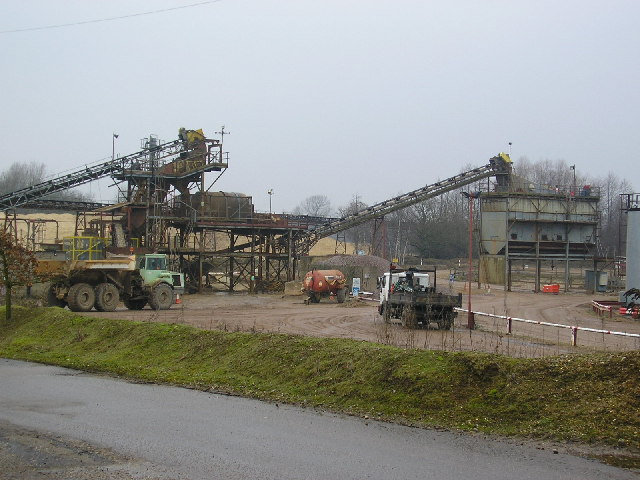
A sand & gravel pit
Photo by Roger W. Hayworth

Annual production of sand & gravel in the United States today it ranks as second in tonnage in the non-fuel minerals after crushed stone.  It is the only mineral commodity that is produced in all fifty states.  In general the United States is self sufficient in the amount of sand & gravel that is produced annually by producing enough to meet all its domestic needs, and is a small net exporter mainly to places where sand & gravel is used to a certain extent in the areas along the borders with Canada and Mexico.
Demand for sand & gravel is mainly controlled by the level of construction activity that controls its demand.  In the United States the production of sand and gravel has grown significantly since the end of WW II with production in 1950 at 320 metric tons increasing to  approximately 900 million metric tons by 2000.  The level of production has dropped since that time.


Sand that has been processed and stored
Photo by Claus Ablieter

Mining sand & gravel is mainly a clean operation in comparison to your local corner bakery although to many people it is unsightly.  This has led to a great misunderstanding on the part of the general public where the perception is that sand & gravel mining is harmful to the environment.  This has caused many sand & gravel deposits to be withdrawn from mining for demographic reasons that in many areas has caused shortages of sand & gravel to occur.
Sand & gravel is a product having a high in-place value that considering the present business conditions costs approximately 50 cents per ton mile.  The further it is necessary to transport the material the more it costs.  Sand & gravel that costs less then $2.00 to produce per ton is apt to cost more then $20.00 per ton delivered. 
A great deal of the problem that was the cause of a special investigation by the governors of the Northeast States was brought about by the mistaken perception that sand & gravel mining was environmentally hazardous; it isn’t.  This misplaced perception has done nothing more then increase the cost of virtually all construction projects throughout the United States.

Wednesday, February 9, 2011

Gold Occurrences in New Jersey

The first mention of gold in New Jersey dates back to 1829 when gold was reported from the general area around Franklin. The report failed to mention whether this was lode or placer gold, but from the geological history of that area it could have been either. One of the features in New Jersey shares in common with all the other states of the northeastern United States is the possibility of placer gold being brought down from the Abitibi Gold Belt in Canada.
An adit in the Sterling Hill Museum at Sterling Hill, NJ

Gold has been reported in the ancient rocks of Grenvellian age from Sussex County associated with the iron deposits.  It has also been reported from the Schwangunk conglomerate from extreme western Sussex County in the vicinity of High Point, New Jersey.  The stone here is a conglomerate composed of quartz pebbles that is identical to the conglomerates of the Schwangunk Mountains of New York State.

Sussex County is also the home to some very rich zinc deposits at Franklin and Sterling Hill.  Although no gold was apparently found at these localities gold is often associated with zinc as a byproduct of the smelting process.  These zinc ores are contained in Precambrian marble with iron and manganese ores at times creating minerals containing both iron, manganese and zinc.  There have even been reports of corundum crystals being found in the same marble.

There have been reports of so-called gold mines in the past one notable example was in the Schuler Mine that showed some gold in quartz.  Many of the reported gold mines in Bergin County during the 19th century were actually scams. 

Southern New Jersey is covered with outwash composed of sand & gravel from the last glacier that came as far south as Staten Island where terminal moraines can be observed half way down the island.  There is a possibility that a small amount of gold may be present in the gravel topping the hills of Ocean County that was brought down from Canada by the glacier..

Although gold appears to be sparse in New Jersey there is otherwise a very rich history of mining for several other commodities including copper and silver in the Newark Basin basalts and sandstone. In the mid-19th century there were several mines producing copper and byproduct silver in this area of New Jersey

Tuesday, January 18, 2011

Have Gold Prices gone into a Slump?

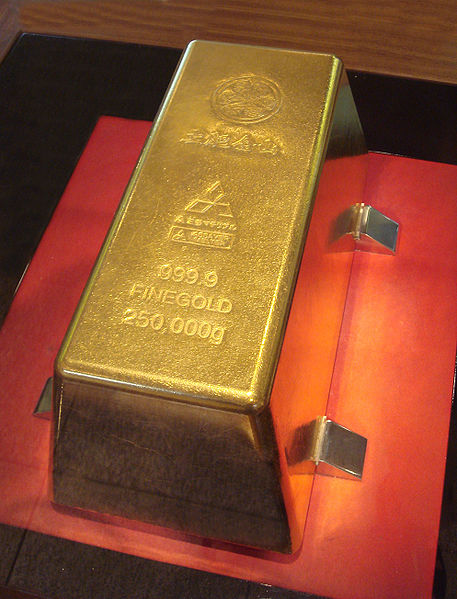
A 250 kilogram gold bar.

In December 2010 gold prices hit an all-time high of $1432.50 in New York, but by January 14, 2011 the price of gold had sunk to $1361.80 per ounce, a decrease of almost 5 percent. Right now gold prices are in this slump that coincides with the expectations of many investors that the economy is slowly recovering in the United States and the European Union. The question is now being asked is, are investors gaining more confidence in the economy by taking their money out of gold and putting it into more speculative ventures. The other question they are asking themselves is this only a small correction or does it indicate a continuing upward trend in the economy?

According to Bloomberg during the second week of January 2011 the price of gold fell on the New York Stock Exchange to its lowest settlement price in seven weeks. This was fueled by speculation that the leaders of the European Union would stabilize economy thereby ending the appeal of gold as a safe haven.

One economist, Dennis Gartman, was quoted as saying that the price of gold was now “toppy” recommending that investors cut their holdings by about one third saying that “Gold has run its course for a while.”

Right now gold and silver may not be the best investment in the world, but in the long run the price for both of these metals looks bright it is expected to rise to even higher levels. Many producers of gold expect to see the price topped $2000 per ounce.


Friday, December 10, 2010

Gold Deposits from Continental Glaciation in the American Midwest

Introduction:
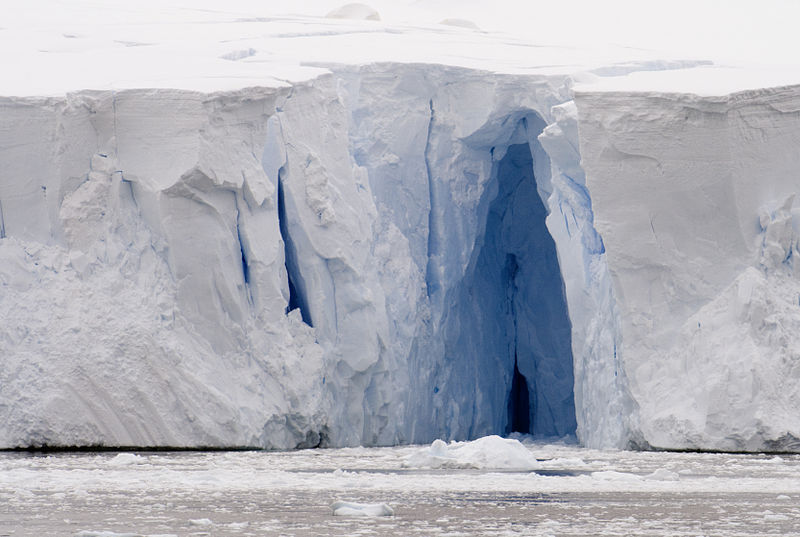
This is what a continental glacier looks like

During the past 1 million years there have been three episodes of continental glaciation that has covered the northern hemisphere with vast ice sheets more than two miles thick. Over much of the Midwest these continental glaciers southern boundaries are today marked by the Missouri and Ohio rivers. This is where the glaciers stopped advancing and is an area called a terminal moraine where for centuries all the material the glacier gathered on its way south was deposited in a similar fashion to the pile that forms under a conveyor belt.

The Abitibi:

To the north in Canada lies one of the great gold provinces in the world, the Abitibi, the second-largest gold producing region on earth. As the continental glacier advanced south it scoured the surface of the land in the Abitibi including many lode gold deposits and deposited them at the regions of terminal moraines accounting for the gold found in the northern Midwest of the United States north of the Missouri and Ohio Rivers. Most of the gold will be found just north of the Ohio River with lesser amounts spread across the states from western New York to Missouri.
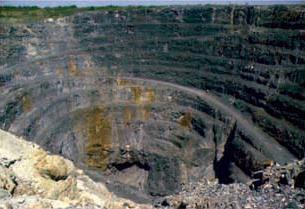
A gold mine in the Abitibi Gold Belt, Canada

The glacier explains the presence of gold in the northern United States, and the absence of placer gold in Ontario. In its travel south from the Arctic it passed over an area of sedimentary rocks south of Hudson and James Bay with no gold leaving the soil covering the Abitibi region with no gold hence the absence of placer deposits.

Gold in the Midwest:
A terminal moraine in the foreground where the glacier stopped and just dumped its load.

A terminal moraine is characterized by a hummocky appearance of many small hills and valleys and large deposits of sand and gravel. Subsequent reworking of the material by streams in a terminal moraine has resulted in the concentration of gold in the channels of streams throughout the area. Most of the gold is concentrated in an area north of the Ohio River, and just to its north, however enough gold was dragged down from Canada that it can also be found in the sands along the Great Lakes and in thin deposits across the states.  .