Total Pageviews

Showing posts with label gravel. Show all posts

Friday, May 20, 2011

How to use a gold pan

The usual size of the gold pan is about 14 inches that will hold about 20 pounds of gravel. Although you can take the gravel straight from the streambed it makes panning much easier if you use a classifier that removes all the stones larger than 3/8 of an inch from the gravel before you start panning. It is a good idea to examine these larger stones just to see if there are any gold nuggets present that might be thrown away with the oversized stone.

Gravel the largest piece in this picture in about 4 cm. This is typical of gold bearing gravel.
Photo by Stan Zurek


Gold is 19 times the density of water meaning that by shaking the gold pan combined with a circular motion when it is full of water will cause gold particles to settle through the gravel to the bottom of the pan. This is a process that you will want to repeat several times in the process of panning.

The gold pan is held at an angle so it's lower edge is submerged in water allowing the gravel to slowly pour over the rim and back into the stream. Periodically remove the pan from the stream and repeat the swirling motion to be sure you don't lose any of gold. Keep repeating this process until all that is left in your pan is an accumulation of black sand. It is in this black sand where gold accumulates. Always keep the edge of pan having the riffles submerged because the gold will be caught in the riffles rather than poring over the edge of the pan.
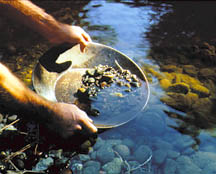
Gold panning showing how to hold a gold pan.  USDA


For the most part black sand is an accumulation of magnetite and hematite that our oxides of iron. Magnetite can be removed using a conventional magnet: hematite can be removed using a rare earth magnet. The magnetic separation of the iron oxides leaves behind a concentrate of the other heavy minerals that are found in stream gravel the most common of which are garnet and zircon as well as any other gold particles and other precious metals such as platinum. Gold and platinum often occur together!

Saturday, May 7, 2011

Big Boys Toys for the Gold Patch

A sampling of some of the equipment that is produced by Goldlands at their plant in Bellingham Washington


As far as we know there is no formal definition for the Gold patch, so we will make one up right now. Our definition of the “Gold Patch” is that it is a large commercially viable deposit of placer gold from which the gold is recovered using specialized large-scale equipment.

Making a large-scale deposit of placer gold payoff is strictly a function of how much gold bearing gravel you can process in a day. You're not going to do it with neither a gold pan nor any other equipment that is used by the small-scale miner this takes some pretty good sized toys. One such company that makes this kind of gold recovery is Goldlands from Bellingham, Washington. The company makes a line of gold mining equipment specifically for the recovery of gold, platinum group metals and gemstones.

Goldlands manufactures a complete line of heavy industrial equipment suited for large scale operations for the recovery of gold and other heavy minerals.  They have some of the most innovative equipment in the field as they have been doing so since 1977.  Some of this equipment includes as quoted from their Webpage:;

“1.   The Gold SONIC CONCENTRATOR or "Live Sluice", a two tray, heavy duty high oscillation gravity concentrator for hardrock and alluvial precious metals extraction and concentration.  These process from 50 to 150 Tons per hour and can be placed in series for higher capacity operations.

Goldlands live sluice concentrator
 

2.   Portable 
HELICOID CONCENTRATORS called the Goldland "Blasters" which continuous feed and upgrade the metals and material.  These units include the MicroBlasters, GoldBlasters and NuggetBlasters, starting at the smallest test units of 1 Ton/Hour, up to high capacity of 150 Ton/hr units.

3.    
TROMMEL/SCRUBBERS:  These clay scrubbing units are portable a trailer mounted and process from 50 to 150 Tons/hour.  The gravels are washed thoroughly, releasing any gold baring material from gravel conglomerates.
Goldlands trommel unit


4.    Rotary 
MICRON GOLD CENTRIFUGES:   These centrifugal cylinders have a series of baffles within.  The units are rotated at a high but regulated speed which breaks the water tension and forces the micron, floating gold and precious metals to be captured and build up in the interior baffling.  The units are then purged at the end of shift and the concentrate extracted.

5.     
SCREENING SYSTEMS:  These high vibrating units have 4-6 decks and can be adapted to process either concentrate or bank run material. They are ideal for micron gold recovery.

6.     
MINING PROPERTIES AVAILABLE - Goldlands operates its own gold mines and has properties available for new customers who wish to learn to operate Goldland's mining equipment.   Learn and earn at the same time!”

Goldlands ships their equipment all over the world dismantled in shipboard containers.  There have even been reports of some of their equipment being used in Africa producing as much as $25,000 worth of gold per day.

Wednesday, February 23, 2011

Sand and Gravel

According to the USGS sand & gravel is one of the most accessible natural resources in the United States second only to crushed stone in value.  It has had an explosive growth rate since the beginning of the 20th century when relatively little was used.  Sand and gravel is mainly used in the construction industry in the form of construction sand & gravel mainly used in the production of concrete and in bituminous concrete (blacktop).


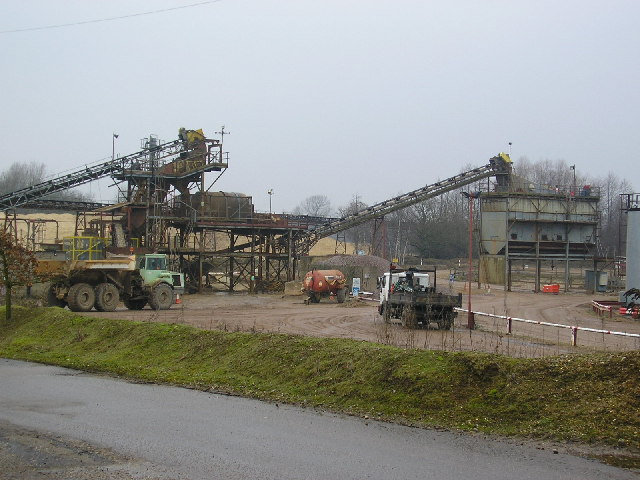
A sand & gravel pit
Photo by Roger W. Hayworth

Annual production of sand & gravel in the United States today it ranks as second in tonnage in the non-fuel minerals after crushed stone.  It is the only mineral commodity that is produced in all fifty states.  In general the United States is self sufficient in the amount of sand & gravel that is produced annually by producing enough to meet all its domestic needs, and is a small net exporter mainly to places where sand & gravel is used to a certain extent in the areas along the borders with Canada and Mexico.
Demand for sand & gravel is mainly controlled by the level of construction activity that controls its demand.  In the United States the production of sand and gravel has grown significantly since the end of WW II with production in 1950 at 320 metric tons increasing to  approximately 900 million metric tons by 2000.  The level of production has dropped since that time.


Sand that has been processed and stored
Photo by Claus Ablieter

Mining sand & gravel is mainly a clean operation in comparison to your local corner bakery although to many people it is unsightly.  This has led to a great misunderstanding on the part of the general public where the perception is that sand & gravel mining is harmful to the environment.  This has caused many sand & gravel deposits to be withdrawn from mining for demographic reasons that in many areas has caused shortages of sand & gravel to occur.
Sand & gravel is a product having a high in-place value that considering the present business conditions costs approximately 50 cents per ton mile.  The further it is necessary to transport the material the more it costs.  Sand & gravel that costs less then $2.00 to produce per ton is apt to cost more then $20.00 per ton delivered. 
A great deal of the problem that was the cause of a special investigation by the governors of the Northeast States was brought about by the mistaken perception that sand & gravel mining was environmentally hazardous; it isn’t.  This misplaced perception has done nothing more then increase the cost of virtually all construction projects throughout the United States.