Total Pageviews

Showing posts with label platinum. Show all posts

Wednesday, February 1, 2012

Cleaning up Concentrates containing Gold and Platinum

Hematite particles forming ferro-fluid with a rare earth magnet beneath a sheet of glass.

One of the problems in the recovery of gold,silver and platinum from concentrates of stream heavies is the removal of iron oxides that make up the majority of heavies. Most of the other heavies are composed of silicates and in rare cases oxides of various elements. In the case of iron oxide there are two types present in most heavies. The most easily removed is magnetite because it is attracted to an ordinary magnet with the best being an Alnico magnet. This will quickly remove the magnetite that is the easiest to remove. Hematite is the second iron oxide in heavies that is not attracted to an ordinary magnet, but is attracted to a rare earth magnet that can be ordered on the internet. The remaining heavies composed of mineral silicates and oxides being much less dense and having a far lower specific gravity then gold, silver or platinum that is left behind in the pan.

The iron oxides can be removed in two stages; the first is removing magnetite. There are commercial magnetic separators available, but for the small amount usually encountered an ordinary magnet will suffice. A small amount of concentrate that has been thoroughly dried is placed on a sheet of paper and the magnet is passed over the concentrate just above its surface, but high enough not to touch the concentrate. The magnetite present will stick to the magnet so you will have to periodically remove it from the magnet.

The hematite is removed in the second step by using a small rare earth magnet by repeating step 1 using the more powerful magnet the remaining concentrate containing heavies, gold, silver and platinum group metals. This concentrate is poured into a separate container for further work in the process.

Although geologists know ways of separating heavies using dense fluids, but they are all highly toxic and shouldn’t be used by an untrained layman. The best way to remove them is with a small ten inch gold pan immersed in water using conventional panning methods. Its tedious work, but the pan full of concentrate can be worked down until the only thing left in the pan is gold, silver and platinum group metals (PGM).

The remainder in the pan is gold, silver and PGMs that are saved for further processing; because of the length of the whole process we are going to divide it into several articles we will publish in the near future. Watch for them!

Friday, April 29, 2011

Gold Occurrences in Oregon

In 1964 the author spent some time as a prospector looking for gold in southeastern Oregon on down by the Nevada border. Although we didn't see much gold we had a good look at the Oregon desert.

Map of Oregon showing the High Desert
By Oxygun


According to the geology reports there is plenty of gold in Oregon it just depends on where you look. Gold and other minerals of interest are found throughout the state, but the northeastern part of the state has produced more Gold placers. Gold mining was occurring in Oregon as early as 1859 when the first goal strike happened. Most of the rivers and streams in Oregon carry placer gold; another place where placer gold is found accompanied by about 10% platinum is in the black sands found on the beaches of the Pacific Ocean.

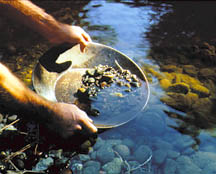
Panning for gold in a stream.  USFS


What you should do is try panning for gold in a likely looking stream for starters. The best kind of stream to find gold in is what might be termed a babbling brook with lots of boulders and rapids and other places where gold may be entrapped. You can usually find gold on the inside of bends on what is called the point bar. Gold is also found behind a boulder or any place where the water changes velocity from fast to slow. Generally any place where Swiftwater trout would be found is also a good place to look for gold.

Two of the best places where gold may be found in a stream is where the water runs over a ledge in the stream causing the gold to be caught in cracks on the rocks. The other place is in the plunge pool beneath a waterfall.

One of the best places to search for gold in Oregon is in the northeast quadrant of the state. This part of Oregon is mostly desert, and because of the arid conditions water is apt to be scarce for gold panning. A gold pan works almost as well in the desert as it does in more humid places where water is abundant; the difference is you don't have any water to help of the panning process otherwise the process for finding gold is practically the same.

This is what you have to do to dry pan. Fill your gold pan about half full of gravel and go through the same motions that you would if there was water in the pan. That is shaking the pan horizontally so that the larger stones and pebbles come to the top. You’ll have to pick them out by hand almost the same way that you do with water. Keep working the pan until all you have left is sand.

Now you are ready to work the sand down into a concentrate. Holding the pan so the internal riffles are facing you and slowly by rocking the pan back and forth while the excess sand pours over the edge of the pan. In this manner you can work the sand down until there isn’t really anything left but the black sand concentrate that you can take home and work over at your leisure.

This is a thunderegg collected in the Blackrock Desert.
Photo by David Rix Eibonvale


There are other minerals of interest in Oregon among them are agates and thundereggs. These stones are usually associated with flows of basaltic lava. It is in the cavities and gas bubbles in the lava that the agates and thundereggs are formed.

Most of these thundereggs are found in gravel where they have been washed out of the basalt cliffs. The thunder egg have a crust that is kind of nubbly looking. Once you see one you will always be able to recognize another. Agates and thundereggs are very hard to see in nature, but there is a way to lure them out of their hiding place. Using a spray bottle filled with water spray the gravel in front of you and if there are any agates were thundereggs there. By being soaked with water will make them stand out against the other stones like a neon sign.

Monday, April 18, 2011

Nancy Twinkie sees Green and finds Platinum

After a few prospecting and rock hounding trips it was apparent that Nancy Twinkie was going to become a seasoned prospector and it wasn't just for gold. On the road from Chester Massachusetts to Middlefield you drive by a long stretch of serpentinite along the road where the builders had blasted the road out of the side of a mountain. The serpentine that came off that mountain during the 19th century was used as ship’s ballast by an enterprising ship captain that originally came from Chester.

This is a piece of uncut jade that resembles the serpentine found in Chester, Massachusetts.

In a previous voyage he had taken some of the serpentine to China, and the Chinese jade carvers fell in love with the stuff because it looked just like jade and was easier to car because it was softer. For it while there was a brisk trade in the serpentine, and several shiploads found their way to China where it was carved then exported back to the United States and the rest of the Western world as Soochow jade.

Just about in the center of this exposure of serpentine a small stream came down off the mountain, and although at different times I had stopped alongside this road cut to pick up some samples of serpentine myself, and quickly discovered that it was fine cutting material for making cabochons that were greenish incolor and displayed some interesting patterns.

A platinum nugget of the same color of what we found in our gold pans.
Photo by Rob Lavinsky

On one of our rock hounding trips into the Berkshires Nancy Twinkie and me stopped at this small stream to see if it contained any gold. Because serpentine is derived from metamorphosed oceanic crust that in some places is called greenstone there was a pretty good probability that we may find some gold. We didn't, but what we did find were some very small flakes of silvery metal that although we never tested these flakes to see what they really were there is a good possibility that they were platinum. Serpentine is what they call an ultra-mafic rock in which platinum is known to occur; so there is a good possibility that was what we found that day.

Gold associated with belts and greenstone in many places in the world where they produce gold; one of these so called greenstone belts is the Abitibi gold belt in Québec and Ontario is one of the great gold producing areas on earth. You might say that Nancy Twinkie saw the greenstone, serpentine, and probably found platinum.