Total Pageviews

Showing posts with label placer. Show all posts

Wednesday, May 16, 2012

Gold Occurrences in the Argentine


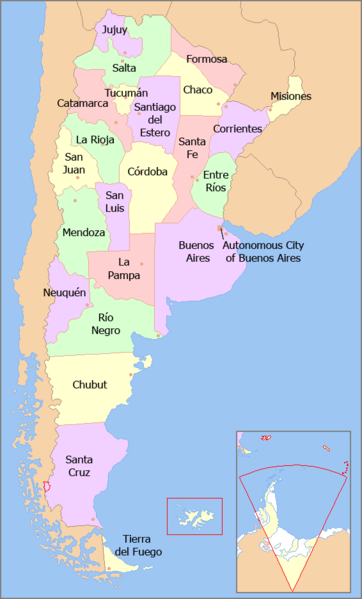
Map of Argentina.  The provinces in the far west of the country are most apt to contain gold
By Bliff


Although an ocean separates them Argentina has a neighbor the country of South Africa that although they were split apart with the opening of the Atlantic Ocean during the Cretaceous millions of years ago they share much in common.  Forty percent of all the gold that has ever been mined comes from the Witwatersrand in South Africa that leaves the question are like gold deposits to be found in the rocks of Argentina.  The very name of the country is derived from the Latin word for silver “argent” hence Argentina.

Argentina overhauled its protectionist mining laws in 1993 causing gold production to rise in a parabolic curve from a mere 36,000 ounces to over 1 million ounces.  This change in the laws has made Argentina the third largest producer of gold in South America.  This number was only exceeded by Peru and Brazil, respectively.  Only Argentina has seen as dramatic a rise in recent years.

Only in Argentina has the level of gold production raised in recent years with the production of gold having peaked in the other countries.  These points out the fact that unlike the others Argentina’s gold fields are from being mature is respect to their development cycles.  Argentina’s wealth of buried gold is yet to see any meaningful development translating into a booming domestic gold industry with a pronounced growth curve.

In area Argentina is the second largest country in South America that is 1,580 kilometers from east to west and 3,460 kilometers from north to south.  To its west it borders Chile along the crest of the Andes.  The country has well over thirty volcanoes that also follow the Andes which have supplied the heat engines necessary to forming deposits of gold dissolved in their hydrothermal waters.

The presence of placer gold in the rivers and streams draining the eastern slopes of the Andes Mountains are known to contain large amounts of placer gold.  Some of the deposits that have been found are supposed to exceed 1 million ounces of gold.  Some of this gold is pristine crystals giving weight that gold nuggets are caused by gold fixing bacteria.  Much of this crystalline gold is as high in content as >98% pure gold, some of the purest in the world.

Lode gold is often associated with arsenopyrite and copper sulfides the normal byproducts of hard-rock gold.  Another element often associated with the gold from Argentina is mercury that may explain why the placer gold has such a high percentage of gold because the mercury left over from past mining operations has dissolved the residual silver.  There are lode deposits the length of Argentina in the spine of the Andes Mountains.

Tuesday, May 15, 2012

Gold Occurrences in Bolivia


A scene from Potosi a famous Bolivian mining center.  Note the volcano in the background a source of gold deposits.
Photo by Idobi


Although Bolivia is noted for its tin production especially in the area around Potosi gold mining and prospecting proceeded at a brisk rate during the late 1980s.  Gold is found throughout the country with more then 300 cooperatives and over 10,000 prospectors producing gold.

Bolivia like many other countries in the world now faces a trade-off between economic growth vs. the environment.  The country derives much of its foreign exchange from the mining industry with zinc being its largest mining export followed by tin, gold and silver. As a result of this dilemma Bolivian mining companies have developed tighter rules with gold mining being an important source of foreign exchange for the country.  Things get difficult because Bolivian and U.S. environmental groups continue to fight prospecting and mining efforts because of their devastating effects on the local environment.

The practices of the mining industry leads to soil erosion combined with pollution of the country’s fresh-water resources.  This leaves the peons of the country torn between mining and jobs or protecting the environment that fails to bring Bolivia much needed jobs.

Mining is the mainstay of Bolivia’s economy with around 50% of its foreign exchange coming from this source.  The country’s private mining sector has continued to grow led by Canadian and U.S. companies.  The government has set aside a large area about 120 km north of LaPaz for gold mining and exploration.

There are plenty of active and extinct volcanoes in Bolivia to provide heat engines to drive the hydrothermal waters responsible for building gold deposits when the water reaches conditions that will precipitate the dissolved gold from solution.  This volcanic activity has given birth to extensive deposits of hard rock gold and abundant placer deposits in the country’s rivers and streams.  There is both artisanal and full scale mining in Bolivia, and it’s still ongoing.

Mining has been going on in Bolivia since the days of the Spanish conquest that began in 1524 and was mainly completed in 1833.  In those days after the conquest what is now Bolivia was known as “Upper Peru.”  When it was founded in 1545 as a mining center Potasi quickly started pouring immense mineral wealth into the coffers of the Spanish Empire it quickly became the largest city in the New World with a population larger then 150,000.  The Spaniards were mainly interested in gold it was later that Potasi became known for its tin deposits.  Mineral wealth continues to pour from Bolivia. .   

Saturday, December 24, 2011

Gold Occurrences in Costa Rica

Coat of Arms of Costa Rica

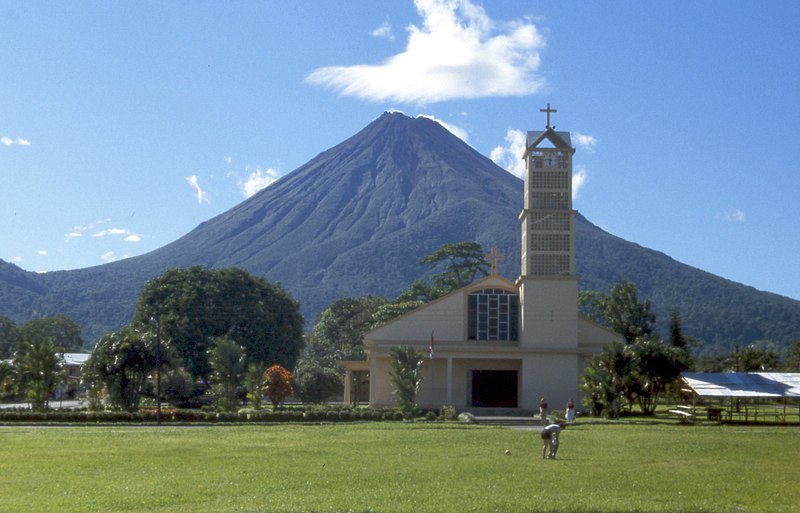
The very name Costa Rica in English means "Rich Coast" a country that has become the home to many expatriate Americans because of its stable government.  What makes it favorable to so many gold hunters is the chain of volcanoes reaching from north to south through the country.  There are several gold bearing regions found throughout the country associated with its volcanic nature.

The only producer in Costa Rico is presently “Inversiones Valle Columbia” that holds an exploitation concession right in the center of the historic Las Juntas mining district.  There are two veins LaPita and the Olga that have been developed into mines feeding the mill that supplied ore running from 10 grams to 20 grams per ton that were supplying up to 80 tons of ore per day.

Volcan Arenal in Costa Rica
Photo by Matthius Prinke

The owner of Invesions Valle Columbia, Luis Canto bought the Rio Chiquito mine from Corporacion Minerales Laguna SA in 2002 that has stated resources of almost 177,000 tons.  It’s his intention to prove and exploit this deposit that averages 11.18 g/t Au and 21.2 g/t Ag.

There is even a district in Costa Rico called the Montes de Oro, literally Mountains of Gold about 70 km west of the countries capital San Jose close to the town of Miramar overlooking the Pacific Ocean.  This mine owned by Glencairn is producing up to 60,000 oz of gold per year.  The property has produced gold off and on for more then a century.

At the Crucitas project Vannessa Ventures has acquired one of the premier gold producing areas in Costa Rico consisting of 10 concessions that cover 176 km2 where they have already spent over US$34 million in exploration and development.  Crucitas is ready for mine development containing measured, indicated and inferred resources of more then 2.4 million ounces of gold.

A long tradition of placer gold mining has affected the local population of the Osa  Peninsula in Costa Rico.  This goldfield that extends across three-quarters of the Peninsula has even managed to produce some large nuggets.  In this area you can at least pan colors in your distinctive gold pan that was developed by the local populace for their mining conditions.

There are several concessions of placer gold for sale in Costa Rica including one of 10 km2 in southwestern Costa Rica containing at least 7,500 kg of gold as stated by the Costa Rican Department of Geology.

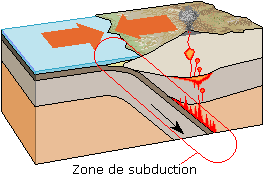
This is similar to the subduction zone off the West Coast of Costa Rica.

.
A long subduction zone can be found off the west coast of Costa Rica that is the cause of so much volcanic activity in the country that supplies the “Heat Engine” necessary to build deposits of gold.  This is not only applicable to Costa Rica, but anywhere on Earth where similar conditions are to be found.  The whole west coast of the Americas have subduction zones laying just off their west coasts producing gold deposits from superheated water associated with the volcanism.

Tuesday, July 19, 2011

Gold Occurrences in Tennessee

A piece of gold bearing copper ore from the mines at Ducktown Tennessee
Photo by Brian Stansberry


Most of the gold in Tennessee occurs in a narrow belt found in Monroe and Polk counties where they come into contact with the North Carolina border. For a distance of about fifty miles in the streams draining down from the Smoky Mountains placer gold deposits are formed.  According to reports placer gold has been discovered in the Caney Fork River around five miles below the Center Hill Dam.  Most of the gold recovered is found as small particles that are dust sized.  However, there are reports of larges sized nuggets as large as 2 or 3 ounces.

According to reports there have been a few nuggets recovered around Knoxville and further north in the area around Bristol, Tennessee.  Recent communications report that there is also gold found in the central Smokey Mountains to the northeast of Knoxville.  The author has seen some photographs of microscopic gold deposited in quartzite from this area.  Gold has also been recovered from the copper sulfide ores mined around the Ducktown area as a byproduct of copper and zinc mining.  

The bedrock map of Tennessee shows that the far eastern border of the state is in the Blue Hills province, a known gold producer that abuts the Valley and Ridge province immediately to the west.  The map indicates that the whole Smokey Mountain National Forest probably contains gold the problem is really one of the idea the place has never been properly prospected.

Bedrock Geological Map of Tennessee.  Most of the gold is found close to the North Carolina in the rock shown as brown. USGs


It was from the Valley and Ridge province where the author saw the photographs of gold in quartzite.  This is a perfect place to find gold as the quartzite and quartz pebble was eroded from mountains that were further east in the Piedmont province of North Carolina.  The Piedmont is peppered with gold mines, and it stands to reason some of this gold would have reached the Valley and Ridge province by the processes of erosion.

Gold has also been found at the Tellico plains as small grains eroded from bedrock of the nearby Unika Mountain on the border with North Carolina.  The Unika Mountains is where the gemstone Unikite is found.  This is a variety of granite with pink feldspar and green pisticite that is cut into cabochons.  The gold is found mixed with the soil from near the summit of the mountain in a stratum of soil that is from 10 to 12 inches deep.

Most of the Gold in Tennessee is found along the eastern edge of the state and rocks that are of Cambrian or pre-Cambrian age. Or also called on the western flank of the great Smoky Mountains as well as in the creeks a few miles east of not those Springs. Another place where it is found is in back of Chilhowee Mountain medicine bottle County. Gold is also found in Polk County on Citico Creek, Cane Creek, Coker Creek and the headwaters of Tellico River. Coker Creek in their own County produced nearly all the gold that has ever been found in Tennessee that according to some authorities about into a little less than $200,000 worth of gold.

Some of the best areas to prospect for gold in Tennessee are a narrow belt of stream gravels that are about 50 miles long in the southern part of Blount, Monroe and pull counties where they are alongside the North Carolina border. According to some authorities some of the best prospect in and be found in the rivers and creeks of Monroe County. Goals also found associated with the many copper mines of Polk County around the Copperhill-Ducktown Square is produced as a byproduct from the copper mines. 

Monday, March 28, 2011

On the Nature of Placer Gold

Gold is found in all the rivers of the world in sizes ranging from nuggets that can weigh several pounds to tiny flakes that are the size of a grain of flour. There is a size range between nuggets and flour gold that are called “pickers” because they can be picked up between the thumb and forefinger.

Although placer gold forms as particles weathered from existing bedrock that are concentrated into viable deposits by the action of running water in rivers or beaches, or by wind. In rivers gold is commonly found in places where there is a sudden decrease in the velocity of water causing the gold to fall out of the current. Gold has a specific gravity slightly higher than 19 when it is pure. It is this high specific gravity that causes gold to be carried down through a layer of sand and gravel to come to rest on the surface of the bedrock under the river. It is because of this fact that gold is rarely visible in a river. Gold is also found in aeolian deposits where the wind has blown away for lighter components of sand.

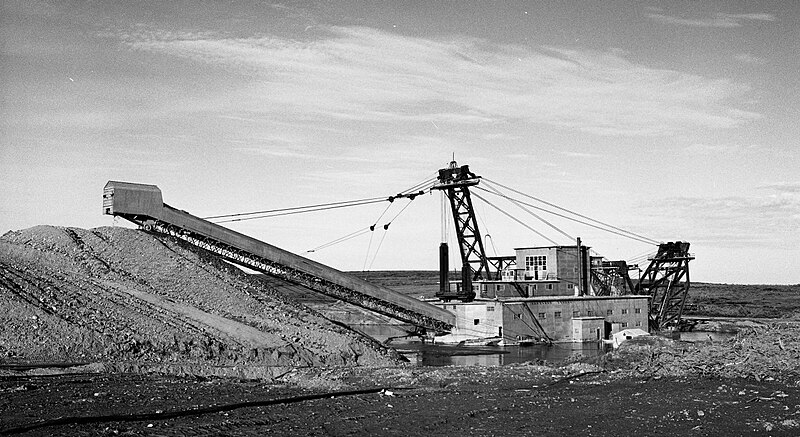
This is gold dredge No. 3 in Nome, Alaska the largest dredge in the world for mining placer gold.

Another type of placer deposit is formed in areas that have not been glaciated that are called saprolites. These deposits can be several hundred feet deep, and are composed of bedrock that has been subjected to a warm moist climate that has changed the rock into a mixture of clay and quartz leaving behind gold and a host of other insoluble minerals. In this case the gold is scattered throughout the entire depth of the deposit.

In all placer deposits gold is mostly found in the sand portion of the deposit gold nuggets are found in the gravel portion. Before the invention of metal detectors a great deal of gold was lost in the tailings pile because the miners classified the material they were working into sand. The gold nuggets were often discarded with the mine tailings, but are now being recovered by modern miners equipped with metal detectors.

Placer gold in a gold pan.
By alaskagold 
Although it is usually possible to recognize gold in placer deposits by its color. There are times when there is a thin film of metal oxide; usually iron or manganese that forms on its surface. Gold then takes on the appearance of the other black sands in the gold pan making it virtually impossible to recognize. This problem can be solved by treating the concentrate with vinegar or muriatic acid that dissolves the covering of metal oxides.

An old time prospector panning for gold.
By Tony Oliver

There is another type of gold that we are all familiar with these are the tiny specks that show up when we are finishing a pan of gold. These specks are so small that they float on the surface of water by surface tension and are called "floaters" by prospectors.  We normally lose them over the edge of the gold pan. This can be prevented by a single drop of dishwashing detergent added to the pan that causes these tiny specks to sink to the bottom where they can be recovered in the course of a regular cleanup.

Thursday, February 10, 2011

Gold Occurrences in Germany

The history of gold mining in Germany goes back to Neolithic times long before the Romans with the discovery of many gold artifacts dating back to that time. Although gold mining pre-dates the Roman Empire the first serious mining for gold in Germany was done by the Roman miners. The problem is identifying the places where gold was by in prehistoric times. From the discovery of objects made from gold it becomes quite obvious that during the second phase of mining in the Middle Ages was the time when much of the gold in Germany was produced.

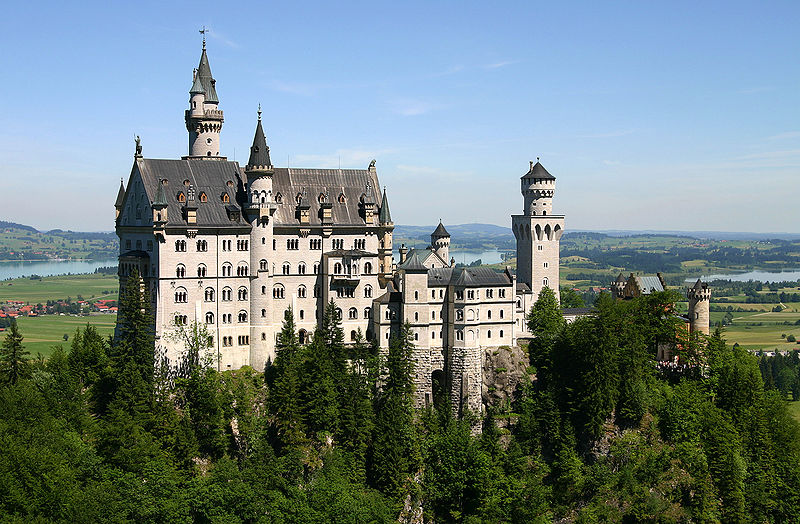
The area around Neusschwanstein Castle may be gold bearing.

It was during the same period that the first book on mining was published by Georgius Agricola (Georg Bauer), “Re de Metallica” that laid the foundation for the modern study of mining engineering, and still finds use as a historical reference book. It was during this period that Nuremburg rose to prominence as a mining and smelting center.

The discovery of the New World by Columbus in 1492 saturated the European market with gold so that the search for gold in Germany or Europe languished from that day on. Most of the Golden Germany is found in volcanic and metamorphic rocks of pre-Cambrian age. Other sources of gold in Germany can be placer deposits in the stream gravels of various streams and rivers. They are also found in what are considered fossilized gravel deposits of Paleozoic age especially in the foreland north of the Alps.

The Crown of Bavaria that could be made from German gold.

Another area of interest is the Mesozoic aged kupferschiefer deposits that occur in sandstone in veins up to a meter thick where the gold occurs as a byproduct of the copper sulfides found in these deposits. In this case the gold often occurs as a thin film between the crystals of the sulfide minerals.

Most of the evidence for gold comes from the discovery of pre-Colombian artifacts that are discovered during archaeological digs. At this point it appears that the number of gold deposits as large, but gold itself is sparse. There is a pretty good chance that more gold deposits may be discovered by a program of exploration using modern equipment and methods.

Wednesday, February 9, 2011

Gold Occurrences in New Jersey

The first mention of gold in New Jersey dates back to 1829 when gold was reported from the general area around Franklin. The report failed to mention whether this was lode or placer gold, but from the geological history of that area it could have been either. One of the features in New Jersey shares in common with all the other states of the northeastern United States is the possibility of placer gold being brought down from the Abitibi Gold Belt in Canada.
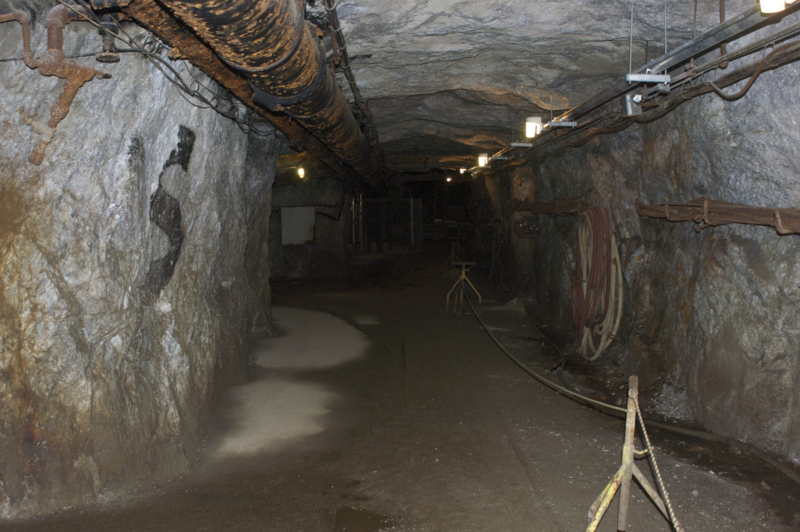
An adit in the Sterling Hill Museum at Sterling Hill, NJ

Gold has been reported in the ancient rocks of Grenvellian age from Sussex County associated with the iron deposits.  It has also been reported from the Schwangunk conglomerate from extreme western Sussex County in the vicinity of High Point, New Jersey.  The stone here is a conglomerate composed of quartz pebbles that is identical to the conglomerates of the Schwangunk Mountains of New York State.

Sussex County is also the home to some very rich zinc deposits at Franklin and Sterling Hill.  Although no gold was apparently found at these localities gold is often associated with zinc as a byproduct of the smelting process.  These zinc ores are contained in Precambrian marble with iron and manganese ores at times creating minerals containing both iron, manganese and zinc.  There have even been reports of corundum crystals being found in the same marble.

There have been reports of so-called gold mines in the past one notable example was in the Schuler Mine that showed some gold in quartz.  Many of the reported gold mines in Bergin County during the 19th century were actually scams. 

Southern New Jersey is covered with outwash composed of sand & gravel from the last glacier that came as far south as Staten Island where terminal moraines can be observed half way down the island.  There is a possibility that a small amount of gold may be present in the gravel topping the hills of Ocean County that was brought down from Canada by the glacier..

Although gold appears to be sparse in New Jersey there is otherwise a very rich history of mining for several other commodities including copper and silver in the Newark Basin basalts and sandstone. In the mid-19th century there were several mines producing copper and byproduct silver in this area of New Jersey

Wednesday, January 12, 2011

Gold Occurrences in New Hampshire

Too many of us the very thought of gold mining produces visions of the California gold rush or trekking into the Klondike during the Klondike Gold Rush. Our thoughts immediately bring up the picture of some grizzled old prospector with a donkey looking for gold in some far-off desert, or a frozen waste in some icebound part of the far North. To everyone's surprise gold is not unknown in the Granite State of New Hampshire.

When some New Hampshire miners return from the California gold rush they went poking around in the hills and mountains of their native state, and they discovered that both lode and placer gold could be found in them thar hills. Most of gold from the New Hampshire is located in Grafton County where it occurs as both veins in the country rock and is placer deposits in the rivers and streams of the county. Gold is found in many different geological environments ranging all the way from igneous rocks, metamorphic rocks, sedimentary rocks and then detritus such as sand and gravel or any other soil that is found in New Hampshire.         

A postage stamp of the Old Man of the Mountains New Hampshire's state symbol that used to be in Franconia Notch
Gold is considered a noble metal because it resists corrosion and any other kind of chemical weathering it is only dissolved by a mixture of nitric acid and hydrochloric acid that is called aqua regia or in solutions of alkaline metal cyanide usually in the form of potassium cyanide. It also combines with mercury to form a gold/mercury amalgamate. Many of its unique properties are taken advantage of in the process of refining gold. It is also the same standoff property from other elements that causes gold to be found in its native form sometimes almost pure, and at other times alloyed with silver in a pale brassy colored metal called electrum.

Gold Panning in New Hampshire  
Photo by Alan Souter

Gold is extremely malleable so that it can be beaten into thin sheets only a few atoms thick that are called goldleaf that is used for gilding many objects of art. It is the same property that forms gold nuggets it's in streams when the metal is being transported by water.

Gold is found in lode deposits where it is held loosely in the intracrystalline spaces in quartz veins as a special alloy with silver that is called electrum, As disseminated deposits like the deposits in Nevada's Carlin Trend where the gold is so fine it can only be seen with an electron microscope. The metal is also found is placer deposits in the beds of streams, or beach deposits and sometimes in stratified glacial drift.

Gold is one of the metals that tends to be fractionated from late stage hydrothermal fluids that form during the cooling of igneous rocks such as granite. In rock metamorphism gold tends to be quite mobile especially when the rocks hold an abundant amount of brine, usually a salty brine.

The Ammonoosuc River spanned by a covered bridge at Bath, New Hampshire

Gold is usually associated with granitic rocks, but also with those rocks that are known serpentinite that theoretically are fragments of rock from the ocean bottom that were originally basalt that have been altered into serpentine by the process of metamorphism. Another name for serpentinite is greenstone and it is assumed that greenstone contained gold that was leached out by the action of salt brine and deposited in quartz veins. One of the largest greenstone belts in the world is the Abitibi Gold Belt found in Québec and Ontario, Canada.

For the most part now that rocks that are now abundant in the state are usually found associated with the granitic rocks of the White Mountains. It is estimated that about 50% of the rocks in the state are metamorphic that in part are derived from rocks that were originally of volcanic origin.

Mount Washington from Bretton Woods
Photo by W. Woods

In New Hampshire most groundwater contains trace amounts of gold that is usually less than 1 ppb for the most part are of scientific interest only but can be used for geochemical exploration that is often be used for locating lode deposits of gold and other metals.
Although gold can be found widely dispersed across the entire state of New Hampshire to rocks that are of the most interest to the mineral exploration companies are those in which gold is finely disseminated in deposits similar to the Carling Trend of Nevada. Modern gold exploration is today centered on low-grade, large volume deposits than on high-grade deposits such as those found in quartz veins.

Such lode deposits however are an important source of specimens for the rock and mineral collectors that are found throughout the state. Placer gold is Gold that has been weathered out of rocks and has been transported by water and redeposited in the bed of streams. Placer deposits are often found on beaches or offshore marine sediments especially when they are near the mouths of rivers and streams entering the sea.

It would be nice if this gold was found in New Hampshire, but it came from Alaska
Photo by Alaskan Miner

In the state of New Hampshire recreational gold panners or the operators of sluice or rocker boxes and portable dredges are not regulated by New Hampshire statutes. However large-scale dredging and similar operations are regulated by the state understand statues RSA 482 -- A and RSA 485 -- a: 17 because of their potential for causing environmental damage. In all cases it is necessary to have landowner’s permission before commencing any gold covering operations on private property, and if you are planning any large-scale operations unit better contact the state first for the latest regulations.

You can get detailed information about permitting from:
New Hampshire wetlands Bureau
P.O. Box 95, Hazen Drive
Concord New, Hampshire 03302 -- 0095
Phone (603) 271 – 2147

The use of power equipment is not permitted in the White Mountains National Forest for the recovery of gold that includes sluice boxes, rocker boxes and dredges, but recreational gold panning is allowed.

Even though gold mining has never been done on a commercial scale in New Hampshire mining interest dates all the way back to colonial times with the possibility of a major gold find being found within the context of modern gold genetic models similar to the Carlin trend in Nevada.

There have been found in New Hampshire many anomalous occurrences of gold that were well documented by the mid-19th century. Many of these deposits were found by 49ers returning home from the California Gold Fields that realized many of the local rocks were similar to those that were found in the California Gold Fields. The first deposits that were found by these miners were along the Ammonoosuc River in Grafton County where even today it is possible to pan for gold. By 1864 there were several small mines that were open supporting 2 operations that produced about $50,000 worth of gold that at the time there was valued at $20 per ounce. This gold was shipped to the Philadelphia Mint before economic circumstances closed the mines.

A bit later in 1878 a smaller amount of gold that was shipped to the Philadelphia Mint that was produced at Diamond Ledge mine in Ossipee. The richest area in the state is centered on the Ammonoosuc district where it is found in veins of sulfide minerals such as pyrite for his free gold that is the positive in quartz veins, or dispersed in sheared chloritic schist.

The Ammonoosuc Gold District is centered on the towns of Lyman, Monroe and Bath. It can also be found in southwestern little plum, northwestern Landaff and Western Lisbon extending north to the Connecticut Lakes. Any of the streams running westward to the Connecticut River in this district are all likely to be gold bearing.


Tuesday, November 23, 2010

A Tool for Prospecting: The Gold Cube

Introduction to the Gold Cube:

The shores of Lake Superior contain gold in the form of small flat flakes that are hard to recover this is what Mike Pung while on a prospecting trip discovered in July 2009 while mining gold from the beaches of Lake Superior.  Instead of complaining Mike decided to do something about that gold.  From this trip to Lake Superior Mike invented a new way to recover virtually 90% of the placer gold in the world called the “Gold Cube.”

Mike’s invention is not a stand alone device, but is used with other gold mining equipment such as a high-banker or sluice box.  The final cleanup from the Gold Cube is a common gold pan.  The Gold Cube is used for the clean-up at the end of a gold mining expedition or used at home to process gold bearing sand at your leisure you have brought back from your last gold mining expedition.  The Gold Cube is made from a series of nesting trays that are 5 x 12 x 15 inches that are stacked in a zigzag fashion usually three segments high.  The Gold Cube is designed to work in about 90% of all gold bearing sands in the world.        

How it was invented:

When most people think of prospectors their minds turn right away to California during the 1849 gold rush, but they have plenty of modern compatriots these are people that hold another job, but go gold prospecting or mining during their time off. 

One of these gold miners was Mike Pung while prospecting for gold along the shores of Lake Superior in Upper Michigan.  Like all small scale gold miners Mike doesn’t want to say where, because it would quickly attract other miners possibly starting a gold rush like the one in Hemlo, Ontario a few years ago that is across Lake Superior on its opposite side.

The gold that is found on the beaches of Lake Superior was brought there by the great continental glaciers having their origin in Ontario where one of the great gold provinces of the world is located, the Abitibi Gold Province.  This is where most of the placer gold found in the northern mid-western states had its origin.

While working with a high-banker and a sluice box Mike had a bright idea to make the  gold miners life easier.  The result was the invention of the Gold Cube that was dreamed-up during a prospecting trip in July, 2009. 

What it does:

The Gold Cube is not a panacea for gold mining it is just one of many tools that have been developed over the years making the gold miner’s life easier.  As a tool the Gold Cube has been designed to recover a kind of gold that occurs as small flat flakes one of the most common kinds of placer gold in the world accounting for about 90% of all the placer gold in the world.  It will allow the miner to process about 1,000 pounds of gold bearing sand per hour with a very rate of gold recovery. 

How it works:

The gold cube has three stackable components made from low density polyethylene (LDPE) whose decks are permanently covered with a type of fabric used for making conveyor belts.  This particular fabric is one of the most effective gold traps in use.  The whole unit weighs about 20 pounds making it completely portable with three sections that are stackable in a zigzag configuration.  The top section has a built in hose connection using from 800 to 1,100 gallons per hour making completely usable in the field for cleanup mining operations.

Once the unit is setup with water running the gold bearing sand is fed into the Gold Cube one scoop at a time.  The running water carries the sand down through the zigzags trapping the gold on the fabric covered decks on the way down.  The unit has a further trick for the recovery of gold before the sand and water slurry can reach the next section a baffle on the bottom of section forces the mixture to rise up before it can reach the next segment.  This has a space in its bottom where gold can settle, and the lighter sand is carried on to the next segment.  The assembled Gold Cube will process about 1,000 pounds of gold bearing sand at 8 mesh size per hour.  

After the gold sand has been run the Gold Cube is disassembled and the individual segments are washed out in a tub of water.  What little is left in the bottom of the tub is mainly gold with some other heavy minerals that can be separated with a conventional gold prospectors pan.

How to get a Gold Cube:

Gold Cubes can be bought directly from their website goldcube.net The website has an excellent video showing the Gold Cube in action as well as many other sites of interest to placer gold miners.