Too many of us the very thought of
gold mining produces visions of the California gold rush or trekking into the Klondike during the Klondike Gold Rush. Our thoughts immediately bring up the picture of some grizzled old prospector with a donkey looking for gold in some far-off desert, or a frozen waste in some icebound part of the far North. To everyone's surprise gold is not unknown in the Granite State of
New Hampshire.
When some
New Hampshire miners return from the
California gold rush they went poking around in the hills and mountains of their native state, and they discovered that both lode and placer gold could be found in them thar hills. Most of gold from the
New Hampshire is located in
Grafton County where it occurs as both veins in the country rock and is
placer deposits in the rivers and streams of the county. Gold is found in many different geological environments ranging all the way from igneous rocks, metamorphic rocks, sedimentary rocks and then detritus such as sand and gravel or any other soil that is found in
New Hampshire.
 |
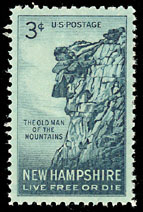
| A postage stamp of the Old Man of the Mountains New Hampshire's state symbol that used to be in Franconia Notch |
Gold is considered a noble metal because it resists corrosion and any other kind of chemical weathering it is only dissolved by a mixture of nitric acid and hydrochloric acid that is called
aqua regia or in solutions of alkaline metal cyanide usually in the form of potassium cyanide. It also combines with mercury to form a gold/mercury amalgamate. Many of its unique properties are taken advantage of in the process of refining gold. It is also the same standoff property from other elements that causes gold to be found in its native form sometimes almost pure, and at other times alloyed with silver in a pale brassy colored metal called electrum.
 |
Gold Panning in New Hampshire
Photo by Alan Souter |
Gold is extremely malleable so that it can be beaten into thin sheets only a few atoms thick that are called goldleaf that is used for gilding many objects of art. It is the same property that forms gold nuggets it's in streams when the metal is being transported by water.
Gold is found in lode deposits where it is held loosely in the intracrystalline spaces in quartz veins as a special alloy with silver that is called electrum, As disseminated deposits like the deposits in Nevada's Carlin Trend where the gold is so fine it can only be seen with an electron microscope. The metal is also found is placer deposits in the beds of streams, or beach deposits and sometimes in stratified glacial drift.
Gold is one of the metals that tends to be fractionated from late stage hydrothermal fluids that form during the cooling of igneous rocks such as granite. In rock metamorphism gold tends to be quite mobile especially when the rocks hold an abundant amount of brine, usually a salty brine.
 |
| The Ammonoosuc River spanned by a covered bridge at Bath, New Hampshire |
Gold is usually associated with granitic rocks, but also with those rocks that are known serpentinite that theoretically are fragments of rock from the ocean bottom that were originally basalt that have been altered into serpentine by the process of metamorphism. Another name for serpentinite is greenstone and it is assumed that greenstone contained gold that was leached out by the action of salt brine and deposited in quartz veins. One of the largest greenstone belts in the world is the Abitibi Gold Belt found in Québec and Ontario, Canada.
For the most part now that rocks that are now abundant in the state are usually found associated with the granitic rocks of the White Mountains. It is estimated that about 50% of the rocks in the state are metamorphic that in part are derived from rocks that were originally of volcanic origin.
 |
Mount Washington from Bretton Woods
Photo by W. Woods |
In New Hampshire most groundwater contains trace amounts of gold that is usually less than 1 ppb for the most part are of scientific interest only but can be used for geochemical exploration that is often be used for locating lode deposits of gold and other metals.
.
Although gold can be found widely dispersed across the entire state of New Hampshire to rocks that are of the most interest to the mineral exploration companies are those in which gold is finely disseminated in deposits similar to the Carling Trend of Nevada. Modern gold exploration is today centered on low-grade, large volume deposits than on high-grade deposits such as those found in quartz veins.
Such lode deposits however are an important source of specimens for the rock and mineral collectors that are found throughout the state. Placer gold is Gold that has been weathered out of rocks and has been transported by water and redeposited in the bed of streams. Placer deposits are often found on beaches or offshore marine sediments especially when they are near the mouths of rivers and streams entering the sea.
 |
It would be nice if this gold was found in New Hampshire, but it came from Alaska
Photo by Alaskan Miner |
In the state of New Hampshire recreational gold panners or the operators of sluice or rocker boxes and portable dredges are not regulated by New Hampshire statutes. However large-scale dredging and similar operations are regulated by the state understand statues RSA 482 -- A and RSA 485 -- a: 17 because of their potential for causing environmental damage. In all cases it is necessary to have landowner’s permission before commencing any gold covering operations on private property, and if you are planning any large-scale operations unit better contact the state first for the latest regulations.
You can get detailed information about permitting from:
New Hampshire wetlands Bureau
P.O. Box 95, Hazen Drive
Concord New, Hampshire 03302 -- 0095
Phone (603) 271 – 2147
The use of power equipment is not permitted in the White Mountains National Forest for the recovery of gold that includes sluice boxes, rocker boxes and dredges, but recreational gold panning is allowed.
Even though gold mining has never been done on a commercial scale in New Hampshire mining interest dates all the way back to colonial times with the possibility of a major gold find being found within the context of modern gold genetic models similar to the Carlin trend in Nevada.
There have been found in New Hampshire many anomalous occurrences of gold that were well documented by the mid-19th century. Many of these deposits were found by 49ers returning home from the California Gold Fields that realized many of the local rocks were similar to those that were found in the California Gold Fields. The first deposits that were found by these miners were along the Ammonoosuc River in Grafton County where even today it is possible to pan for gold. By 1864 there were several small mines that were open supporting 2 operations that produced about $50,000 worth of gold that at the time there was valued at $20 per ounce. This gold was shipped to the Philadelphia Mint before economic circumstances closed the mines.
A bit later in 1878 a smaller amount of gold that was shipped to the Philadelphia Mint that was produced at Diamond Ledge mine in Ossipee. The richest area in the state is centered on the Ammonoosuc district where it is found in veins of sulfide minerals such as pyrite for his free gold that is the positive in quartz veins, or dispersed in sheared chloritic schist.
The Ammonoosuc Gold District is centered on the towns of Lyman, Monroe and Bath. It can also be found in southwestern little plum, northwestern Landaff and Western Lisbon extending north to the Connecticut Lakes. Any of the streams running westward to the Connecticut River in this district are all likely to be gold bearing.
.