Total Pageviews

Showing posts with label North Carolina. Show all posts

Tuesday, July 19, 2011

Gold Occurrences in Tennessee

A piece of gold bearing copper ore from the mines at Ducktown Tennessee
Photo by Brian Stansberry


Most of the gold in Tennessee occurs in a narrow belt found in Monroe and Polk counties where they come into contact with the North Carolina border. For a distance of about fifty miles in the streams draining down from the Smoky Mountains placer gold deposits are formed.  According to reports placer gold has been discovered in the Caney Fork River around five miles below the Center Hill Dam.  Most of the gold recovered is found as small particles that are dust sized.  However, there are reports of larges sized nuggets as large as 2 or 3 ounces.

According to reports there have been a few nuggets recovered around Knoxville and further north in the area around Bristol, Tennessee.  Recent communications report that there is also gold found in the central Smokey Mountains to the northeast of Knoxville.  The author has seen some photographs of microscopic gold deposited in quartzite from this area.  Gold has also been recovered from the copper sulfide ores mined around the Ducktown area as a byproduct of copper and zinc mining.  

The bedrock map of Tennessee shows that the far eastern border of the state is in the Blue Hills province, a known gold producer that abuts the Valley and Ridge province immediately to the west.  The map indicates that the whole Smokey Mountain National Forest probably contains gold the problem is really one of the idea the place has never been properly prospected.

Bedrock Geological Map of Tennessee.  Most of the gold is found close to the North Carolina in the rock shown as brown. USGs


It was from the Valley and Ridge province where the author saw the photographs of gold in quartzite.  This is a perfect place to find gold as the quartzite and quartz pebble was eroded from mountains that were further east in the Piedmont province of North Carolina.  The Piedmont is peppered with gold mines, and it stands to reason some of this gold would have reached the Valley and Ridge province by the processes of erosion.

Gold has also been found at the Tellico plains as small grains eroded from bedrock of the nearby Unika Mountain on the border with North Carolina.  The Unika Mountains is where the gemstone Unikite is found.  This is a variety of granite with pink feldspar and green pisticite that is cut into cabochons.  The gold is found mixed with the soil from near the summit of the mountain in a stratum of soil that is from 10 to 12 inches deep.

Most of the Gold in Tennessee is found along the eastern edge of the state and rocks that are of Cambrian or pre-Cambrian age. Or also called on the western flank of the great Smoky Mountains as well as in the creeks a few miles east of not those Springs. Another place where it is found is in back of Chilhowee Mountain medicine bottle County. Gold is also found in Polk County on Citico Creek, Cane Creek, Coker Creek and the headwaters of Tellico River. Coker Creek in their own County produced nearly all the gold that has ever been found in Tennessee that according to some authorities about into a little less than $200,000 worth of gold.

Some of the best areas to prospect for gold in Tennessee are a narrow belt of stream gravels that are about 50 miles long in the southern part of Blount, Monroe and pull counties where they are alongside the North Carolina border. According to some authorities some of the best prospect in and be found in the rivers and creeks of Monroe County. Goals also found associated with the many copper mines of Polk County around the Copperhill-Ducktown Square is produced as a byproduct from the copper mines. 

Friday, March 4, 2011

Gold Occurrences in North Carolina

Gold was discovered in North Carolina in 1799 by an 11-year-old farm boy named Conrad Reed who was fishing in the creek that ran across this father's property. He was fishing in the creek when something that was yellow and shiny caught his eye, so he took it from the creek  and brought it home where for several years it was used as a door stop. It was actually a gold nugget that weighed 17 pounds, but nobody in his family was able to identify what the mystery stone was. From that time on gold is an important part of North Carolina's history.

Reed was one of the many Hessian soldiers that deserted from the British Army during the Revolutionary war and took up farming in North Carolina. Although he was unable to identify what the mystery stone was, but by being a practical man when he was offered $3.50 by a local jeweler he accepted the offer. It wasn't until later that he found out with the mystary stone really was that led to a suite where Reed was eventually awarded $1000.

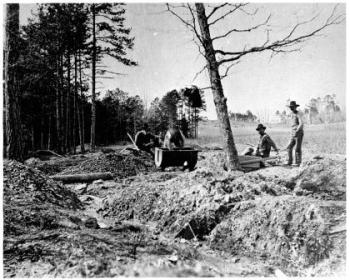
Panning for gold in North Carolina

The first gold mine in the state was established in 1803 that would make North Carolina the only state producing gold until 1828. It remained nation until the discovery of gold in California in 1848. The gold rush of 1849 into North Carolina's reign as the leading gold producing state of the nation although gold is still produced in the state mainly by weekend miners and prospectors.

Although there are placer gold deposits to be found in North Carolina most of the early mines were in hard rock where some of them extended as far as 400 feet into the earth. One of these mines located at Gold Hill eventually reached a depth of 800 feet in 1857.

North Carolina is located in the gold pyrite belt of the Southern Appalachian's that reaches from Maryland to Alabama. In North Carolina it includes the Piedmont and the Blue Ridge Mountains. The last significant amount of gold that was produced in North Carolina was as a byproduct from copper mining in the Blue Ridge Mountains.

Amalgamation tables at the Reed Gold Mine in North Carolina 

Gold is still being produced in North Carolina by small-scale miners and weekend prospectors that even though they don't get much gold for their efforts they are at least rewarded with a few colors of gold at the bottom of their gold pans.