Total Pageviews

Showing posts with label africa. Show all posts

Monday, June 18, 2012

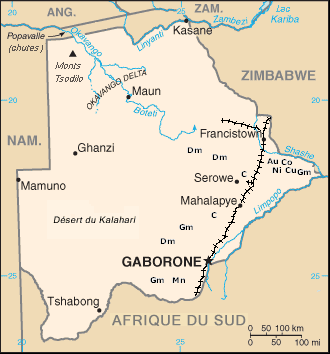
Gold Occurrences in Botswana


Mining in Botswana


Although gold is mined in Botswana since the early 1990s diamond production has led the pack with most of the diamonds produced were of gem quality.  This made the country the world’s leading producer of diamonds by dollar value.  Other minerals produced included gold, copper-nickel matte and soda ash.  During 2005, mining accounted for about 38% of the country’s Gross Domestic Product (GDP) with more then 50% of the government’s revenue coming from the mining industry.

Almost two thirds of Southern Africa including Botswana is composed of rocks of the Karoo Supergroup and most of the rest of Southern Africa.  The rocks are deposited in a series of basins in which the deposits had their origin in the formation and breakup of Pangea. The strata in the main crew consists mainly of shales and sandstones that record an almost continuous sequence of marine deposits ranging from glacial to terrestrial the presentation from the late Carboniferous through the early Jurassic for a period of about 100 million years.

The sediments accumulated in a retroarcforeland basin, these sediments are called the named Main Karoo with a thickness of about 12,000 km. They are overlain by basaltic lavas of the Drakensberg group. The basin was formed by the subduction and orogenesis that occurred along the boundary of Gondwana and the Panthalassan Sea, paleo – Pacific. The basalt layers are approximately 1.4 km thick.

A subsidiary of Gallery Gold called Mupane Gold operated the Mupane gold mine that was located about 30 km south of Francistown. This gold came from the Tau pit, and after mid-year production came from the oxide zone of the Tholo pit. Gallery gold continued exploring other gold prospect in the area of the Mupane mine including several other prospects.

One company suspects there are outlaying members of the Witwatersrand underlying parts of the Karoo formation, but that are and there is an active drilling program that is being undertaken.

Tuesday, May 15, 2012

Gold Occurrences in Uruguay


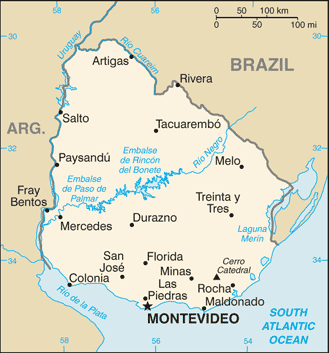
Map of Uruguay


Until 1997 gold was not mined in Uruguay although the potential for finding it existed and a gold mine named El Arenal in Rivera where a $30 million investment created a mine that was expected to last for six years.  This start-off created a sustained growth in the mining industry that is still ongoing.

Although Uruguay has long been noted for its exploitation of non-metallic industrial minerals it has only been within the past few years that metallic minerals have been exploited.  That coupled with significant foreign investment has brought about a rise in production.  The processing of granite is one of the benefactors of this as well as the production of gemstones especially large amethyst lined geodes some as large as houses and other metallic minerals.

Uruguay is a country that has been little explored until recently with the outlook promising for further exploration.  The future of the mining industry in Uruguay is very forward looking with many licenses for mineral exploration having been granted in recent years with national interests driving the further exploration.  Attracting foreign investment is one of the aims of the present government.

Before the continents of Africa and South America split apart millions of years ago Uruguay was joined to Namibia in Africa making it entirely that both gold and diamonds could be found in the country.

Although there are no volcanoes today in Uruguay there is plenty of evidence of past volcanoes and volcanism.  The amethysts are associated with vast flows of basalt that heralded the splitting of the continent of Gondwanaland when the Atlantic Ocean opened during the Triassic/Jurassic to form today’s deposits of basalt.  Earlier volcanic activity occurred during the Precambrian.  These episodes of ancient volcanism provided the heat engines to cause gold to be deposited in favorable places.

Although gold is known to exist in Uruguay it still remains one of the most under-explored countries on the face of the earth.  There is known gold that has already been contracted to a Canadian Mining Company and there are at least two other areas containing gold that haven’t been let out on contract as of yet.  Today the country is like a treasure chest waiting to be opened.

Tuesday, February 15, 2011

Gold Occurrences in Madagascar

Although in the past Madagascar was a significant gold producer but because of its tumultuous political history for many years it remained in the doldrums. Today Madagascar is considered to be an up-and-coming place for mining now the political situation has become more stable. Today Madagascar has become a beacon for the mining and exploration industry that right now is largely undeveloped.

Madagascar is shown in red.

For those who don't know where Madagascar is, is approximately 400 km due east of the African mainland. It is separated from Africa by the Mozambique Channel.

Although the island has a vast potential for hosting valuable mineral deposits right now the country does not have a well-developed mining industry. As little as 30 years ago it was one of most geologically studied areas in the African region, but then the country underwent a period of political instability resulting in mineral exploration being put on the back burner. It wasn't until 1993 that the political instability vanished when the country returned to a liberal democratic form of government. It wasn't until recently however, that it began to regain some of the lost footing it once had in exploration and mining.

Although Madagascar is considered to be a part of the African Continent the island geologically is a micro-continent between Southern Africa and India. This becomes readily apparent when you start looking at the local geology and the flora and fauna. The geology of the island is more akin to that of Sri Lanka and India that is anything found in Africa.

Madagascar's primary gold deposits are similar to those of the Abitibi region of Canada than anything else. Like the Abitibi the gold is associated with greenstone belts, quartz reefs and veins, and is also found the fuse for the country rock in deposits similar to those of the Carlin Trend in Nevada.  There is a great deal of gold that is also associated with that volcanogenic massive sulfide (VMS) deposits similar to those that are found at the kidd Creek Mine in Timmins, Ontario or the Horne Mine in Rouyn-Noranda, Québec. Both of these mines are in the Abitibi Gold Belt of Canada.

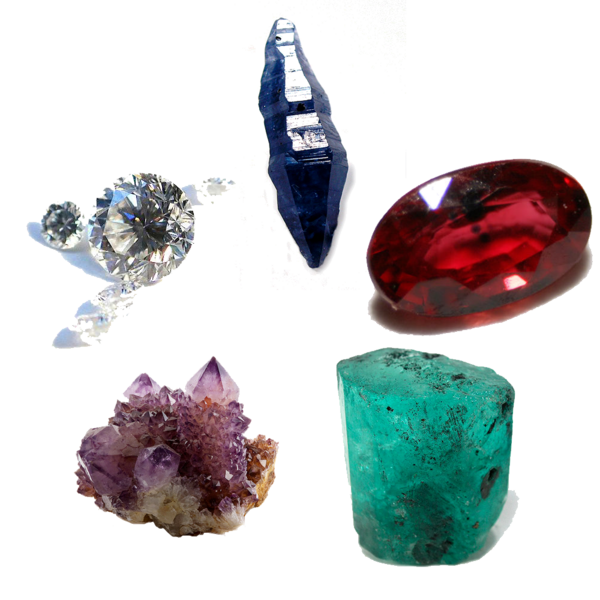
Gold isn't the only thing found in Madagascar that is worth money.
Photo by Rob Lavinsky

Alluvial gold is also been recovered from both ancient and recent placer deposits as well as lateritic earth. Aside from the gold deposits found in Madagascar is also the home of many valuable gemstones including those of the ruby and sapphire family that are mined mainly by artisanal miners although in some cases a few of these mines have been mechanized.

Although the primary gold deposits found on the island predate the breakup of Gondwana one of the two continents that made up the supercontinent Pangaea. This is very important to remember because it makes the regional tectonics arrival into the emplacement of gold deposits. Madagascar's gold bearing rocks are all part of its suite of basement rocks. These rocks are divided into three different systems with the youngest being the Vohibory System, the middle is the Graphite System and the oldest is the Androyen System. Most of the gold however is found in the graphite system. There are also some interesting gold deposits in the Vohibory System.