Total Pageviews

Showing posts with label diamonds. Show all posts

Monday, June 18, 2012

Gold Occurrences in Botswana


Mining in Botswana


Although gold is mined in Botswana since the early 1990s diamond production has led the pack with most of the diamonds produced were of gem quality.  This made the country the world’s leading producer of diamonds by dollar value.  Other minerals produced included gold, copper-nickel matte and soda ash.  During 2005, mining accounted for about 38% of the country’s Gross Domestic Product (GDP) with more then 50% of the government’s revenue coming from the mining industry.

Almost two thirds of Southern Africa including Botswana is composed of rocks of the Karoo Supergroup and most of the rest of Southern Africa.  The rocks are deposited in a series of basins in which the deposits had their origin in the formation and breakup of Pangea. The strata in the main crew consists mainly of shales and sandstones that record an almost continuous sequence of marine deposits ranging from glacial to terrestrial the presentation from the late Carboniferous through the early Jurassic for a period of about 100 million years.

The sediments accumulated in a retroarcforeland basin, these sediments are called the named Main Karoo with a thickness of about 12,000 km. They are overlain by basaltic lavas of the Drakensberg group. The basin was formed by the subduction and orogenesis that occurred along the boundary of Gondwana and the Panthalassan Sea, paleo – Pacific. The basalt layers are approximately 1.4 km thick.

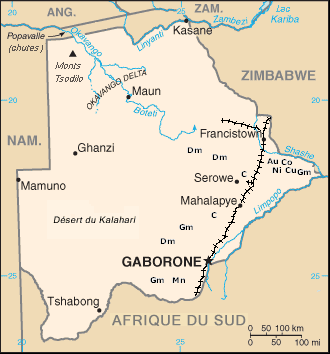
A subsidiary of Gallery Gold called Mupane Gold operated the Mupane gold mine that was located about 30 km south of Francistown. This gold came from the Tau pit, and after mid-year production came from the oxide zone of the Tholo pit. Gallery gold continued exploring other gold prospect in the area of the Mupane mine including several other prospects.

One company suspects there are outlaying members of the Witwatersrand underlying parts of the Karoo formation, but that are and there is an active drilling program that is being undertaken.

Thursday, June 7, 2012

Gold Occurrences in Benin


Map of Benin


Mineral resource development is controlled by the Office BĂ©ninoise des Mines (OBEMINES). Benin has been revising its mining laws in order to attract foreign investment.

Benin has gold, iron ore and phosphate potential and has awarded several exploration licenses for gold exploration in the country to foreign investors. There are deposits of brick and china clay, feldspar, the Loumbu Loumbo low grade iron ore deposits and the Mekrou phosphate deposits. The development of the Loumbu Loumbu and Mekrou deposits hinges on the proposed development of a hydro electric power scheme that is to be constructed on the Mekrou River. Gold mineralization has been identified in the Atacora and Alibori regions, where hard rock and alluvial deposits are known to exist. At Alibori, a 350 km2 prospective area includes alluvial and vein hosted gold occurrences.

Major sources of alluvial gold and diamonds can be found in the Birimian rocks that are found in Ghana, the Ivory Coast, Mali and Burkina Faso   These rocks derive their name from the Birim River thay are one of the main tributaries of the Pra River of Ghana.  The same rocks also contain the country’s most important diamond deposits.  Diamonds are produced in Ghana and Mali that are the second and third largest producers in Africa.

The gold and diamond bearing rocks are called the Birimian Terranes that are composed of a mix 0f meta-volcanics, meta-sedimentary and rocks that are plutonic in nature.  Almost half of the rocks found in the southern part of the West African Craton are alkaline granites.  These rocks formed in a period of about 50 million years between 2,200 and 2,100 Ga years ago.

It is believed the Birimian Rocks that stretch across the countries that are to the north of the Gulf of Guinea formed when a series of island arcs were driven together forming a series of parallel belts that trend to the northeast in a belt that is about 40 to 50 kilometers wide.  Many of the volcanic rocks have been metamorphosed into greenschist facies.

Although most of the gold mined in the country is recovered by artisanal miners from the Birimian Terrane it has recently discovered more gold is found in the overlaying conglomerate of the Tarkewian formation.  The gold does not have its origin in the Birimian Terrane. 

There are several varying theories about the origin of the Birimian Terrane.  One theory holds the rocks were formed by the collision of the Archean Cupixi-Carajas craton of the Southern Guiana Shield.  Another theory that is more widely accepted is the terrane has it origins in a mid-oceanic series of volcanic island arcs that formed a crust that was then thrust faulted onto the West African Craton that was later compressed into a series of folds.

During the recent civil war in Benin foreign investment literally dried up, but with the onset of peace it is beginning to flow once again.

Friday, June 24, 2011

Gold Occurrences in Missouri

The only part of Missouri where gold is found is in the counties bordering the Missouri River where gold was brought down from Canada by the glaciers.  The gold was left behind when the last glacier melted about 12,000 years ago.  Whatever gold is found is extremely, what miners call flour gold that won’t support a commercial operation, but is a lot of fun to find anyways.

This is gold found in terminal moraines that formed where the glacier was continuously melting in one place that are recognized by their hummocky appearance and many sand & gravel deposits. The Gold deposits are often accompanied by diamonds that are more likely to be found in payable amounts throughout the areas where glaciers once trod.  Diamonds are another example of the many riches brought down from Canada by the glaciers.

Gold is found as panable deposits along the sand bars that line the Chariton River and its tributaries.  It has also been found at Kirksville in Adair County in sand and gravel deposits. In Macon County there are two areas containing gold one of these is near the town of Elmer where gold is found in Murray Gulch.  Around the town of Gifford gold has been discovered in glacial deposits.

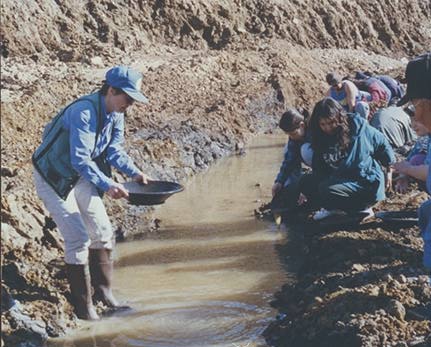
A group being taught how to pan for gold. 
The advice given by many geologists is not to spend too much time looking for gold in Missouri because you will be wasting your time.  That doesn’t mean that Missouri is bereft of minerals because there are mineral deposits scattered throughout the state.  The area around Joplin used to be the scene of extensive deposits of lead and zinc.  These mines are now closed, but there are plenty of mineral specimens to collect in the area.

Saturday, January 1, 2011

Gold Deposits of India

Although India is by far the greatest importer of gold in the world it has a very poor gold mining industry. There are however, some gold mines that are active including the Kolar Goldfields in Karnataka, the Dona block in Andra Pradesh, the Bansawar district in Rajasthan and Madhya Pradesh.

The Champion Reef Mine in the Kolar Gold Field of India
It has been estimated by the Geological Survey of India (GSI) that there are more then 20,000 metric tons of gold spread across several states of India causing the Indian government to askthere the GSI to explore for additional reserves that can be tapped in Andhra Pradesh, Karnataka, Madhya Pradesh, West Bengal, Rajasthan, Bihar and Chhattisgarh.

The Indian government is concerned over its dependence on imports of gold into the country where India has been the top importer of gold in the world for several years. This concern was increased by the recent economic downturn when the price of gold shot up to $1,000 per ounce in the international markets, and is recently traded for over $1,400 per ounce in US dollars.

This is prompted the Indian government to give the GSI three years in which to explore the possibilities of being able to tap the estimated 14,000 tonnes of gold they presently have which should be increased to 20,000 tonnes in the next three years. As well as gold the Indian government also wants the GSI to explore for diamonds.

The Hope Diamond originally from Golconda, India

There are several overseas companies that are in talks with the Indian government for gold mining and exploration including Indogold, Anglo-American Gold Mining, Monarch Gold Mining, De Beers India Ltd., Rio Tinto Exploration Ltd and BHP minerals.

At the present time the Indian government is using all the initiatives it has to expedite the efforts to unearth valuable minerals like gold and diamonds. Right now in India produces hardly 4/10 of 1% of the Golden consumes despite having about 9% of all the gold reserves in the world within its borders.

Under Indian law presently foreign companies rarely invest in India because they cannot sell the data they map and can only use it if they open the mines themselves. The new mining policy however, is expected to open the mining sector to foreign investment. Under the new rules that have been suggested to approvals for most minerals must be made of about a year or will be automatically referred to a tribunal.

At present international gold companies are looking to form joint ventures with gold exploration firms in India enabling them to launch new exploration projects. It is in southern India in the Deccan region where it's been assumed as a result of some surveying or largest deposits of gold might be found.