Total Pageviews

Showing posts with label gold mines. Show all posts

Friday, December 23, 2011

Gold Mines of the Future


An underground waterfalls inside a gold mine.  Crusier


Future gold mines and mines in general haven’t changed much except incrementally in more then a century, a situation that has to change as mines keep getting deeper and hotter.  Theoretically it is possible to reach depths of 33,000 feet using existing technology, but at these depths human miners are not able to work efficiently calling for other technologies not depending on man.  There have been many advances in the scienceof robotics that may fill some of these needs, but other technologies are going to be needed too.  The engineering department of Laurentian University in Sudbury, Ontario is one of many organizations working on the problem of developing the Future Mine work is progressing at both the university level and in the R&D labs of mining companies.

One of the first things to vanish from mines in the future is the headframe that has been a hallmark of underground mines for centuries.  The mine hoist will no longer be needed as in most mines the hoist and cables will be replaced with a Maglevsystem similar to that used today on Maglev railroads.  There is no reason why the Maglev system won’t work vertically as well as horizontally.

Explosives that have been used in mines since the 17th Century are another thing that is apt to be replaced by a system developed by Noranda Mines that makes use of high energy electricity that is stored in powerful condensers where the power is channeled into a drill hole filled with water that is ionized by having the electrical charge funneled into a thin copper wire between to steel rods.  The resulting explosion caused by the ionized water is extremely powerful capable of pulverizing rock, and is far safer to use then conventional explosives.

The Tunnel Boring Machine (TBM) has already been successfully used for boring many tunnels throughout the world, one place where it has been used is in New York City where it has cut the tunnels for the New York Water Tunnel #3 that is 28 feet in diameter and many miles long.  Variations of this system can be used to replace the system of drill and shoot that is presently used.  The use of the TBM allows very small suzes some as small as a beer can used to follow small veins in the rock that are overlooked during today’s mining techniques.

One thing that is certain as man goes further into the Crust of the Earth in his quest for minerals man himself is apt to be left behind replaced by robots.  Human miners will become redundant.  One visionary even sees robots the size of ants being used in future mines that would spat a bacteria charged solution onto ore bearing rock that would dissolve the metals that then would be recovered from the resulting solution.  Things they are achanging!

Thursday, June 16, 2011

Gold Occurrences in Texas

A worker in a gold mine


Gold was first discovered by the Spaniards in Texas in 1756 where they discovered gold and silver on Riley Mountain. They made their discovery of gold in the central mineral district around the Llano Uplift. It was in the same area that the Spaniards discovered the lost San Saba Gold Mine that according to tradition was worked by Mexican miners after they gained their independence from Spain sometime in the early 1800s. The Spaniards lacked any technology to keep mines from flooding caused by the inrush of groundwater. This was the reason why the Spaniards limited their mining to those areas that were above the water table causing these mines to exist as long trenches that have long since been eroded away. The consequences of this weathering are that today these old gold mines are hard to find, and for the most part were operated as placer deposits.

The peculiar thing about the Llano Uplift is because it is composed of Grenville aged rocks that are around 1.2 billion years old that are actually an extension of rocks that are often found in the Appalachian Mountains instead of the Rockies. It is in these ancient rocks that gold is found usually in small deposits that are quite numerous; these deposits are similar to those that were found during the Klondike Gold Rush where the gold had eroded from the rocks and formed large placer deposits.

In many of the rivers and streams that drain the Llano Uplift placer gold can still be found. There have been tales of gold occurring in this area for the past 250 years many of these tales are more credible than others. It is tales of this sort to drive the prospecting business even though gold is found in small quantities throughout the area. It is the hope of virtually all prospectors that they will eventually strike a Bonanza or even find El Dorado itself.

The Llano uplift itself is pre-Cambrian in age, but is surrounded by rocks of Paleozoic age making it  very similar to the Gold Belt of the Southeastern United States. Most of The state is an ocean of sedimentary rocks having an occasional outcrop of older crystalline rocks. It is in these rocks that you are apt to find gold. Gold can be found in rocks of both the Proterozoic and Phanerozoic ages.

The rocks found in the hills overlooking Presidio in the Rio Grande Valley are probably closely related in age to the Central Texas Mineral Region. With sedimentary rocks you often find a situation where occasionally older rocks do get exposed at the surface. This was what is happening here as well in the southern gold belt (Piedmont) in the Appalachian Mountains.

On the southern flank of the Chinati Mountains overlooking Presidio is the Prasidio Mine that was active from 1880 until 1942 when the War Production Board closed all the gold mines in the United States to free the gold miners for other wartime production. This one mine produced 92% of the silver and 73% of the gold ever produced in Texas.

There is also gold associated with a sandstone of Eocene age located in the Gulf Coastal Plain. This is gold that probably eroded out of the Llano Uplift rocks.

Nowhere in the state however is gold mining ever been extensive because the amount of metal available in the state appears to be limited. The Presidio and Hazel mines in West Texas and the Heath mine Llano have produced a total of 8,277 ounces of gold that end in 1942 when the government closed on all gold mines in the United States as part of the war effort during World War II. The last minute was in production in Texas was the Presidio mine where production and that in 1942.

Sunday, March 6, 2011

Gold Occurrences in South Carolina

Although gold mining operations reportedly ceased in South Carolina in 1990 at the Hailie Mine because it became too deep to work with the technology of those days, but recently a Canadian mining company has taken an interest in the mine and is reopening it.

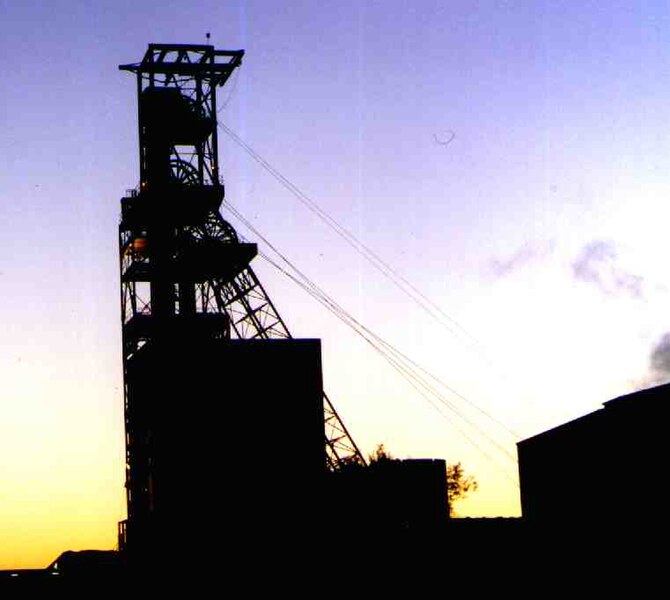
The headframe of a goldmine at sunset.
Photo by Babakathy

Gold was first discovered in South Carolina in 1827 as part of the gold belt that extends all the way from Maryland to Alabama where gold is found in both placer lode deposits. The South Carolina geological survey lists over 130 gold mines or prospects in the state. Even though many of these mines are now closed there is still an active group of small-scale miners and prospectors that are continually finding gold in many of the creeks and branches of the state. Recently several large gold mining companies have taken interest in some of these mines. The gold belt that extends across central South Carolina is part of the gold pyrite belt that is found in the Piedmont and Blue Ridge Mountains of the the Southern States.

Although the gold is no in South Carolina is originally came from Morocco were a piece of that country was plastered onto the East Coast of North America during the Appalachian orogeny that created the southern Appalachians. The same orogeny carried with it but some pieces of oceanic crust that created the greenstone belts in the southern Appalachians that is the source of much gold and other mineralization that is found in South Carolina.

Most geologists feel this oceanic crust was the bearer of gold that has been found in the region that was activated by a late Permian to the early Jurassic thermal event the mobilized goals of the greenstone belt and caused it to be deposited in quartz veins and all types of rock in the affected area.

South Carolina gold is found in the following counties of the state:

“Abbeville, Anderson, Cherokee, Chesterfield, Fairfield, Greenville, Greenwood, Kershaw, Lancaster, Laurens, McCormick, Newberry, Oconee, Pickens, Saluda, Spartanburg, Union and York.”


Saturday, March 5, 2011

What to do with an old Gold Mine

What to do with an old Gold mine was and probably faced not only the Homestake Mining Company, but the citizens of Lead, South Dakota when the world-famous Homestake Mine was closed in 2002 because of the then declining price for gold and the fact the mine was over 8000 feet deep making it the largest and deepest gold mine at the time in North America.

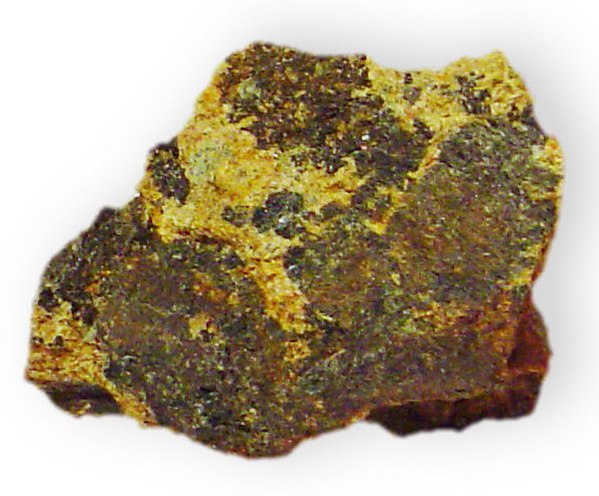
Gold ore from the Homestead Mine composed of cummingtonite and chlorite from the 4,500 foot level where the new laboratory will be located.   Photo by Dave Dyet

Even before it closed the Homestake mine was famous in the scientific community for being the site at which the solar neutrino problem was finally solved. At the time it was known as the Homestake Experiment where deep underground laboratory was set up by Raymond Davis Jr. during the mid-1960s where Davis set up the first experiment to observe solar neutrinos.

The Open Pit mine at the Homestake Mine site in Lead, SD
Photo by Rachel Harris

Five years later on July 10, 2007, the Homestake mine was selected by the National Science Foundation for its new deep underground science and engineering laboratory (DUSEL) where it won out over several other candidates that include the Henderson mine near Empire, Colorado. When it is completed the DUSEL facility will carry on with the early work was undertaken by Davis for the ultra-low background experiments on dark matter and neutrinos. The site will also include other laboratories for biology, geology and mining research.

Thursday, March 3, 2011

Gold Occurrences in Virginia

The first printed reference the gold being found in Virginia was in 1782, when it was reported by Thomas Jefferson involving a 4 pound piece of gold bearing rock that was found on a north side of the Rappahannock River at a distance of about 4 miles below its falls. This was only the first report because gold was produced in Virginia amounting to about 100,000 troy ounces dating from 18 42 1947 when the last of the over 301 gold mines and prospects in the state closed down.

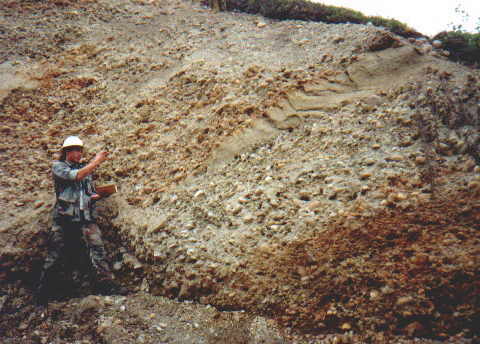
Alluvial (Placer) Gravel containing placer gold.
Photo by Dennis Garrett

The bulk of this gold was discovered in the so-called Gold-Pyrite Belt that essentially includes the Piedmont and the eastern slopes of the Blue Ridge Mountains. By May of 1995 the division of mineral resources had documented 301 mines and prospects producing gold and silver or places where they are known to have occurred.

Besides the placer deposits that are found in the areas of the Piedmont and Blue Ridge Mountains that contain gold; it is also found as free gold in quartz veins, or it may occur with pyrite as thin films on the crystal faces between individual pirate crystals. Gold also is known to occur as an alloy with other base metals in various massive sulfide deposits. It is the weathering of these kind of deposits that produces placer gold that can occur as grains, flakes or sometimes even nuggets of free gold.

The first lode deposit of gold that was discovered in Virginia occurred during 1806 at the Whitehall mine that was 1.5 miles to the northwest of the Shady Grove Church in the western part of Spotsylvania County. The Virginia Mining Company of New York has the title of being the first mining company in Virginia to produce lode gold. This company operated a lode deposit of gold in the so-called “Grasty” tract along Mine Run in Orange County for over 100 years from 1831 to 1934 of over a century. Old records show that at least five mining companies operated in the general area in period from 1831 until 1910 having several different episodes of substantial mining activity.

During the early 1800s: Virginia was often extracted from what are termed shallow saprolites that were formed by deep weathering of the rock that contained lode gold. The type of gold mining that occurred in these deposits was relatively simple because labor was cheap so they were able to use hand shoveling; panning, sluicing and dredging that could be accomplished without any further processing. This type of deposit is able to produce gold at a profit in 1837 if there was a dollar's worth of gold available from every bushel of ore. At the time it was estimated the cost of mining 100 pounds of rock was about $.35 per bushel. Deposits of this type were mined until the deposits were exhausted.

Once saprolite deposits were used up the miners had to resort to underground mining methods for the recovery of gold. Operating in underground gold mine is far more expensive than working placer deposits because the ore is in the form of a hard rock that has to be pulverized before any kind of recovery system can be used. During the decades preceding the Civil War it has been estimated that lode gold mines of Virginia produced about 3000 ounces of gold every year.

It was the California Gold Rush of 1849 that really spell the death knell to gold mining in Virginia because many of the miners moved to California allowing gold production in Virginia to decline. During the Civil War gold mining operations throughout the South were destroyed as a matter of policy by the Union Army.

During a meeting of the Prospectors and Developers Association of Canada (PDAC) in early March of 2008 the author was speaking with some other mining executives where it was revealed that one of the main targets for exploration in the near future would be in the southern Appalachians. Even if the big boys haven't arrived yet there are hundreds of part-time gold miners that have been combing the hills and valleys of Virginia for gold.

Wednesday, March 2, 2011

Gold Occurrences in Maryland


You can probably find gold under the capitol dome!
YHistorically there have been several active gold mines in Central Maryland that have produced both lode and placer gold; this also includes the District of Columbia  There is a gold belt that runs across the middle of the state where today there are no active gold mines presently, but there are plenty of people panning for gold.  This panning activity takes place in several rivers and creeks including the Potomac River as it flows through Washington as far south as Georgetown.

Georgetown is located across the Potomac River from Washington, DC so we have to assume that gold is in our nation’s capitol. Just think of that the Capitol United States is built on a foundation of gold. That is probably a novel idea since most of the gold diggers in Washington seem to be in the Capitol itself.

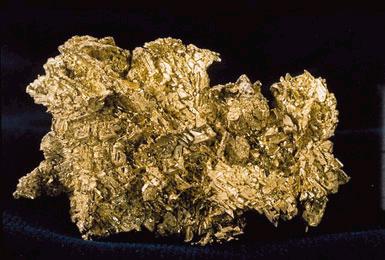
Crystalline gold.   USGS

Before it was closed during WW II there was an active lode4 gold mine located at the Great Falls of the Potomac in Maryland. All gold mining activity was banned by the government nationwide as it was felt the manpower to operate a mine would be better used in the war effort.  It was originally planned to reopen the mine after the war was over, but it never did.

There is ongoing placer mining and prospecting in the center of the state reportedly with a great deal of success.  This placer mining takes place on the rivers and creeks found in the area.  This gold mining belt extends across the state ending in Baltimore; can’t you imagine panning for gold on the banks of the Susquehanna River right in one of the Baltimore’s city parks!

The gold in Maryland was originally discovered by an Irish Union soldier while on KP duty, during the Civil War, that was washing frying pans on the banks of the Potomac River.  One of the ways to clean an army frying pan is to use sand as a cleaner.  The soldier probably had filled the frying pan with sand and gravel from the river that he sloshed around to clean the pan and found gold in the bottom of the pan.  It has been reported he was a member of a regiment from California.  If that was the case he was already familiar with the process of how to pan for gold, and was probably goofing off on his KP duty.

One of the precursors of gold is the presence of greenstone in the gold bearing belt thought by geologists familiar with gold deposits to be the source rock from which it is percolated by the action of hot groundwater.  The first chromite produced in the United States came from these same greenstone belts. The hot gold bearing groundwater that has percolated through the greenstone removing its gold content also carries many other dissolved minerals.  One of the principle minerals is silica that is deposited from the water at about the same temperature as gold.  Gold in quartz ore is often found together in veins making it one the most common forms of lode gold.


References:
Kuff, Karen, Cold in Maryland, 1987, http://www.mgs.md.gov/esic/brochures/gold.html
Prospecting for Gold near Washington, DC, http://www.infiltec.com/gold/

Saturday, January 1, 2011

Gold Deposits of India

Although India is by far the greatest importer of gold in the world it has a very poor gold mining industry. There are however, some gold mines that are active including the Kolar Goldfields in Karnataka, the Dona block in Andra Pradesh, the Bansawar district in Rajasthan and Madhya Pradesh.

The Champion Reef Mine in the Kolar Gold Field of India
It has been estimated by the Geological Survey of India (GSI) that there are more then 20,000 metric tons of gold spread across several states of India causing the Indian government to askthere the GSI to explore for additional reserves that can be tapped in Andhra Pradesh, Karnataka, Madhya Pradesh, West Bengal, Rajasthan, Bihar and Chhattisgarh.

The Indian government is concerned over its dependence on imports of gold into the country where India has been the top importer of gold in the world for several years. This concern was increased by the recent economic downturn when the price of gold shot up to $1,000 per ounce in the international markets, and is recently traded for over $1,400 per ounce in US dollars.

This is prompted the Indian government to give the GSI three years in which to explore the possibilities of being able to tap the estimated 14,000 tonnes of gold they presently have which should be increased to 20,000 tonnes in the next three years. As well as gold the Indian government also wants the GSI to explore for diamonds.

The Hope Diamond originally from Golconda, India

There are several overseas companies that are in talks with the Indian government for gold mining and exploration including Indogold, Anglo-American Gold Mining, Monarch Gold Mining, De Beers India Ltd., Rio Tinto Exploration Ltd and BHP minerals.

At the present time the Indian government is using all the initiatives it has to expedite the efforts to unearth valuable minerals like gold and diamonds. Right now in India produces hardly 4/10 of 1% of the Golden consumes despite having about 9% of all the gold reserves in the world within its borders.

Under Indian law presently foreign companies rarely invest in India because they cannot sell the data they map and can only use it if they open the mines themselves. The new mining policy however, is expected to open the mining sector to foreign investment. Under the new rules that have been suggested to approvals for most minerals must be made of about a year or will be automatically referred to a tribunal.

At present international gold companies are looking to form joint ventures with gold exploration firms in India enabling them to launch new exploration projects. It is in southern India in the Deccan region where it's been assumed as a result of some surveying or largest deposits of gold might be found.