Total Pageviews

Showing posts with label turbidites. Show all posts

Thursday, July 5, 2012

Gold Deposits in Ancient Turbidites

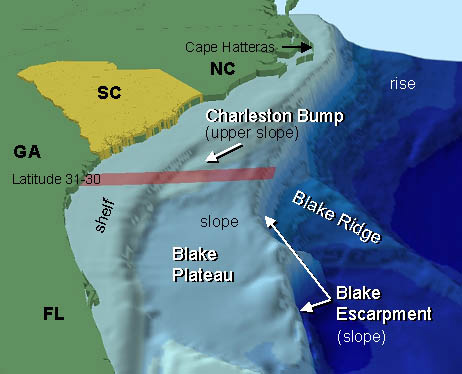
The southeastern coast of the United States - NOAA

The largest deposits of gold on Earth are found in ancient turbidites that include the Witwatersrand of South Africa and the Abitibi found in Canada in both Québec and Ontario. By definition a Turbidite is a landslide that occurs on a continental slope of a continental landmass where the erosion products of the continent eventually work their way to the abyssal plain at the bottom of the ocean that can be several kilometers deep.

Turbidites start at the edge of the continental shelf and can be caused by several different geological phenomena. They are deposited by a special type of water flow called a Turbidity Current that can be started by an earthquake, a powerful oceanic storm or in some cases just by the amount of material that collapses in on itself. The turbidity current contains not only water but suspended debris that causes it to flow out of town little slow but a speed that exceeds that of water itself because the current is also carrying suspended particles. Depending on the height of the slope the speed that it flows can reach as much as 70 km/h.

Once this flow reaches the bottom of the slope it quickly loses its forward speed and as it does drops off particles according to their density. It has such a high specific gravity of more than 19 gold is one of the first things that is dropped from a turbidity current. The finer particles and spread out over the abyssal plain of the ocean extending across the abyssal plain for hundreds of kilometers. In many cases at the edge of the flow the finer particles may only be a few millimeters thick, but over time this can actually be built into deposits of great thickness.

Mostly gold of the Turbidite deposit will say relatively close to the edge of the continent. Examples of these Turbidite flows are found in several places in the world one of the classic examples is the MegumaTerrane of Nova Scotia.

Some of the metals found in this environment include gold, silver, tungsten and antimony.  In western Connecticut the Rowe schist is an example of a metamorphosed turbidite.  This formation extends from northern Massachusetts almost to Long Island Sound in Connecticut.  Over the years reports of gold have been rumored about with this formation, but what is lacking is substantial proof i.e. no core drilling.

A capsule description of a turbidite deposit is gold-quartz veins, segregations, lodes, sheeted zones that are hosted by fractures, faults, openings in anticlines, synclines, along bedding planes in the turbidites and those that are associated with poorly sorted clastic sedimentary rocks.

These rocks are typically found close to the margins of continents or in back arc basins.  These rocks were typically deposited in submarine troughs, periarc basins, foreland basins and other remnant oceanic basins.  One feature that is typical of these rocks is multiple deformation events accompanied by metamorphism.  They show evidence of being thick sediment sequences displaying both deformation and are metamorphosed.  Although there can be some igneous rocks found in one of these deposits they tend to be quite rare and are usually present as pegmatites.  In some cases there are younger granitic intrusions associated with these rocks raising them to be raised to greenschist, but in some cases can reach amphibolite grade metamorphism.

The ore mineralogy of one of these deposits whether it is principle or subordinate includes native gold, pyrite, arsenopyrite, phyrottite, chalcopyrite, sphalerite, galena, molybdenite, bismuth, stilbite, bornite and other sulfosalt minerals. These minerals generally have a low sulfide content of less than 2.5%. The usual minerals found in association with these ore minerals are Quartz, carbonates, feldspar and chlorite.

When rocks of this type are discovered in glaciated terrains they may undergo deep weathering where alluvial recycling may produce rich placer deposits, such as in the Bendigo region of Australia.

There is several factors that control the ore deposits that are often found in fold crests, discordant veins and tension gashes. In some cases such as the in the Bendigo there is a relationship between ore deposits in the amount of graphite that is found in the country rock. The structural control is often extended to a district causing a scale alignment of deposits. Sometimes the veins appear confined to a specific stratigraphic interval that is often near to a change in stone type. Sometimes a more subtle relationship occurs lower deposits more closely related to the upper portion of the turbidite as of the magma district of Nova Scotia.

Because the low sulfide content, the majority of Quartz veins houses most geophysical methods of geophysical exploration to become ineffective it is often necessary to resort to the more usual prospecting techniques that are often accomplished with a gold pan by tracing the deposit.

In the deposit of this kind is not unusual to find deposits that range from a 50 g per tonne. Many of these are attractive targets for exploration as many of them are world class deposits.

Deposits of this type become incorporated into continental land masses with the death of an ocean by two continental masses colliding and the turbidite deposits are squished between the continents causing the turbidite to become incorporated into the mountain range that is a result of the collision. 

Thursday, May 31, 2012

Gold Occurrences in South Africa


The headframe of a gold mine in Reef City, South Africa
Photo by Nolween


More then 40% of all the gold ever mined has come from the Witwatersrand commonly called “The Rand” since 1870.  The deepest mines in the world are also found in The Rand.  In 2005 it accounted for 12% of the total world’s gold production, but as late as 1993 it accounted to over 30% of the world’s gold.  Overall it has been estimated that greater then 50% of the world’s gold reserves are from South Africa with 40% from the Witwatersrand alone.

The word Witwatersrand in Afrikaans means the ridge of white waters a large range of sedimentary hills in the northeastern part of South Africa.  The range has a height ranging from 1,700 to 1,800 meters although it appears lower then that because its relief is low and the heights are because it is on top of a large mountain plateau.  The ranges run from east to west mainly in the Gauteng province of South Africa.

Geologically it is quite complex composed mainly of quartzites, quartz pebble conglomerate and shale.  These rocks are geologically turbidites that flowed down a Precambrian continental slope.  The Witwatersrand gold and uranium deposits for years have been the center of a controversy as to where they came from.  The controversy was apparently laid to rest with the discovery by analyzing some of the platinum group metals that determined they came from a long lost mountain range to the north.

The rocks of the “Rand” or reef are similar to those found at Elliot Lake and Timmins, Ontario and are very rich in gold and uranium.  So famous is the name Rand even South Africa’s currency is called a Rand.  The name Witwatersrand also attaches itself to the Greater Johannesburg Metropolitan Area.

Gold was discovered in the Rand as early as July 31, 1826 by Peter Jacob Marais on the banks of the Jukskei River; the find was kept secret at the time.  Gold mining really started on the Rand in 1886 although there were sporadic efforts before that.  The Rand sparked a gold rush in the Witwatersrand and later deposits of gold and uranium eventually created the largest urban area in sub-Saharan Africa.

Among the many gold mines in South Africa are two of the world’s deepest mines.  In the East Rand Mine at Boksburg reaches a depth 3,585 meters.  The TauTona mine in Carletonville is 13 meters less then the East Rand Mine.  Plans are afoot to work on an extension of the TauTona mine that will bring its total depth to more then 3,900 meters (12,800 feet). This will break the present by 39 meters (127 feet).  When you get to these depths the rocks can reach 60o C (140o F).

Wednesday, August 24, 2011

Gold Occurrences in New Zealand


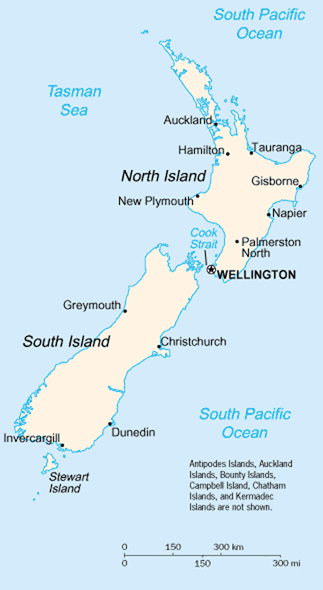
Map of New Zealand


There are several different types of gold deposit that are found in western New Zealand.  Orogenic gold deposits are found in both fault and shear zones at all crustal levels in quartz veins found within and around brittle ductile transition zones. 

The framework of New Zealand is controlled by two major faults the Wellington fault in North Island that terminates at the Bay of Plenty to the south coast, and the Alpine Fault that traverses South Island. New Zealand was rifted from Australia millions of year ago.  There is a subduction zone to the east that today drives the volcanoes found on the west side of North Island.  It is these volcanoes and earlier volcanism that has formed the gold deposits of the Islands.

Together these two faults represent a suture zone that runs the length of the islands.  It is a well known fact that many metal deposits are found associated with suture zones, and that is true in New Zealand.  Another mineral that is often found in suture zones is nephrite that is commonly called jade.  Jade is found in areas of high pressure-low temperature metamorphism commonly in blue schist grade rocks.

These deposits originated ranging from 3 km to 12 km deep with hot water from 200o to 400o C.  The gold deposits were brought to the surface by earth movements and erosion. The gold deposits are found mostly in regionally metamorphosed Paleozoic sediments that are found including those found at Golden Blocks in the northwest at Nelson, Reefton and Lyell.  Other deposits are found at Preservation Inlet in Fiordland where gold bearing quartz veins are found dipping steeply and are generally striking parallel to the axes of folding in greywacke and argillite slate host rocks.  Most of these veins are found to de discordant to the bedding. 

The lodes in these locations are usually less then a meter wide and 200 meters long.  The Birthday Reef at Blackwater, Reefton is the largest quartz vein found in the Paleozoic rocks.  This vein averages about 60 cm wide and has been mined for a distance of 1070 m that extend to a depth of 830 m.  There is also disseminated gold deposits that are next to the quartz lodes at Globe-Progress as well as others at the Reefton deposits.

There are also deposits of gold found in the Mesozoic rocks in the schist of the Otego and Marlborough as well as the greywacke found in the Southern Alps.  Here the lodes are typically lensoidal in shape that are rarely more then a meter wide and are localized along single or multiple shear zones that are parallel that usually dip steeply and are discordant to the bedding of the country rocks.  One exception is a lode vein found at McRaes where the deposits are found in the Hyde McRaes shear zone.  These gold bearing veins have a strike of more 25 km.

Many of the gold deposits are found in saddle reef deposits similar to those found in eastern Australia where they occur as veins of quartz that approach near horizontal deposits of quartz found parallel to the bedding planes in turbidites ranging in age from Silurian to Devonian in age.  A good example of this kind of deposit can be found at the Hill End Gold Field in New South Wales.  This deposit was developed in regional metamorphism over a considerable length of time.

Gold deposits can be found the length of New Zealand, but are mostly found on the western side of the islands.