Total Pageviews

Showing posts with label scheelite. Show all posts

Tuesday, July 3, 2012

Gold Occurrences in Burkina Faso


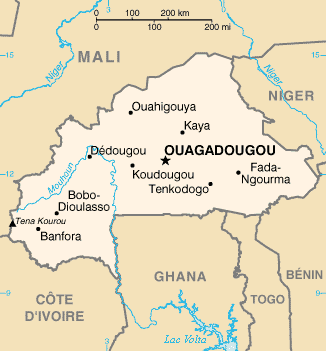
Map of Burkina Faso  -  CIA


In the past 40 years there has been a great deal of interest in gold mining in Burkina Faso. This is a country that is very geologically rich with the Poura region alone accounting for over 25 tonnes gold. As of 2003 the government brought about a new Mining act and immediately after there were more than 30 companies that have undertaken exploration projects in the country. They also created five new mines that are on the point of full production.

As demonstrated by the Abitibi region of Canada some of the richest gold mines in the world are located on greenstone belts.  In Burkina Faso greenstone belts cover about 3,000,000 km² of West Africa the Burkina Faso accounted for approximately 21% of these greenstone exposures. There are about 13 international mining companies that are active in this area now. .

As many as 13 international mining companies are working in the country mainly in the Greenstone belts. These belts account for over 21% of West Africa's Greenstone belt exposures that house on the world's most prolific gold mines. Some of these mines are capable of producing over 100 thousand ounces of gold per year. Much of this gold is produced by the heap leaching process and probably accounts to more than 1,000,000 ounces per year. Although some of these are producing mines, more of them are exploration projects that have been ongoing for some time.

All of the United Nations development program and Burkina Faso indicates that the early Proterozoic (Birrimian) Greenstone belts located at Boromo and Hound consists of steeply dipping volcanic and volcano-sedimentary units that have been intruded by the Eburnean granitoids there about 2 billion years old that have undergone incipient to low grade greenschist metamorphism. Many of the former gold prospects and mines are found in the Greenstone belts including the spell Poura vein gold deposit and the Dossi shear zone prospects. Much of gold that is discovered is associated with scheelite, calcium tungstate that is an ore for the metal tungsten.

Gold mining is one of the newest stories in Burkina Faso in recent years where the gold mining industry has been developing apparently inexhaustible resources.  There are many Australian companies that are already there searching for gold.  Many are finding it.

Most of the primary gold deposits are derived from metamorphic rocks that were developed from auriferous rocks that were eroded away long before the placer deposits bearing them were metamorphosed in the older volcanic and volcano=sedimentary rocks.  In this they are similar to the rocks found in the Witwatersrand district of South Africa and the Abitibi greenstone belts of Canada.

Sunday, November 13, 2011

Gold Occurrences in the Yukon Territory

The Tintina Gold Belt goes from northern British Columbia to Alaska for 1,200 kilometers.   USGS


You could say it all began with the Klondike Gold Rush in 1898, but the history of gold in the Yukon goes back to the early traders and trappers who first found gold in the territory.  Much of this gold was in placer deposits. Placer is a Spanish word meaning a place where gold was dug from the earth mainly from sand & gravel deposits where the gold was concentrated.

The southwest corner of the Yukon is within the Tintina Gold Belt a great arc that extends from northern British Columbia throughout the Yukon and ends in the Pacific Ocean just above Anchorage, Alaska.  The Tintina is about 1,200 kilometers long and 200 kilometers wide.  Many of the earliest gold discoveries in the Yukon were placer deposits, and even today large quantities of placer gold are produced. During the Klondike Gold Rush many of the miners passed through the Yukon on their way to the gold fields of the Klondike in Alaska without ever sampling the area in the Yukon through which they passed.  If they had the gold rush might just as well been called the “Yukon Gold Rush.”

This part of North America escaped the extensive bouts of continental glaciation that covered much of the northern hemisphere for the past million years allowing the placer deposits that had formed for millions of years to remain in place; the placers were destroyed by the glaciers in other parts of northern north America.  When the glaciers came a good part of the Yukon was part of Baringia an arid land that joined Asia to North America when the sea level was four hundred feet lower then it is now.

For many years geologists and prospectors thought the gold in the Yukon was all placer gold eroded from formations of rock that no longer existed, but in recent years a number of hard rock mines have been put into production.  Many of these lode gold mines are associated with the mineral scheelite, an ore of tungsten in the form of calcium tungstate.  One hard rock mine is actually called the Scheelite Dome Mine (VSE:LAO) because of the amount of scheelite it produces.

The Yukon Territories are shown in red.


Most of the river systems in the Yukon produce placer gold, and lode gold can be found related to intrusions of magma into the country rock.  There are plenty of placer operations found in the territory, and an increasing awareness of the lode gold potential of the Yukon.

Gold Panning in Bonanza Creek in the Yukon.
Photo by Janothird


Thursday, April 28, 2011

Gold Producing Metallogenic Provinces and Epochs (MPE)

There are many metallogenic provinces and epochs (MPE) that can be traced through the formations of various rocks including those particular places and times when gold was deposited. There are at least eight of these episodes that can be found in the Appalachian Mountains of southern Québec. These MPE's can range all the way from the Grenville orogeny that occurred around 1.2 million years ago, and can be traced to different types of orogenies and mineralization to the end of the Permian era. 

A map of selected worldwide ore deposits of metals.
By KVDP


The different MPE's can be directly related to specific orogeny like the Grenvillian or any other orogenic event that has happened in the history of the world. An MPE can be found anywhere on the face of the earth. That means you had better know the geological history of the area where you are prospecting, and remember that some orogenic events left more gold behind them than others.

MPE's are usually associated with a suture zone where one tectonic plate has collided with another. In the case of an oceanic plate colliding with the continental plate the oceanic plate is subducted beneath the continental plate, and about 20 km inside account metal plate there should be a line of granitic intrusions.

The subduction zone acts as a giant heat engine melting the material that has been dragged downward by subduction causing it to become heated to the point the material is melted.  The subducted material is also saturated with water that lowers the melting point of the material, and supplies the water that at depths of kilometers beneath the surface of the earth becomes super heated water that is capable of dissolving many minerals that when they reach the right environment through the action of the superheated hydrothermal fluid are deposited as ore.

A subduction zone.
By A.J. Stern


Searching around in the area that has been intruded one is apt to find gold in the aura of contact metamorphism that is associated with the granitic intrusions. In this case gold is often associated with scheelite, an ore of tungsten in the form of tungsten carbonate. This occurrence is often found where the granite has intruded through an older layer of carbonate rocks such as limestone or dolomite where it forms a skarn..

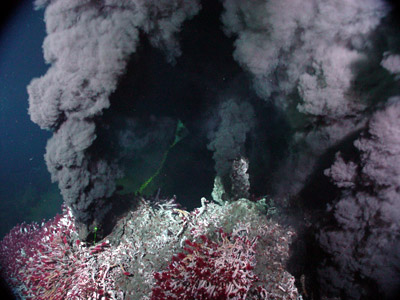
On the oceanic side of the subduction zone are found many metal sulfide deposits where this whole deposits are usually found in small amounts, but there can also be some really huge deposits of sulfide that are formed this way. These are the result of sulfide deposits that are laid down by black smokers found on spreading centers located on the bottom of the ocean. These deposits are laid down very much like plums in a pudding at the scattered across the bottom of the ocean.

A black smoker at a spreading center at the bottom of the ocean. NOAA


As these deposits are carried away from the spreading center by the action of more magma being injected they cover the ocean bottom with spots where they are eventually subducted beneath a continental plate where they are often reactivated to form secondary mineral deposits sometimes in quantities large enough to form ore deposits.

MPE's are where ore deposits are typically found, and in many cases are considered to be the primary source of mineralization, and they eventually break down to form detrital mineral deposits.