Total Pageviews

Showing posts with label granitic intrusions. Show all posts

Friday, August 26, 2011

Orogenic Gold Deposits


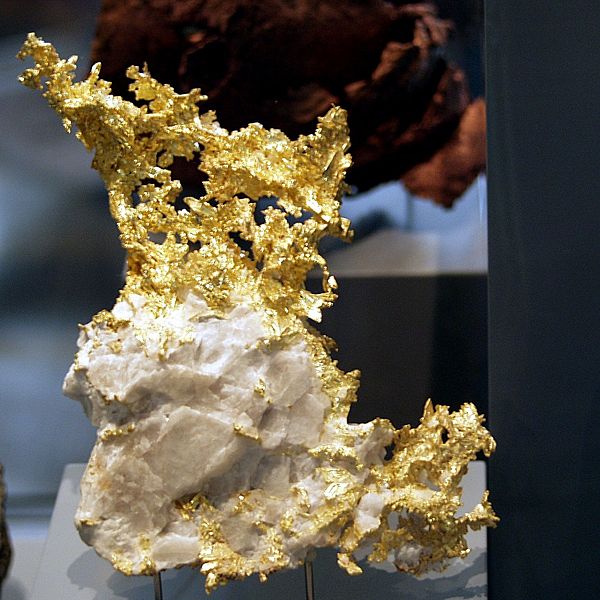
A typical specimen of orogenic gold from California
Photo by Raimond Spekking


Over the last century this class of gold deposit has been known by many different names like mesothermal gold deposits, metamorphic gold, gold-only, lode gold, shear-zone hosted, structurally controlled and a host of other names including greenstone-hosted and turbidite hosted deposits.  To cover this mélange of varying names the term “Orogenic Gold” has been proposed by (Grove et al) in 1998 to cover all these varying terms.  The reason for the change is to lower the confusion in terms since over the years they have changed causing a great deal of confusion in the scientific community,  The reason for this confusion is because of the nature of these gold deposits.  Many of these deposits are hosted in rocks that are intensely deformed and have been intruded from the effects of  regional metamorphism or intrusion by magma.

The Highlands of New York and Southern New England.  This is the type of terrane where gold might be expected.
Camerons Line runs through Connecticut to Staten Island NY.  The black on the map represents an ancient suture zone where rocks of continental origin are in contact with sedimentary rocks that were metamorshosed to schist during the Taconic Orogeny.   USGS
One of the important features of describing these gold deposits as orogenic gold deposits is because they can be found in any type of rock.  Deposits of this nature can be found in metamorphic terranes of various ages that display variable degrees of deformation.  The rocks that host gold deposits range from volcano-plutonic or clastic-greenschist facies commonly found in amphibolite or granulite.  Deposits of this nature can be found in areas that have undergone regional metamorphism or where the immediate area has undergone local contact metamorphism from the intrusion of hot magma.  Some of these deposits can be found in areas that at present represent areas of ancient major tectonic boundaries.  An example of this is found in the north-east part of North America in the fault contact between continental rocks and deep sea rocks that is represented by a fault system undergoing several name changes, but locally is called “Cameron’s Line.”  Most of these features are either compressional or transpressional tectonic settings.

You can find orogenic gold deposits in metamorphic terranes that display various degrees of deformation and various ages.  The rock hosts are various environments that include volcano-plutonic and sedimentary-clastic terranes.  The host rocks have usually been metamorphosed to greenschist facies.  In some places locally the metamorphism can be amphibolite or granulite.  Typically the gold deposits of this environment occur in regional crust scale environments.  They usually display a brittle to ductile style of deformation.  In many cases they are likely the present day expression of major ancient tectonic boundaries.  The gold deposits can be found in  any host rock.

These is a wide diversity of environments displayed that have strong structural controls in the gold deposits.  Orebodies are found in all sizes and all scales.  The morphology of these deposits is very variable including such diverse types as (1) brittle faults to ductile shear zones, (2) extensional fractures, stockworks and breccias and (3) fold hinges.  Many of these Orebodies are composed of highly altered host rocks that have disseminated mineralization of fissure filled deposits.  Many of these deposits can display a large vertical size exceeding 1 km in extent or more. 

Thursday, April 28, 2011

Gold Producing Metallogenic Provinces and Epochs (MPE)

There are many metallogenic provinces and epochs (MPE) that can be traced through the formations of various rocks including those particular places and times when gold was deposited. There are at least eight of these episodes that can be found in the Appalachian Mountains of southern Québec. These MPE's can range all the way from the Grenville orogeny that occurred around 1.2 million years ago, and can be traced to different types of orogenies and mineralization to the end of the Permian era. 

A map of selected worldwide ore deposits of metals.
By KVDP


The different MPE's can be directly related to specific orogeny like the Grenvillian or any other orogenic event that has happened in the history of the world. An MPE can be found anywhere on the face of the earth. That means you had better know the geological history of the area where you are prospecting, and remember that some orogenic events left more gold behind them than others.

MPE's are usually associated with a suture zone where one tectonic plate has collided with another. In the case of an oceanic plate colliding with the continental plate the oceanic plate is subducted beneath the continental plate, and about 20 km inside account metal plate there should be a line of granitic intrusions.

The subduction zone acts as a giant heat engine melting the material that has been dragged downward by subduction causing it to become heated to the point the material is melted.  The subducted material is also saturated with water that lowers the melting point of the material, and supplies the water that at depths of kilometers beneath the surface of the earth becomes super heated water that is capable of dissolving many minerals that when they reach the right environment through the action of the superheated hydrothermal fluid are deposited as ore.

A subduction zone.
By A.J. Stern


Searching around in the area that has been intruded one is apt to find gold in the aura of contact metamorphism that is associated with the granitic intrusions. In this case gold is often associated with scheelite, an ore of tungsten in the form of tungsten carbonate. This occurrence is often found where the granite has intruded through an older layer of carbonate rocks such as limestone or dolomite where it forms a skarn..

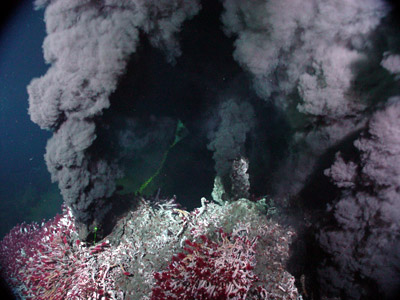
On the oceanic side of the subduction zone are found many metal sulfide deposits where this whole deposits are usually found in small amounts, but there can also be some really huge deposits of sulfide that are formed this way. These are the result of sulfide deposits that are laid down by black smokers found on spreading centers located on the bottom of the ocean. These deposits are laid down very much like plums in a pudding at the scattered across the bottom of the ocean.

A black smoker at a spreading center at the bottom of the ocean. NOAA


As these deposits are carried away from the spreading center by the action of more magma being injected they cover the ocean bottom with spots where they are eventually subducted beneath a continental plate where they are often reactivated to form secondary mineral deposits sometimes in quantities large enough to form ore deposits.

MPE's are where ore deposits are typically found, and in many cases are considered to be the primary source of mineralization, and they eventually break down to form detrital mineral deposits.