There are many metallogenic provinces and epochs (MPE) that can be traced through the formations of various rocks including those particular places and times when gold was deposited. There are at least eight of these episodes that can be found in the Appalachian Mountains of southern Québec. These MPE's can range all the way from the Grenville orogeny that occurred around 1.2 million years ago, and can be traced to different types of orogenies and mineralization to the end of the Permian era.
 |
| A map of selected worldwide ore deposits of metals. By KVDP |
The different MPE's can be directly related to specific orogeny like the Grenvillian or any other orogenic event that has happened in the history of the world. An MPE can be found anywhere on the face of the earth. That means you had better know the geological history of the area where you are prospecting, and remember that some orogenic events left more gold behind them than others.
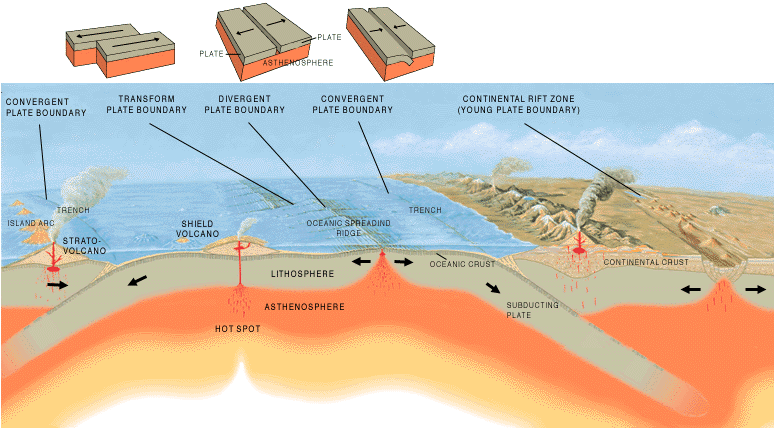
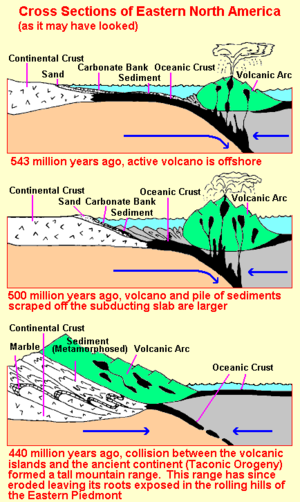
MPE's are usually associated with a suture zone where one tectonic plate has collided with another. In the case of an oceanic plate colliding with the continental plate the oceanic plate is subducted beneath the continental plate, and about 20 km inside account metal plate there should be a line of granitic intrusions.
The subduction zone acts as a giant heat engine melting the material that has been dragged downward by subduction causing it to become heated to the point the material is melted. The subducted material is also saturated with water that lowers the melting point of the material, and supplies the water that at depths of kilometers beneath the surface of the earth becomes super heated water that is capable of dissolving many minerals that when they reach the right environment through the action of the superheated hydrothermal fluid are deposited as ore.
 |
| A subduction zone. By A.J. Stern |
Searching around in the area that has been intruded one is apt to find gold in the aura of contact metamorphism that is associated with the granitic intrusions. In this case gold is often associated with scheelite, an ore of tungsten in the form of tungsten carbonate. This occurrence is often found where the granite has intruded through an older layer of carbonate rocks such as limestone or dolomite where it forms a skarn..
On the oceanic side of the subduction zone are found many metal sulfide deposits where this whole deposits are usually found in small amounts, but there can also be some really huge deposits of sulfide that are formed this way. These are the result of sulfide deposits that are laid down by black smokers found on spreading centers located on the bottom of the ocean. These deposits are laid down very much like plums in a pudding at the scattered across the bottom of the ocean.
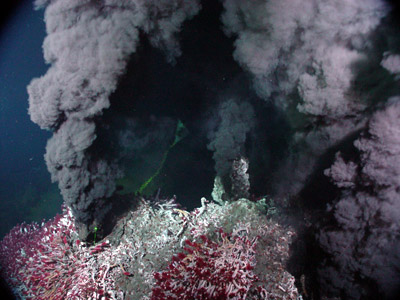 |
| A black smoker at a spreading center at the bottom of the ocean. NOAA |
As these deposits are carried away from the spreading center by the action of more magma being injected they cover the ocean bottom with spots where they are eventually subducted beneath a continental plate where they are often reactivated to form secondary mineral deposits sometimes in quantities large enough to form ore deposits.
MPE's are where ore deposits are typically found, and in many cases are considered to be the primary source of mineralization, and they eventually break down to form detrital mineral deposits.