Total Pageviews

Showing posts with label geological processes. Show all posts

Monday, February 6, 2012

Refining Gold using Electrochemical Processes


An electrolytic cell used in the commercial refining of gold using the electro-chemical process.


This is a continuation of the previous article about the recovery of gold from concentrated stream heavies.  In this article we will examine the WolhwillProcess that was originally invented in 1874 and is still in use today. This process is used to produce gold that is 99.999% pure.  As an industrial-scale technique the Wohlwill process that was invented by Emil Wohlwill for refining gold using methods developed for electrochemistry.

The process makes use of a bar cast from impure gold that has been separated from concentrate like that in the first part of the process we explained in an earlier article.  This is done by pouring the gold and other metals into a crucible, melting then and pouring them into a mold producing what is called a “dore” bar composed of gold, silver and PGM.  If the amount of gold present in the dore bar is less then 95% it will be necessary to add enough pure gold to bring its content up to that level otherwise the other metals will be carried over in the finished product making the gold less then 99.999 fine.  The Dore bar acts as an anode in the process.

The cathode in this reaction is made from thin sheets of 24k gold that are spaced on each side of the Dore bar that acts as the anode.  Providing the anode is composed of more then 95% gold the remaining metals in the cathode will be deposited in the bottom of the electrolytical cell as anode sludge that can be recovered and the values of silver and PGM recovered in a later process.  

The gold along with the other metals are dissolved at the anode when current is delivered to the cell with pure gold coming through the chloauric from ion transfer where it is plated as pure gold at the cathode.  After the anode is completely dissolved the cathode is removed and melted down or processed for making the end product that is usually gold bullion pure gold like this is too soft for most other uses.

At 99.999 fine this gold is too soft for most purposes other then bullion so it must be alloyed with other metals most commonly silver although in some cases copper is also used.  For making jewelry the most common karats used are 14 and 18 k.  This is done by remelting the bullion and forming it into the shapes desired.

There are plenty of gold refiners that will refine the concentrate into pure gold, but they often keep the platinum values as part of the refining fee. 

Sunday, January 16, 2011

The Geologic Framework of a Gold Bearing Suture Zone: Part One

The estimated abundance of gold in the earth’s crust is 4x10⁻³ milligram per kilogram meaning this is the average amount of gold found in every kilogram found in the earth’s crust.  Although gold can be found virtually every place on earth the trick is to find it where it has been concentrated by geological processes to make it profitable to mine.  The necessary conditions are found in several places on earth that within reason have similar conditions that are called by several different names.  One of the most common names is “Gold Belt” another is “Gold Province.”  Names like these are used to define primary deposits of gold that have been deposited by the action of hot salt brines that are in excess of 100o C that deposit their dissolved gold either when its temperature drops below a certain point, or encounters conditions that cause the chemical precipitation of gold by reacting with other rocks.

A map showing modern tectonic plates.

Gold is also deposited when it has been eroded from the rock where it was primarily deposited as detritus in the beds of streams or a similar environment.  In this form gold is called “Placer or alluvial gold.”  Aside from being found in stream sediments it can also be found in sandstone or conglomerate that are really nothing other then fossilized sedimentary deposits.  The largest known deposit of gold is in one of these fossilized conglomerate deposits, the Witwatersrand in South Africa.  The mines here are the deepest on earth some of them are in excess of 13,000 feet deep.

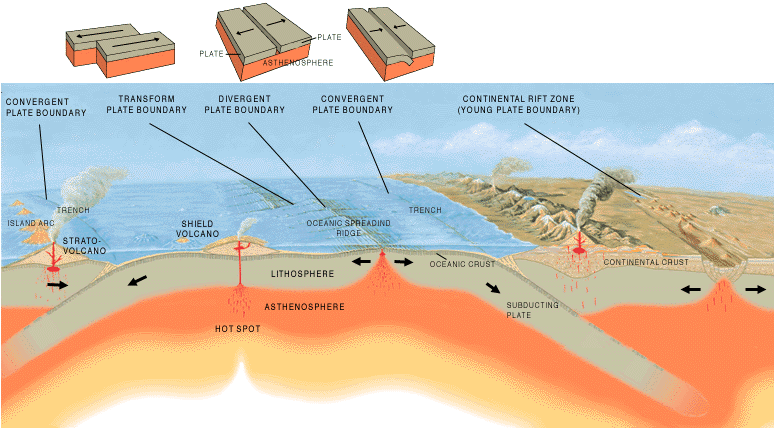
Tectonic Plate boundaries.

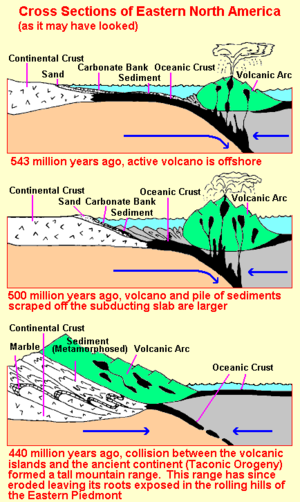
Primary gold deposits accompanied by placer deposits are found mainly in suture zones where one tectonic plate collides with another.  In some cases the oceanic plate is subducted beneath a continent with little affect.  In other cases two continental land masses collide throwing up ranges of great mountains.  There are several examples of this on earth today.  The grand daddy of all mountain ranges caused by such a collision is the Himalayas caused by the collision of two continents, the Asian and the Indian plates.  Between these plates there used to be an ocean called the Tethys Sea that vanished when the collision occurred.  Other examples of similar mountain ranges can be found all over the face of the earth, some of the more recent are: the Appalachians, the Alps, the Andes, the Rockies to name a few of many.

A suture zone is depicted in this series of charts.

Because of the nature of this subject it will require several separate articles to treat it as it should be.  The next article in this series will explain how mineral deposits are emplaced in a suture zone including gold.