Total Pageviews

Showing posts with label aqua regia. Show all posts

Sunday, May 22, 2011

Aqua Regia takes a Back Seat to a new Organic Process for Dissolving Gold and other Precious Metals

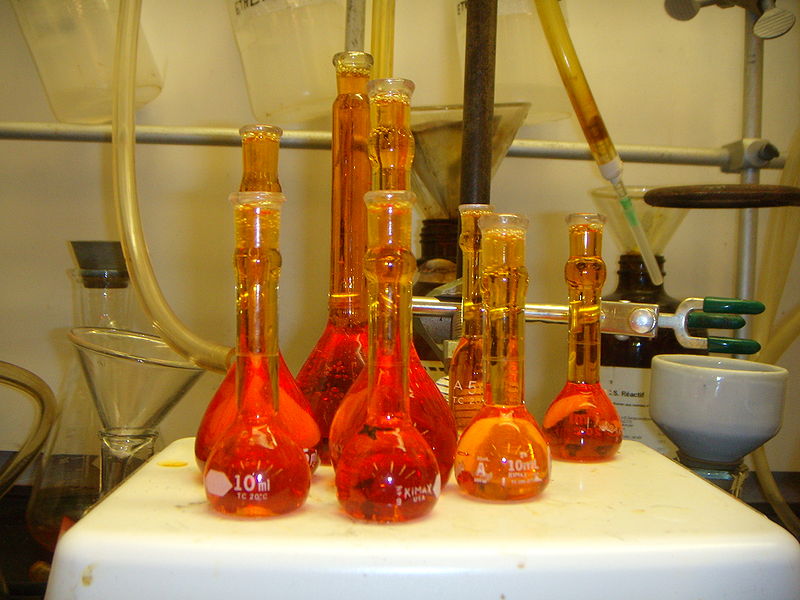
Solution of aqua regia in a laboratory
Photo by Thejohnier


Aqua Regia one of the few chemicals capable of dissolving gold and platinum group metals (PGMs) that was invented about 800 AD by the Arabic alchemist Gebar that was described in western literature in the 13 century by Paul of Taranto sometimes described as the “Pseudo Gebar.”  For centuries Aqua Regia reigned supreme until the development of organic solvents for gold were developed at the laboratory of Wei Lin and collogues at the Georgia Institute of Technology in the early 21st century. 

Aqua Regia is composed of one part of fuming nitric acid and three parts of hydrochloric acid that was used with a solution of tin chloride for the reaction forming the Purple of Cassius the only definitive test for gold until the invention of the Atomic Absorption Spectrometer in the 20th century.  Aqua Regia was also used in the gold refining process, but the same chemicals also dissolved PGMs making it difficult to remove PGMs from gold.  Lin’s new chemistry is capable of selectively removing the errant PGMs from gold by varying the constituents of the solution.

The new solution is based on the reaction of thionl chloride (SOCl2) and the organic solvent pyrazine.  Further experiments disclosed that by substituting other organic solvents such as N-N dimethylformamide (DMF), imidazole and pyrazine.  The gold can be recovered by calcining the resulting mixture.

Gold dust precipitated from aqua regia.
Photo by Greenhorn 1


A mixture of SOCl2 and DMS dissolves gold but doesn’t affect the PGMs making it possible to obtain 99.999 caret pure gold that is bullion grade.  By changing the recipe you can dissolve the PGMs without dissolving the gold.  This part of the process will make it easier to recover PGMs from catalytic converters then previous methods, and fuel cells in the future.

Even though the process can’t efficiently compete with conventional aqua regia at the present time Lin feels it will have uses beyond just dissolving gold and PGMs in the use of making nanostructures of the noble metals as well as recycling nano-coatings,  

Researches are ongoing with this technology, and it is expected that over the following years that advances in the technology will occur as well as new uses for the technology.  One of the major stumbling blocks that has to be overcome is the effects on the environment that is presented by this new technology.

Saturday, December 18, 2010

Using the Purple of Cassius to Check For Gold in the Field

If you have ever gone to church and admired the beautiful stunning colors in the stained glass windows the red in those windows comes from ion sized gold particles disseminated through the glass as it was formed in a furnace.  The same physical characterstics are also seen in the Purple of Cassius.  It is this characteristic of gold that allows us to make a very accurate test for it while in the field.  This test was the standard test for goldsmiths for centuries until it was replaced in the 20th century by the atomic absorption spectrometer.

This is how they prospected for gold and other metals in 15th century Germany   Georgius Agricola


The Purple of Cassius was discovered in 1685 by Andeas Cassius, an alchemist who described it in the work De auro.  It was also described in a book published in the Italian City of Bologna as an artist’s color.  The alchemists of that day that quickly realized that it could be used as a sensitive test for gold.

Besides affording a sensitive test for gold the Purple of Cassius has found much use as an artist’s color. As noted earlier it is also used to produce red glass. The Purple of Cassius is also painted on glass before it is fired leaving the glass with a thin layer of fused-on gold.

When you are prospecting for gold in hard rock or any other place the purple of Cassius is the ideal test to take into the field because the various chemicals you need are capable of being carried in a small space without taking up too much room. It is also so sensitive that the prospector could get a rough idea of how rich the gold deposit is. This is determined by the color of the reaction that could range from a light pink to a dark purple. The darker the purple is the richer is the gold ore.

This is how they mined during the 15th century.   Georgius Agricola


Another advantage of using this test in the field is the ease with which you can mix these chemicals used to test with. There are several simple formulas for doing this but one of the most common is two parts of concentrated nitric acid in one part of concentrated hydrochloric acid. The result is a very powerful acid called “Aqua Regia” one of the few substances that will dissolve Gold.  The other ingredient used in the test is tin chloride solution you can either purchase it alone or you can make it yourself by dissolving the metal tin in some hydrochloric acid.

Beakers like those used in the Purple of Cassius test.


When you are dissolving gold in this acid mixture slosh the material being tested around in the acid to dissolve any gold that may be present.  In itself this is a sort of test as the aqua regia will turn yellow if there is any gold present. This is not too accurate though so don't depend on it as a test.

To perform the test fill a beaker with deionized water followed by a few drops of the gold bearing aqua regia into the water followed by a few drops of the tin chloride solution. The purple of Cassius will then precipitate out of the solution in a depending on the quantity of gold present the precipitation can range from a light pink to a deep purple color. Remember, the deeper purple color there is the more gold there is present.