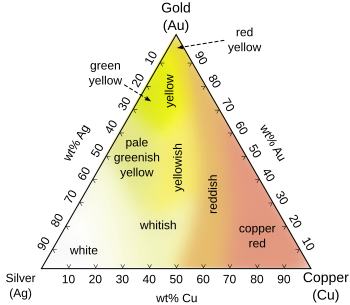
If you have ever gone to church and admired the beautiful stunning colors in the stained glass windows the red in those windows comes from ion sized gold particles disseminated through the glass as it was formed in a furnace.
The same physical characterstics are also seen in the
Purple of Cassius.
It is this characteristic of gold that allows us to make a very accurate test for it while in the field.
This test was the standard test for goldsmiths for centuries until it was replaced in the 20
th century by the
atomic absorption spectrometer.
 |
| This is how they prospected for gold and other metals in 15th century Germany Georgius Agricola |
The Purple of Cassius was discovered in 1685 by
Andeas Cassius, an alchemist who described it in the work De auro.
It was also described in a book published in the Italian City of
Bologna as an artist’s color.
The
alchemists of that day that quickly realized that it could be used as a sensitive test for gold.
Besides affording a sensitive test for gold the Purple of Cassius has found much use as an artist’s color. As noted earlier it is also used to produce red glass. The Purple of Cassius is also painted on glass before it is fired leaving the glass with a thin layer of fused-on gold.
When you are prospecting for gold in hard rock or any other place the purple of Cassius is the ideal test to take into the field because the various chemicals you need are capable of being carried in a small space without taking up too much room. It is also so sensitive that the prospector could get a rough idea of how rich the gold deposit is. This is determined by the color of the reaction that could range from a light pink to a dark purple. The darker the purple is the richer is the gold ore.
 |
| This is how they mined during the 15th century. Georgius Agricola |
Another advantage of using this test in the field is the ease with which you can mix these chemicals used to test with. There are several simple formulas for doing this but one of the most common is two parts of concentrated nitric acid in one part of concentrated hydrochloric acid. The result is a very powerful acid called “
Aqua Regia” one of the few substances that will dissolve Gold.
The other ingredient used in the test is tin chloride solution you can either purchase it alone or you can make it yourself by dissolving the metal tin in some hydrochloric acid.
 |
| Beakers like those used in the Purple of Cassius test. |
When you are dissolving gold in this acid mixture slosh the material being tested around in the acid to dissolve any gold that may be present. In itself this is a sort of test as the aqua regia will turn yellow if there is any gold present. This is not too accurate though so don't depend on it as a test.
To perform the test fill a beaker with deionized water followed by a few drops of the gold bearing aqua regia into the water followed by a few drops of the tin chloride solution. The purple of Cassius will then
precipitate out of the solution in a depending on the quantity of gold present the precipitation can range from a light pink to a deep purple color. Remember, the deeper purple color there is the more gold there is present.