Total Pageviews

Showing posts with label granular magnetite. Show all posts

Tuesday, March 1, 2011

Is there Gold in Northwest Connecticut?

The possibility of gold being found in northwestern Connecticut is much higher than most people think. The mineralogy of the older pre-Cambrian rocks that make up the core of the Northern Appalachians outcrops into areas within Litchfield County. These ancient rocks are found in several towns in the county in two different groups. One group includes the towns of Colebrook, Norfolk, Winsted and Torrington. The other group includes the towns of Cornwall, Goshen, Kent, and New Milford.

Bedrock of the Winsted, Connecticut Quadrangle.  The magnetite deposits are mainly found in the member marked Ygh.

Rocks of pre-Cambrian age that were laid down during the Grenville orogeny around 1.2 billion years ago crop out along the crest of the Appalachian Mountains reaching from Maine to Alabama where they all have one thing in common, and that is deposits of magnetite an oxide iron. It has been estimated by the Pennsylvania Geological Survey said the iron mines around Cornwall, Pennsylvania have produced an estimated 40,000 ounces of gold that is associated with the deposits of magnetite that are found in the area.

This illuminates a great deal of rock types that do not have to be searched for gold, rather it narrows the search to a particular type of mineral deposit namely magnetite. These deposits are easy to find because they create what are called magnetic highs on a specialized type of map called an Aeromagnetic Survey Map that are available at the DEP bookstore at 79 Elm St., Hartford, CT. There are several other good maps that are available from the same source. They also sell bedrock maps of all the quadrangles in the state. Another useful set of maps are the radioactivity maps that were done several years ago when the state of Connecticut performs a radiation anomaly map from the air.

All of the towns mentioned have at one time or another produced iron ore based on these deposits of magnetite. There were at least two of these mines in Winchester; the first one that was only active during the Revolutionary war was located at the top of Street Hill. The other mine was in the Danbury Quarter section of Winchester. But both of these mines produce about 50 tons over each, but from the records it appears they were never checked further gold content.

This is the kind of magnetite ore found around Winsted with abundant sulfides in the form of chalcopyrite.  The gold often occurs as thin film between the crystals of chalcopyrite.  Photo by Rob Lavinsky

The aeromagnetic map displays it extremely high anomaly right under Gilbert school that is strong enough to deflect a compass needle. There are several other areas in the town of Winchester that cause similar effects. One of these areas is right at the top of the borrow area for the Mad River Dam off old Route 44.

Gold deposits that are associated with granular magnetite tend to be low grade and disseminated through the rock is so little that it is normally not visible to the naked eye. The grade can be from grams per ton up to 4 ounces per ton. This is not bonanza ore, but the amount of ore that is available can be vast and capable of producing large amounts of gold.

This is not the type of gold prospecting where you are going to be able to find gold with the naked eye; instead all of these magnetic anomalies are going to have to be drilled, and the resulting cores are going to have to be carefully analyzed. This is not the kind of job that is normally undertaken by a single prospector instead it is going to require mounting an entire exploration team. Whether this ever happens the one thing you can be sure of this type of effort is going to cost several million dollars.

References:

If you want to learn more about gold mining and prospecting go HERE


The Author’s personal experiences 

Wednesday, February 23, 2011

Gold Occurrences in Pennsylvania

Pennsylvania has a long and rich tradition of mining especially for anthracite and bituminous coal as well as iron. What is not generally known however is the state is also produced a considerable amount of gold. It has a well-trained workforce of miners many of whom have a tendency to be prospectors. Because of this some iron miners down around Cornwall have actually produced more than 61,000 ounces of gold while they were mining the magnetite iron ore. Aside from the mine at Cornwall another mine that reportedly produced gold from magnetite was the Grace mine in Morgantown.

There were a series of three openings to the iron deposit in Cornwall located at Big Hill, Middle Hill and Grassy Hill that were originally owned by the Cornwall Ore Banks Co., but were eventually owned by Bethlehem Steel who eventually closed the mines in 1979.  This deposit of magnetite was produced by the replacement of limestone by hydrothermal activity during the Jurassic from a diabase intrusive, so in effect the deposit is a skarn.

The eastern part of the state is covered with crystalline rocks producing potential gold lodes as well as placer gold. This gold weathers out of the crystalline rocks and is collected in the rivers and streams of eastern Pennsylvania. This is not the only source of gold however, in the northern part of the state the last glacier left placer gold in the terminal moraines found in Pennsylvania.

There are several streams producing placer gold that came in Lancaster and York Counties in glaciers that have advanced into the state during the past million years. Any of these glaciers were capable of bringing gold down from Canada where one of the richest gold belts the world the Abitibi is found in Québec and Ontario. According to some geologists there have been as many as 24 episodes of glaciation that have affected the northern part of the United States in the past 2.5 million years.
Although the eastern part of the state is mostly covered with crystalline rocks that produce gold as lode gold that weathers out so it becomes placer gold that collects in the rivers and streams found in eastern Pennsylvania.
One of the places where gold has been found is along the Susquehanna River where it has been found as both nuggets and flakes of gold. Generally Wyoming County has been a good place to look for gold as well as in the surrounding counties.  In York County  placer gold is associated with the deposits of diabase that make up the tops of many ridges. The action of weathering releases the gold from bedrock allowing it to migrate downhill into the streams and rivers in the area.
During the Civil War the great battle at Gettysburg was fought on some of these diabase ridges with names like Little Round Top or Cemetery Ridge. There is no doubt that the rivers and streams around the Gettysburg Battle Site undoubtedly contain gold. 
The best way to find out where the gold is in Pennsylvania is to research old newspapers and town histories.  The state only keeps track of commercial mining operations and not that of individual prospectors. Old newspapers are often the source of stories about where one of the local citizens has found gold in their town.
Helpful Links:


There are several gold prospecting clubs that are active in Pennsylvania that can supply more information about Pennsylvania gold.

Our thanks to Stephen Shanks of the Pennsylvania Geological Survey for additional information.

Monday, February 21, 2011

The Association of Gold and Magnetite

One common type of gold deposit is one where the gold is associated with the mineral magnetite where the gold is formed in skarns of granular magnetite.  The mineral has a chemical formula Fe3O4 that is often found in contact metamorphosed areas associated with intrusions of magma into carbonate or silico-carbonate rocks the intrusion itself is usually granite or monzonite-syenite. In such deposits the common minerals that are found include pyroxenes, amphiboles, garnet and lesser amounts of scapolite, vesuvianite and other silicates, but the most important is magnetite. 

Chalcopyrite deposited on magnetite.  The magnetite is the black crystals.
Photo by Rob Lavinsky

In the field magnetite is one of the most easily found of all minerals because it is magnetic and is attracted to a magnet; some of this mineral possess weak magnetism itself, so it is called lodestone.  The ancients were aware of this, and used it to make the first primitive compasses from magnetite carvings many of which looked like spoons whose handle pointed north. 

To prospector the first Association of gold and magnetite occurs in the bottom of your cold pan in the form of black sand that contains small specks of gold. This black sand along with other heavy minerals is considered to be ore in its own right, and is often refined away from streamside to recover its gold content.

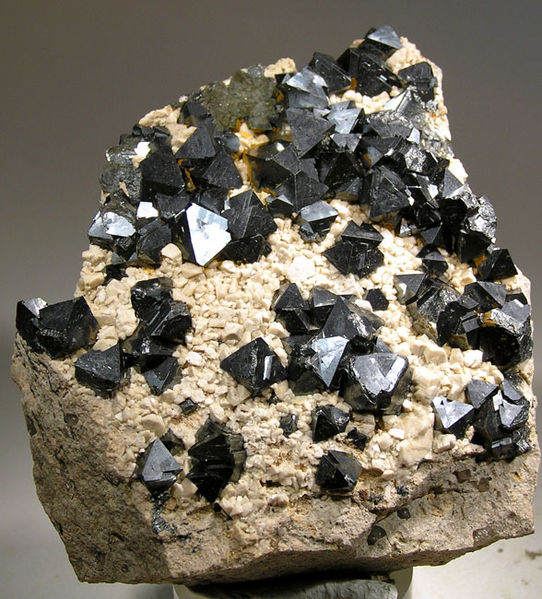
Magnetite crystals in a matrix of feldspar.
Photo by Rob Lavinsky

Gold bearing magnetite may be found in massive deposits where the gold is often invisible to the naked eye with the gold often being disseminated throughout the entire deposit of magnetite. The lower bodies in this type of deposit can be presented as one in particular, tubular or more rarely as sheet deposits.

The sulfide minerals found in such a deposit are usually secondary in nature that have been deposited by mineral laden hydrothermal waters. In some deposits of this type goals is also associated with the sulfides, particularly arseno-pyrite as well as other sulfide minerals.

If gold is present in one of these deposits it is not to be disseminated through the body of the rock and quantities that are so small much of the gold is invisible to the naked eye, or there may be small specks of gold that are visible. The usual tenor of this sort can vary from that measured in grams to about 4 ounces per ton.

A great deal of gold can be recovered from magnetite because of the vast quantities of four that are present coupled with the recovery of gold values using the heap leaching process that takes advantage of the ability of sodium or potassium cyanide to dissolve gold. As a rule of thumb that takes approximately 2 ounces of cyanide in solution to treat gold over in this manner. Cyan night is extremely poisonous as it only takes 2/10 of a gram to kill a person. It also presents some very serious environmental issues that have to be addressed. If the proper environmental safeguards are in place the use of cyanide for gold extraction is extremely cost-effective. 

Friday, December 31, 2010

How to Build a Simple Magnetometer for finding Gold

The earth is nothing more then a giant magnet as attested by its magnetic poles that attract a magnetic needle to magnetic North and South. The same phenomenon of magnetic attraction can be used to detect magnetic minerals even as small as what are termed micro-mounts, or for that matter large masses of magnetic mineral like magnetite below the surface of the earth. Although gold itself is not magnetic that often occurs in the company of different minerals that are; one example is granular magnetite.

This deceptively simple magnetometer can be used both at home or in the field. Its materials are also simple consisting of a very few parts that are obtainable anywhere. The core of this magnetometer is nothing more complicated than an ordinary soda straw with a small magnet glued on one end. There is a needle shoved through the straw at approximately its balance point with the magnet attached. The needle rests on two parallel sides are far enough apart to allow the straw to present up and down.

The best kind of magnet that you can use as a so-called rare earth magnet that is far more powerful than an ordinary magnet. Small maintenance of this type can be found in auto parts stores, sources say are part of an automobile alternator they can also be found in your local junkyard. The best kind of soda straw to use is one that has a flexible joint near its upper end, so you can bend the straw to get it perfectly balanced.

At home your magnetometer is used to detect magnetic minerals that is accomplished by passing the near the magnetic tip to see if the magnet is attracted. If it is you know immediately whether or not the mineral is magnetic, conversely if the magnet is not attracted to the specimen then it is not magnetic. This is important because many minerals look alike and the magnetometer test is one step in identifying the mineral.

In the field; all you have to do is walk a straight line while watching the straw, if the magnet is attracted to a magnetic mass in the ground the straw will move up or down. This is also important because many different mineral deposits are magnetic and have other minerals that are associated with them including gold. A simple method of measuring the amount of dip is by placing a quadrant next to the straw allowing you to measure the amount of dip the straw undergoes.

A simple magnetometer of the type described can be seen by following this URL: