Total Pageviews

Showing posts with label magma. Show all posts

Friday, February 25, 2011

Prospecting on an Ancient Spreading Center

A tectonic ridge is associated with a spreading center where magma from the bowels of the Earth reaches the surface where it is the driving force for plate tectonics. The same feature is also the home of black and white smokers the source of many mineral deposits. For the most part tectonic ridges are found in the ocean deeps usually a depth of about 12,000 feet, but an exception is made for Iceland where the tectonic ridge is exposed on the surface of the land. Iceland is also one of the most volcanic areas on earth with the exception of the Ring of Fire that encircles the Pacific Ocean, but that is caused by just the opposite environment where tectonic plates are plunging beneath other plates in subduction zones.
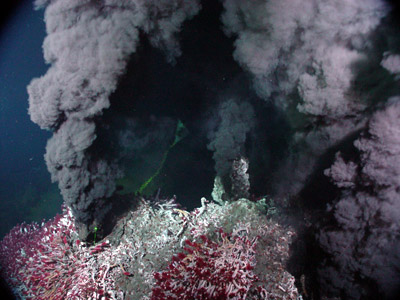
Black smokers emitting clouds of metal sulfides.

The smokers are the result of ocean water penetrating deep into the oceanic crust that is composed of basalt, and leaching out the various metal ions and expelling the from the surface and clouds of metal sulfides. These sulfides are deposited in a particular sequence depending upon their solubility in water copper and iron are usually the first sulfides that are deposits and the other metals are deposited according to the  solubility of their sulfides.
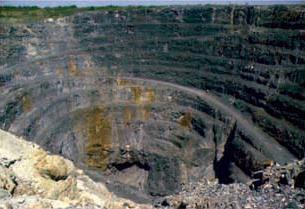
Kidd Creek Mine in Timmins, Ontario

Although deposits of this nature are formed in the depths of the ocean is theorized that because of plate movement these deposits can eventually be incorporated into continental plates. A good example of this type of deposits is the Kidd Creek Mine located in Timmins, Ontario or the Horne Mine in Rouyn-Noranda, Quebec.

Monday, February 21, 2011

The Association of Gold and Magnetite

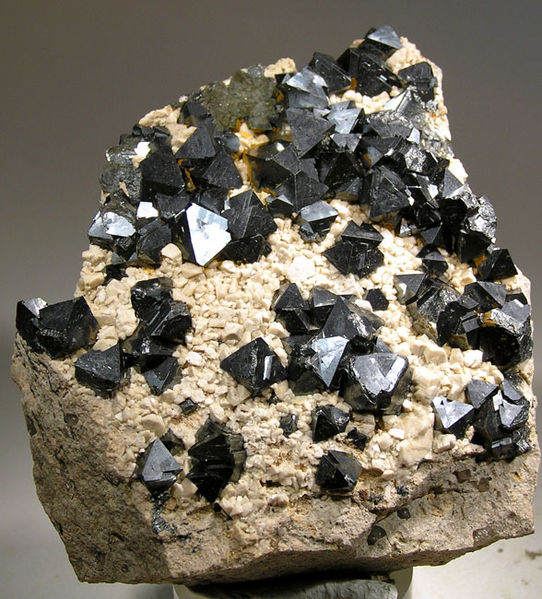
One common type of gold deposit is one where the gold is associated with the mineral magnetite where the gold is formed in skarns of granular magnetite.  The mineral has a chemical formula Fe3O4 that is often found in contact metamorphosed areas associated with intrusions of magma into carbonate or silico-carbonate rocks the intrusion itself is usually granite or monzonite-syenite. In such deposits the common minerals that are found include pyroxenes, amphiboles, garnet and lesser amounts of scapolite, vesuvianite and other silicates, but the most important is magnetite. 

Chalcopyrite deposited on magnetite.  The magnetite is the black crystals.
Photo by Rob Lavinsky

In the field magnetite is one of the most easily found of all minerals because it is magnetic and is attracted to a magnet; some of this mineral possess weak magnetism itself, so it is called lodestone.  The ancients were aware of this, and used it to make the first primitive compasses from magnetite carvings many of which looked like spoons whose handle pointed north. 

To prospector the first Association of gold and magnetite occurs in the bottom of your cold pan in the form of black sand that contains small specks of gold. This black sand along with other heavy minerals is considered to be ore in its own right, and is often refined away from streamside to recover its gold content.

Magnetite crystals in a matrix of feldspar.
Photo by Rob Lavinsky

Gold bearing magnetite may be found in massive deposits where the gold is often invisible to the naked eye with the gold often being disseminated throughout the entire deposit of magnetite. The lower bodies in this type of deposit can be presented as one in particular, tubular or more rarely as sheet deposits.

The sulfide minerals found in such a deposit are usually secondary in nature that have been deposited by mineral laden hydrothermal waters. In some deposits of this type goals is also associated with the sulfides, particularly arseno-pyrite as well as other sulfide minerals.

If gold is present in one of these deposits it is not to be disseminated through the body of the rock and quantities that are so small much of the gold is invisible to the naked eye, or there may be small specks of gold that are visible. The usual tenor of this sort can vary from that measured in grams to about 4 ounces per ton.

A great deal of gold can be recovered from magnetite because of the vast quantities of four that are present coupled with the recovery of gold values using the heap leaching process that takes advantage of the ability of sodium or potassium cyanide to dissolve gold. As a rule of thumb that takes approximately 2 ounces of cyanide in solution to treat gold over in this manner. Cyan night is extremely poisonous as it only takes 2/10 of a gram to kill a person. It also presents some very serious environmental issues that have to be addressed. If the proper environmental safeguards are in place the use of cyanide for gold extraction is extremely cost-effective.