Total Pageviews

Showing posts with label pyrite. Show all posts

Thursday, May 24, 2012

The Lost Gold Ledge in Danville, Washington


Mt. Baker, Washington
Photo by Adam Lindsay


The town of Danville, Washington nestled right up against the Canadian border had a checkered past to say the least.  It started as Nelson, Washington, but the railroad changed its name to avoid confusion with Nelson, British Columbia.  The town had a store with entrances opening into both countries that the authorities closed down because of suspected smuggling.  The heyday of the town came with prohibition when many of its residents worked as guides for the whiskey smugglers guiding them over back-country trail out of sight of the revenuers so they could smuggle Canadian whiskey into the United States.  Once prohibition was over the town slowly faded away.

Before prohibition though in 1912 a prospector named John Falconer was working in the town during the summer as a laborer.  At some point a vicious thunder storm hit the area and a bolt of lightening set fire to a tree on the hillside southeast of the town.  Falconer rode a horse out of town along a game trail to put the fire out before it spread.  On the way it started raining and somewhere along the trail his horse trod on a rock sticking up from the ground.

By the time he reached the blazing tree the rain had put out the fire, so with nothing more he could do there he started back to town.  When he reached where his horse had scrapped the soil from a rock he could see it was full of pyrite so he stopped to get the rock.  It was not until several months later that Falconer realized the rock was full of gold not pyrite.  The gold slab was worth over $1,000 that contained over 50 troy ounces of gold that at the time was selling for $20.67 per ounce.

Around Danville the old timers called it “the golden plate” and thought it was only a small part of a gold ledge.  Falconer and his wife hunted for the place where his horse struck gold, but never could find the place again.

Since then many have looked for Danville’s golden ledge in the hills south east of the town but have never found it either.

It makes sense that there is gold there because it is close to the Cascade Mountains that supplied the heat necessary for the formation of gold deposits.  Two volcanoes that could have supplied the gold deposit are Mt. Baker in Washington and Mt. Garibaldi in British Columbia.


Thursday, January 20, 2011

Gold Occurrences in Rhode Island

Gold occurrences in Rhode Island are not the subject of many reports, however there is the story of the Durfee Hill Gold Mine in Glocester, Rhode Island where there are reports of the remains of a stamping mill and cyanide vats on the site.  There are also some mine shafts that are sunk into the ground nearby.  There are no apparent reports of gold in quartz veins. There are however, reports of gold with pyrite in the quartz veins. The reports of the latter is from Kent County, to the west of Warwick.

Gold bearing pyrite crystals in quartz.
Photo by Rob Lavinsky

Gold that occurs in Rhode Island in three different types of deposits:

One type of gold is found in veins of hydrothermal deposits where the gold often occurs as the native metal in quartz veins.

The second type of gold is often found in his placer deposits in sand and gravel on the beds of streams or on beaches fronting on the ocean. Gold is often panned from this type of deposits by taking advantage of its great density in relation to other minerals. Gold is 19.3 times as dense as water and most of the minerals that occurs with our only three times as dense as water. Placer gold can be found in virtually any stream or river in the world in quantities large enough to see what it looks like.

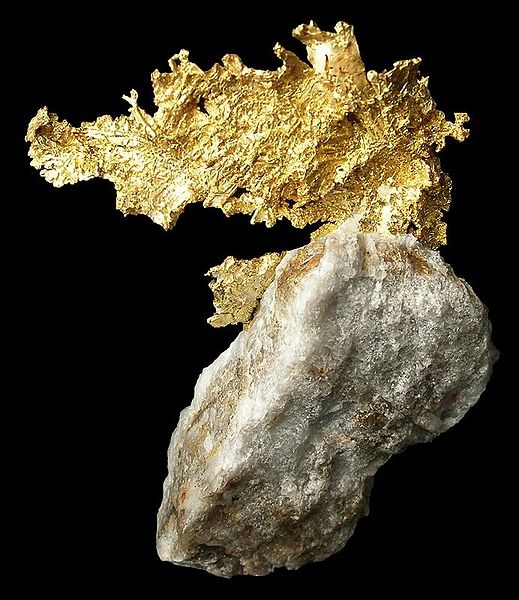
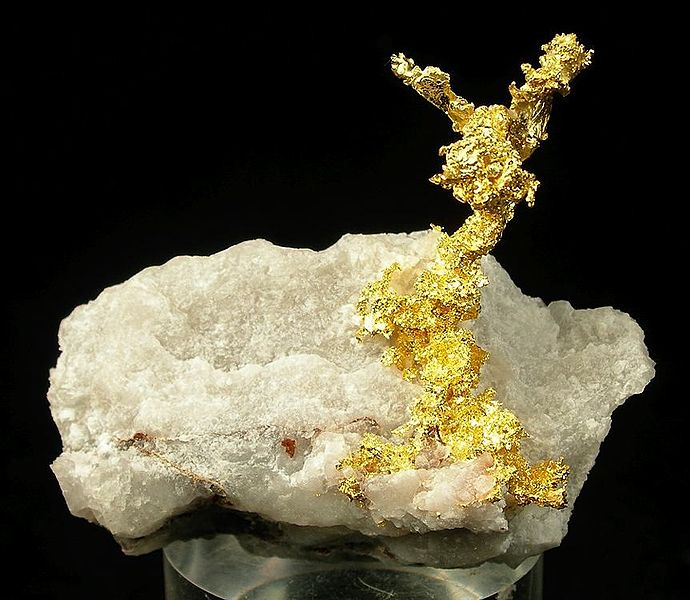
Gold in quartz.
Photo by Rob Lavinsky

In a 1927 issue of the American Mineralogist by Lloyd Fisher and Charles G. Doll of Brown University in volume 12, pages 427 to 436 you can find a listing of the different minerals that are found in the state of Rhode Island.

This is what they said about the area around Durfee Hill, “Glocester (Durfee Hill) epidote, molybdenite, pyrite and phyrottite are present.


The third type of deposits are found in generally associated with pyrite and other metal sulfides where the gold actually appears as a thin film between the crystals of sulfide. 

Another area where gold was then reported in the past is around Johnstown where there are also some old mine workings were a dibase dike cuts across the granites and schists. This is another area that still has old cyanide vats and sluice boxes. When the local chemists reports that the locality has shown a trace of platinum group metals in the mine tailings.

Finally there has been Gold reported at the old South Foster gold mine locality where gold was produced mainly from pyriteferous quartz veins.  There are said to be still visible at this locality four open pits that are now filled with water along with the ruins of a large stamp mill.

One of the areas in Newport, Rhode Island, Purgatory Cliffs, has attracted the attention of the author because the cliffs are made out of a quartz pebble conglomerate with crystals of magnetite in the binding material between the pebbles. There is often an association between gold and magnetite. Another area is found in the black sands of the beaches in southern Rhode Island west of Narragansett Bay.

Although these last places are strictly speculative the geology is right for finding gold, and as far as that goes the entire set of rocks along the western side of Rhode Island where borders with Connecticut is another area that geologically is a good place to search for gold especially in placer deposits in the streambeds of the area.

Friday, December 24, 2010

Gold Occurrences in Maine

This article explains some of the gold occurrences found in Maine where gold can be had from three different sources as placer gold, lode gold where it occurs in quartz veins and as a trace element associated with metal sulfides especially pyrite where it occurs in thin films between individual pyrite crystals.

According to the Maine Geological Survey placer gold has been found in the following streams:

Sream
Township
County
Swift River and its tributaries
Byron area
Oxford, Franklin
Sandy River
Madrid to New Sharon
Franklin
South Branch-Penobscot River
Sandy Bay; Bald Mtn; Prentiss
Somerset
Gold Brook
Bowman
Oxford
Gold Brook
Chain of Ponds; Kibby
Franklin
Gold Brook
Chase Stream
Somerset
Gold Brook
T5 R6; Appleton Township
Somerset
Nile Brook
Dallas; Rangeley
Franklin
Kibby Stream
Kibby
Franklin
St. Croix River
Baileyville
Washington

This is the kind of mountain stream where you can expect to find gold.
This list is by no means conclusive because virtually any other stream in the vicinity of those listed can also contain gold. The bed load of the streams eventually reaches the Atlantic Ocean where the litterol current carries in parallel to the coastline depositing its load of gold onto the sand and gravel beaches of Maine. As a teenager the author did some prospecting along these beaches discovering that the gold that was present was mainly flowered gold. The most gold was discovered near the mouths of the rivers running into the ocean. 

Ogunquit Beach, Maine where as a teenager we panned for gold.  Notice the small stream entering the ocean on the left side of the picture it was here where we had our most luck panning.

Because gold is 19 times denser than water another place that might be profitable to look is in the lower reaches of sand and gravel deposits where the deep deposits are at rest on bedrock or a bed of clay. Another factor that has to be taken into consideration is stream migration. Since the time of the glacier melting around 12,000 years ago the stream channel may have migrated several hundred feet to the West of its original position. To the practiced eye this can be readily seen by an area of flat terrain with the higher banks on the west side of the stream.  This is a situation that not only exists in Maine, but is a worldwide phenomenon where ever you have flowing water.

Gold on Quartz   Photo by Rob Lavinsky

Placer gold is that the only variety of gold found in the state of Maine.  Maine also has lode gold where gold is found in quartz veins. Even more complicated is gold deposits found as trace elements in base metal sulfides where gold is found as an impurity that must be recovered when the metal ore is smelted.  Finally gold is often associated with iron pyrite where it is a thin film between the crystal faces of pyrite.

You can purchase all kinds of supplies and equipment through our associate Amazon.com needed for operating a placer gold mining site.  By using the Amazon Searchbox you can access both new and used equipment. 

Friday, July 16, 2010

Telling gold from fools gold!

The problem of identifying real gold in the field to separate it from fools gold often arise. There are several minerals that mimic gold in appearance like iron pyrite and weathered biotite mica that both have a gold-like appearance.

The easiest field test for gold is simple its density is 19 grams per cubic centimeter that is far denser then any of its mimics. Some genius in antiquity developed the “touchstone” test for gold based on what color its streak is when left on a dark colored stone. In practice this is usually a piece of black slate. Gold will leave a gold-colored streak on this stone its mimics will not. For ages this was the definitive test for gold until it was replaced by the “Purple of Cassius” test during 1685 by Andreas Cassius.

Another ancient test used frequently was based on the fact gold is malleable. You can bend it, and it keeps its bend. You can also bend weathered biotite, but unlike gold it quickly snaps back into shape. The other method based on malleable gold is hammering it into a flat sheet all of those minerals that mmimic gold are brittle and will break-up into a powder if hammered.

The acid test works because gold is unaffected by all strong acids except aqua regia, all the other minerals that mimic gold are affected by acids and are dissolved. A possible exception to this is weathered biotite mica.

The Purple of Cassius’s history goes back to the fourteenth century where it was described as an artist’s pigment however Andreas Cassius gets the credit for its invention. The principle behind the purple of Cassius is the ability of Aqua Regia a two to one mixture of concentrated nitric and hydrochloric acids to dissolve gold.

Just by its dissolution in aqua regia gold produces a rough-and-ready test because the gold charged aqua regia assumes a golden-yellow color. This test is not accurate enough however to be definitive. The purple of Cassius is however. Until the invention of the modern science of spectrometry developed during the nineteenth and twentieth century’s the purple of Cassius was the recognized definitive test for gold.

The test works by adding a few drops of the gold charged aqua regia to 100 ml of clean water, then adding twice as many drops of a solution of tin chloride to the solution. The tin will cause the gold to precipitate from the solution forming a colloid that ranges in color from pink thru dark purple. The darker the color the more gold is present.

The science of “spectroscopy” has supplanted most of the chemical tests for gold in the laboratory, but not in the field where because the various manifestations of the spectroscope are just to bulky. Many of the old chemical tests for gold and other minerals are still being used.

References:

The creation of color in eighteenth century Europe, Gutenburg.org,
http://www.gutenberg-e.org/lowengard/C_Chap33.html

Acid test (Gold), Wikipedia, http://en.wikipedia.org/wiki/Acid_test_(gold)

Spectroscopy, Wikipedia, http://en.wikipedia.org/wiki/File:Light_dispersion_conceptual_waves.gif